Get Full Government Meeting Transcripts, Videos, & Alerts Forever!
Get email alerts on the Water Rates topic
No spam. Unsubscribe anytime.
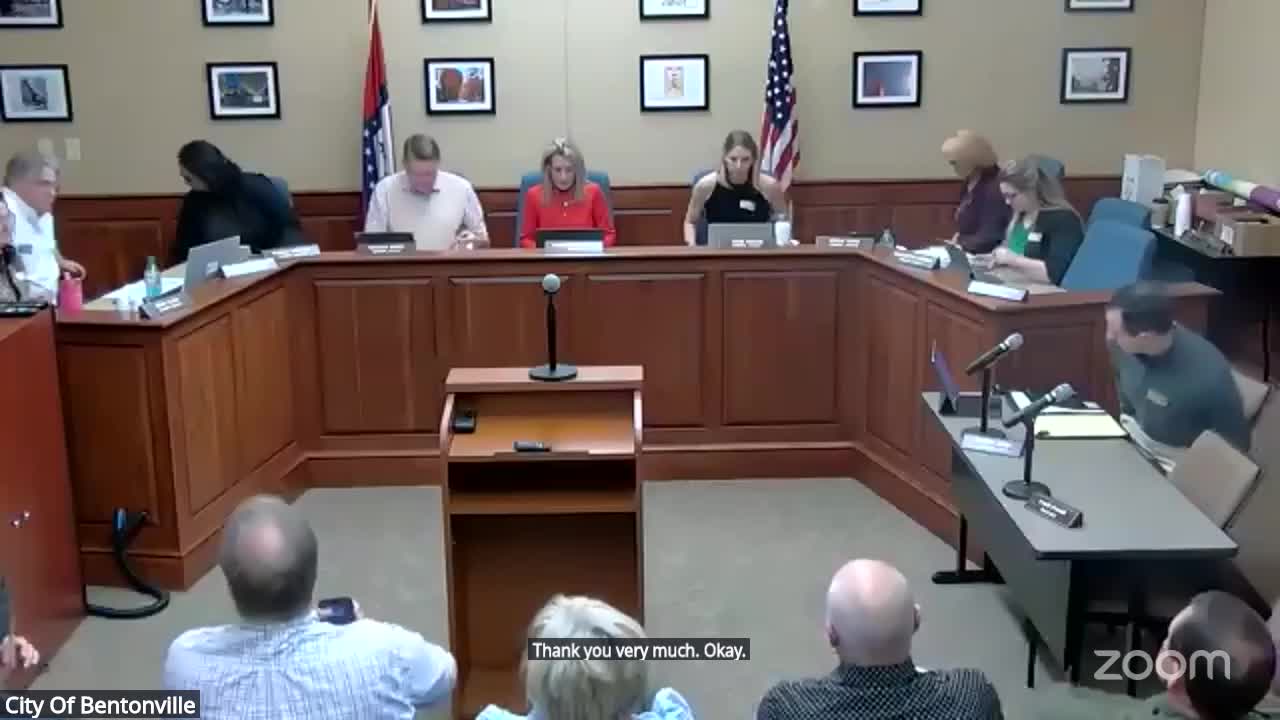
Bentonville leaders weigh emergency water-rate increase as city hunts thousands of leaks
Summary
City staff and consultants told the Bentonville City Council the utility is buying far more water than it bills because of a mix of meter inaccuracies and physical leaks; staff described contracts, audits and an immediate need for revenue to keep contractors working while longer-term financing and fee options are explored.
Bentonville — City staff on Tuesday told the Bentonville City Council that a rising gap between water the city purchases and water it bills has created a short-term cash shortfall and prompted proposals for an immediate water-rate increase to keep repair contractors working and preserve the utility’s ability to borrow for larger projects.
Preston, a water department staff member, opened the presentation by tracing the problem to meter and installation issues first identified in 2014 and to a steady rise in ‘‘unaccounted-for’’ water since 2018. He said the utility now buys significantly more water than it records through its meters, and that part of the loss is apparent (meter under-registration) while part is real (leaks in mains and service lines). Colin Dratt, project manager at rate consultant Raftelis, told the council that replacing meters reduced under-registration but that the most significant remaining cost driver is physical loss from leaks.
Why it matters: the city pays the wholesale cost for every gallon it purchases from Beaver Water District, while lost billed gallons represent lost revenue at the full retail rate. Councilmembers and residents said the issue is pressing because day-to-day operations are at risk without immediate revenue and because proposed mid-term investments and borrowing rely on showing a sustainable utility cash flow.
Most important details - Staff described multiple responses undertaken since 2018: AMI meter upgrades, static-pressure testing, third-party meter autopsies (including testing at Utah State), hiring of leak-detection contractors and creation of district metering areas to locate loss. - Contracts and procurement: the city awarded indefinite-quantity (IDIQ) service-line replacement contracts in November 2024 to two contractors at $500,000 each, and council later approved a January 2025 amendment that added $500,000 to each contractor (total $1,000,000 in amendments). Staff said those funds will be spent down by April–May 2025 at current pace unless new funding is secured. - Leak-detection work: the city has a $149,400 contract for a citywide acoustic survey and a $159,680 contract to run an acoustic ‘‘smart ball’’ inspection of the 48-inch transmission line that brings water from Beaver Water District into Bentonville; staff said the smart-ball run is scheduled for April and will take about 11 hours to operate and generate a report. - Measured loss and financial impact: staff and consultants cited historical loss rates—about 27% in 2014, roughly 40% by 2018, 46% in 2022 and roughly 54% in 2023—and told the council that real and apparent losses together produced a multi‑million‑dollar 2024 deficit. The city’s 2024 shortfall was described in the meeting as roughly $9.4 million (staff-provided figure). The wholesale purchase price cited in the presentation was $1.42 per thousand gallons at one point in 2022. - Near‑term funding options discussed: (a) a one-time or multi-part water-rate increase to generate immediate revenue; (b) using or re‑directing limited general-fund or capital penny proceeds; (c) loans or bonds (which require showing sustainable revenues); and (d) impact or capacity fees for future growth (these fees cannot legally be used to cover ongoing operating shortfalls). Raftelis advised that lenders require evidence rates will remain in place when debt is issued.
Council discussion and public comment Councilmembers asked for more frequent reporting and for guardrails on any rate change. Several councilmembers said they wanted an annual review of rates and quarterly updates on leak-detection progress and cash flow; one councilmember explicitly proposed language requiring the council to reexamine the rate change within 12 months. Raftelis and staff warned that a clause that automatically sunsets the new rates without an affirmative council vote could undermine the city’s ability to borrow against those revenues.
Residents and business owners in public comment urged alternatives to a large one-time increase. Typical requests included pursuing impact-fee studies, pursuing grants, re-examining general-fund spending and exploring bonds to spread the cost across a broader tax base. Multiple residents asked the city to hold developers and builders accountable for substandard installations; staff said inspection regimes and changed construction standards are already being strengthened, and that many of the current leaks are in service lines installed during a mid-2000s growth period.
What the council directed or decided - Direction to staff: staff was asked to provide more frequent (quarterly) updates on water-loss volumes, repair progress and cash flow and to present a recommended ordinance for a water-rate change at the council’s next meeting. (The council scheduled a vote on the water-rate ordinance for the next meeting.) - Financing constraint noted: Raftelis and the finance director explained that lenders generally expect the rate structure to remain in place when long-term debt is issued; language that would automatically terminate rates after a set period could limit borrowing options.
Context and next steps Staff said current contractor funds will likely be exhausted in April–May 2025 at current activity rates. Staff and consultants emphasized this is both an operating and capital challenge: reducing lost gallons through leak repairs lowers the city’s annual purchase cost and improves its ability to fund longer-term capital projects. The council asked staff to return with clearer quarterly metrics, to present options on impact/capacity fees and bonds, and to bring the water‑rate ordinance forward for a vote at the next meeting.
Quotes (selected) - "So we do have 3 items tonight on our agenda, the first of which is the water rate discussion," Preston, a water department staff member, said as he introduced the presentation. - "I am Colin Dratt with Raftelis. I am our project manager on this project," Colin Dratt, the Raftelis consultant, said during the consultant presentation.
Ending The council left the meeting with a near-term decision point: whether to approve a revenue increase to cover expected contractor and purchase-water costs while pursuing longer-term financing and policy tools (impact fees, bonds and capacity agreements). Staff agreed to provide more granular, recurring reporting and to return with the ordinance for council consideration at the next meeting.