Get Full Government Meeting Transcripts, Videos, & Alerts Forever!
Get email alerts on the Water Rates topic
No spam. Unsubscribe anytime.
Bentonville council tables proposed water-rate increase after public concern, directs more outreach
Summary
The Bentonville City Council voted to postpone action on an ordinance to amend water rates after multiple public comments and council members asked for more public information and a committee briefing; staff and consultants will hold a committee-of-the-whole meeting to present data and answer questions before the next council meeting.
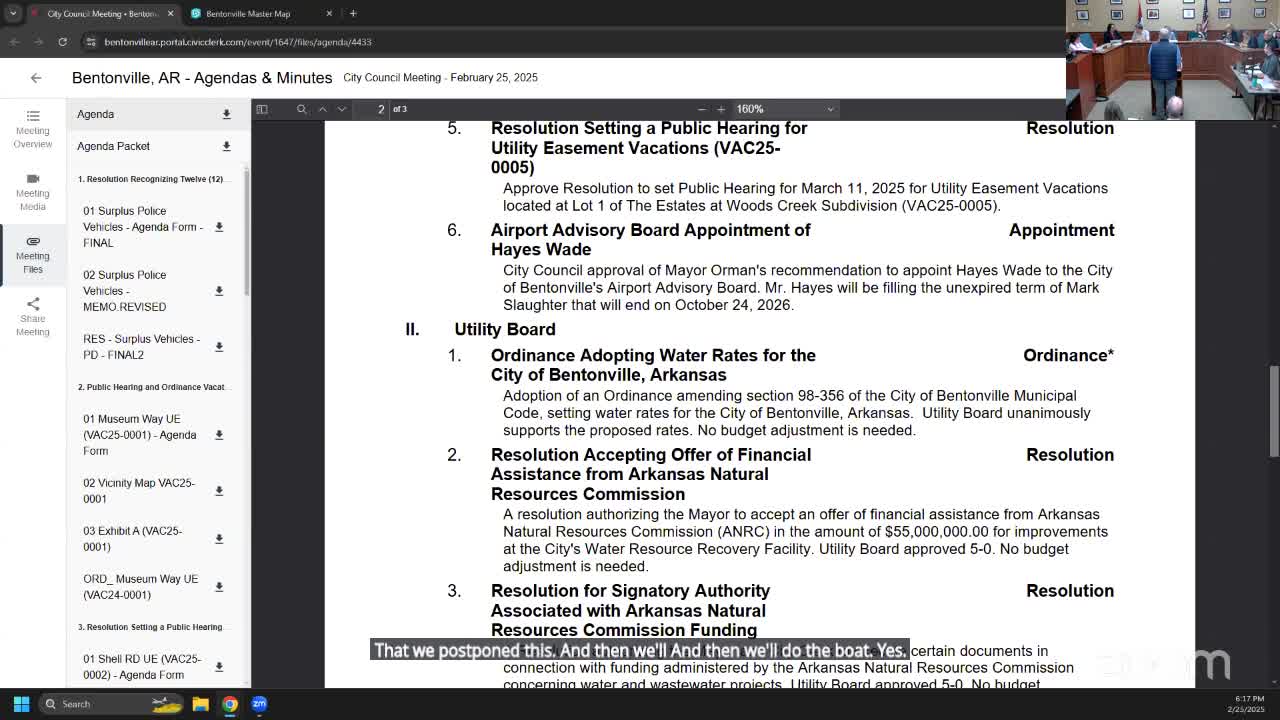
The Bentonville City Council voted to table action on an ordinance that would amend Section 98-356 of the Bentonville Municipal Code to raise water rates, after residents and several council members said the proposal felt sudden and asked for more outreach and data.
The ordinance was the most contested item at the meeting. Council members heard five public comments and several council speakers press staff and consultants for clearer, publicly available data on the size of the proposed increase, how the revenue would be used, and alternatives to rate increases. After discussion the council voted to postpone the item to the next regular meeting and requested a public committee-of-the-whole presentation beforehand.
Why it matters: The ordinance would change both the fixed (meter/facility) charge and the volume (usage) charge. Council members and members of the public said the change would be substantial for some households and asked for clearer, accessible explanation of the city’s water-loss figures, project list and funding options.
Public comment and council concerns
Several residents told the council the proposal had reached them as a surprise and urged more outreach. “I almost feel like I’m in a fast food restaurant asking for doubles, but at the end of the day, only getting half of what I’m paying for,” said resident Bob DiChacma, who emphasized impacts on seniors and fixed-income households. Josh Barker, another resident, asked the council to publish a phased funding roadmap, stress-testing and modelling so future infrastructure needs are not handled as afterthoughts.
A member of the public, Mary Zettle, urged the city to prepare an FAQ and consistent public messaging before any further outreach. The council agreed that inconsistent answers sent to residents had increased confusion.
Council members asked for more technical follow-up. Council Member Burkhart (as identified in the meeting) said the emergency was driven by water-system losses and long-term underfunding, adding that the city had run operating deficits that required corrective action. “We’ve been allowing [the utility fund] to run on a deficit for too long,” Burkhart said. Council members pressed staff about alternatives discussed internally, including splitting increases, borrowing from the general fund, and applying for low-interest loans.
Technical details and clarifications
Staff described the proposed change as an increase applied to both the monthly base (meter/facility) charge and the usage charge. Staff said the current base for a typical 5/8-inch residential meter is $7.71 per month; under the consultant recommendation that base would rise proportionally with the proposed ordinance. Staff provided an example: a domestic user consuming 4,000 gallons monthly would see a bill rise from about $23 to roughly $46 under the proposed rates (this example excludes irrigation service). The council asked staff to produce clear fact sheets and the graphs referenced in the council briefing showing historical rate changes.
Next steps and direction to staff
The council voted to postpone consideration of the ordinance to the next regular meeting and directed staff to schedule a committee-of-the-whole briefing (committee on the tenth was discussed at the meeting) with the consultants to walk through the documents and to make consultants available to answer questions. Council members also asked staff to publish an FAQ, the graphing used in internal briefings, and a plain-language summary of projected revenue needs, candidate projects, and funding sources (including loans from the Arkansas Natural Resources Commission that staff referenced).
Votes and outcome
The motion to postpone the ordinance to the next meeting passed on roll call (recorded yes votes in the transcript include: Suter, Agnew, Harcourt, Hook, Sanchez, Patterson, Acree, Piava). The council directed staff to host a public committee-of-the-whole session and to prepare consistent public materials before the next council meeting.
Ending
Council members and staff said they expect more public engagement and clearer materials will be provided before the item returns. The council asked consultants to be available for the committee forum so members can ask detailed questions about projected capital projects, leak detection and the relationship between water and sewer planning.