Get Full Government Meeting Transcripts, Videos, & Alerts Forever!
Get email alerts on the Zoning And Land Use topic
No spam. Unsubscribe anytime.
Board of Adjustment tables homeowner’s request to raise rear fence at 403 Magnolia Drive
Summary
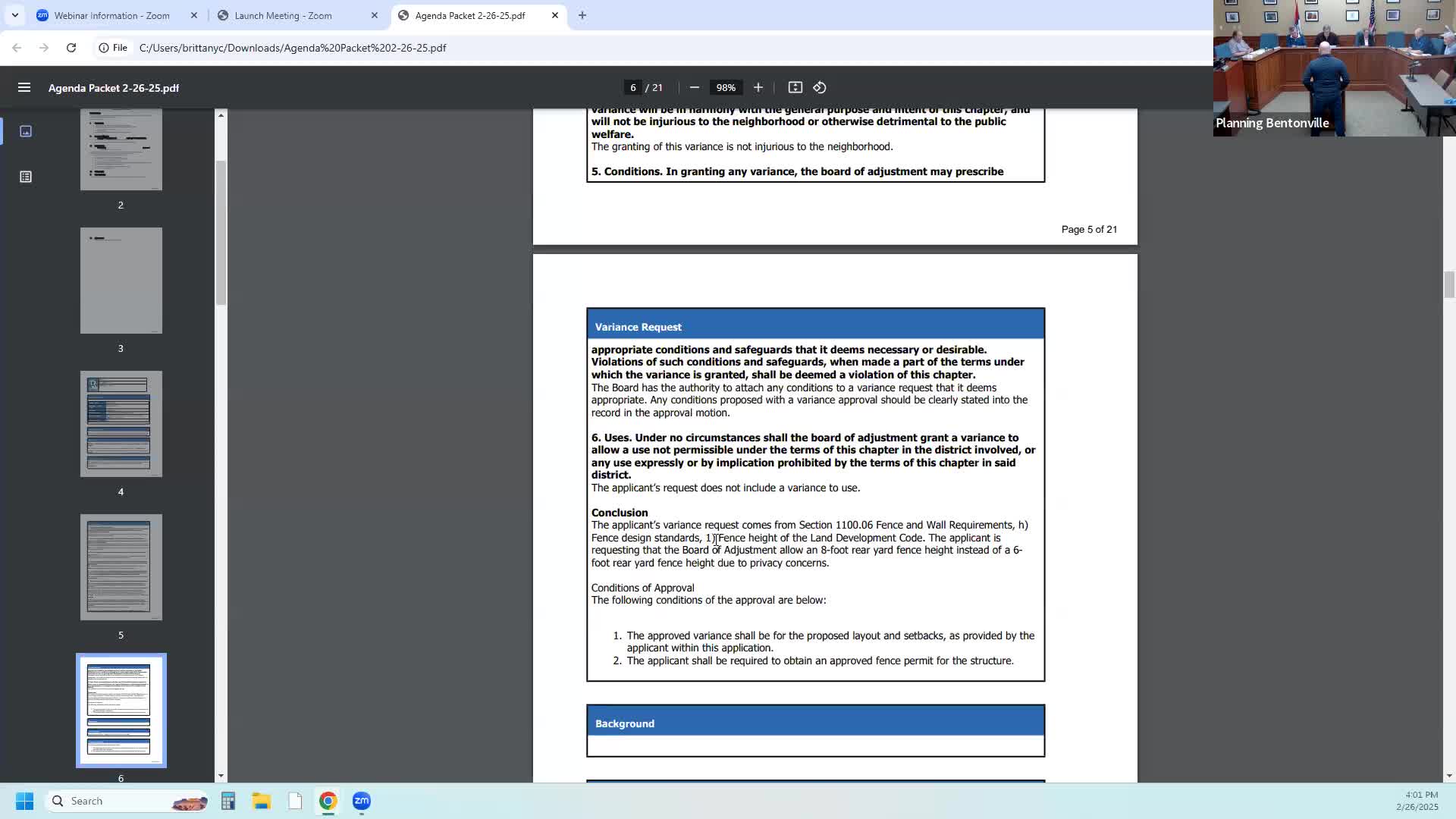
At its Feb. 26 meeting the Bentonville Board of Adjustment voted to table a homeowner’s request to replace a 6-foot rear fence with an 8-foot cedar fence and asked staff to pursue administrative review under the city’s code rather than grant a variance.
At its Feb. 26 Board of Adjustment meeting, the panel voted to table a variance request from the owner of 403 Magnolia Drive to replace a deteriorating 6-foot rear fence with an 8-foot cedar fence and asked staff to investigate whether the change could be approved administratively under the existing code.
The variance application cites the Land Development Code’s fence and wall requirements (section 1100.06(T)), which caps typical rear-yard fence height at 6 feet. Staff summarized the request as an applicant seeking an 8-foot rear-yard fence “due to privacy concern.”
The homeowner, identified in the record as the applicant, described purchasing the property Nov. 1 and said the existing fence is damaged and that an additional two feet would increase privacy because neighboring yards are at a higher elevation. “We purchased this property in November the first of last year. Existing fence is somewhat deteriorated,” the applicant said. “I would like to replace it with an 8 foot cedar fence, same location.”
Planning staff told the board the request was a variance to section 1100.06(T) of the Land Development Code. Board members repeatedly pressed the applicant to identify a legal “hardship,” a required element for a variance, and said the change looked like a minor, topography-related adjustment that staff might be able to approve administratively. “We are a quasi judicial board here,” the chair said, noting the board must find a unique hardship before granting a variance. Several members said they would prefer staff use the administrative flexibility discussed in recent code updates rather than have the board issue a variance.
Board members also discussed alternative paths: rezoning the lot to a different future land-use designation (DN1) or pursuing an administrative adjustment tied to topography. A staff comment in the hearing noted the property’s future land-use designation and that rezoning could be an option under the new map; the applicant and board also discussed the potential cost of rezoning, which during the meeting was referenced as roughly $4,000.
After discussion, the board made and approved a motion to table the variance and direct staff to re-evaluate whether an administrative approval or another non-variance pathway could be used to permit the increased fence height. The motion to table was recorded as approved by the board. Board members requested staff provide a follow-up report at the next Board of Adjustment meeting so the applicant’s file would remain active while staff pursued the administrative review.
Next steps: staff will re-check applicable administrative provisions of the Land Development Code and report back to the Board of Adjustment at its next meeting; the applicant’s variance application remains tabled.