Get Full Government Meeting Transcripts, Videos, & Alerts Forever!
Get email alerts on the Reclamation Development Grants topic
No spam. Unsubscribe anytime.
Senate committee hears House Bill 7 to fund reclamation, high‑hazard dam and drought projects
Summary
House Bill 7 would fund reclamation and development grants for abandoned‑mine, hazardous‑substance and crucial‑state‑need projects. DNRC staff said the bill contains planning and project grant pots and that an incorrect revenue estimate reduced available funding; sponsors said one Granite County request was removed for lack of matching funds.
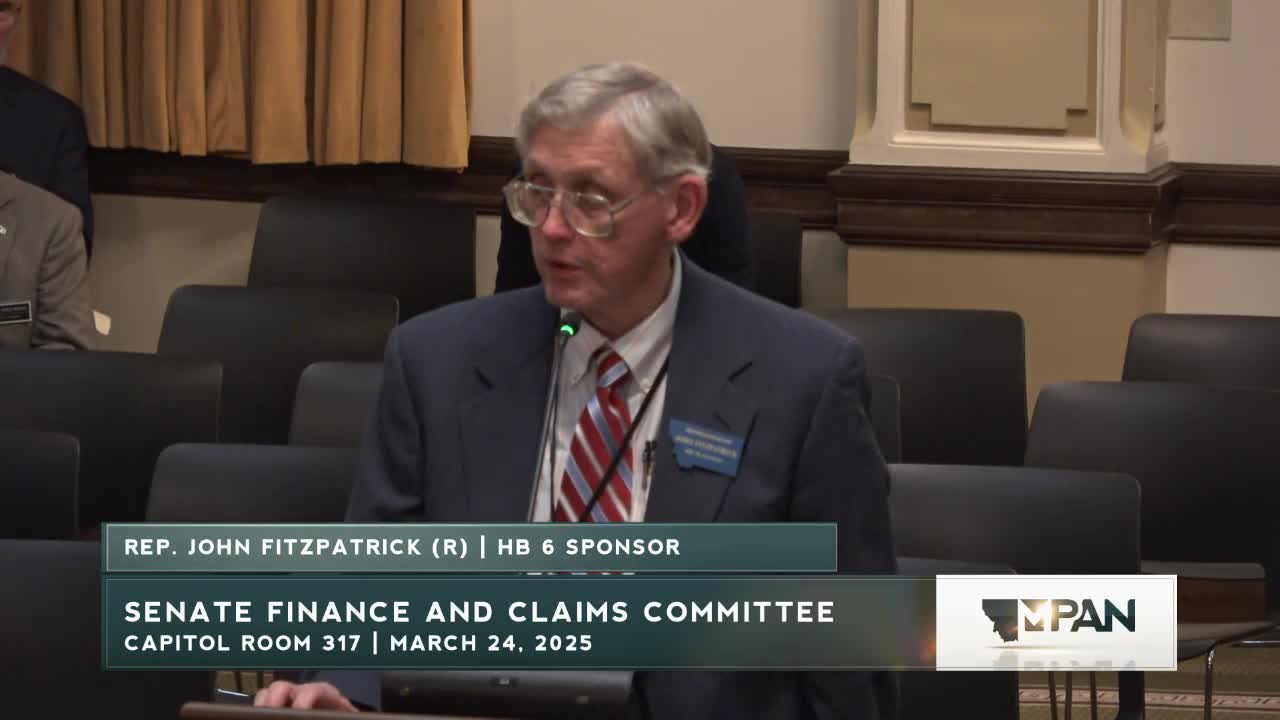
Representative John Fitzpatrick, House District 76, presented House Bill 7 to the Senate Finance and Claims Committee as the reclamation and development grants (RDG) program administered by the Department of Natural Resources and Conservation (DNRC). Fitzpatrick said RDG funds address sites harmed by historic mining, petroleum releases and other resource extraction when no responsible party can be found and described the program’s preference for abandoned‑mine projects.
Autumn Coleman, deputy administrator at DNRC, said the RDG program funds both project grants (up to $500,000) and planning grants (up to $70,000) and that projects are ranked by statutory criteria including public resource benefits, urgency and technical feasibility. “The reclamation and development grants program statute also allows for projects that meet this crucial state need definition, which is to serve the public interest and total environment of the citizens of Montana,” Coleman said. She told senators DNRC received 17 applications requesting just over $7.1 million; seven sought abandoned‑mine reclamation funding and 10 addressed crucial state needs such as high‑hazard dams and drought mitigation.
Fitzpatrick and DNRC staff said the same revenue‑estimate error that affected House Bill 6 also limited funding available in House Bill 7; as printed, the bill contains $700,000 for planning grants and $3,800,000 for reclamation grants, funding projects down through the East Fork Dam project on the printed list. Fitzpatrick recounted that a project in Granite County was not funded because the local applicant offered no match; he said the county had an elevated cash balance and declined to provide local funds requested for administration and matching.
Proponents including Trout Unlimited, the Montana League of Cities and Towns, Montana Rural Water Systems and the Montana Association of Conservation Districts testified in support of the bill. They said planning grants and reclamation investments help protect drinking water sources and stabilize contaminated sites, rehabilitate dams, and support rural economies.
Committee members asked when additional money might be available to expand the funded list; Fitzpatrick said staff expect to know within about a week which could permit prorating or adding projects. DNRC staff said they follow statutory ranking and plan to notify the committee if further revenues can be distributed across the two bills in a prorated fashion.
Ending: The committee closed the hearing on House Bill 7 without a vote and scheduled follow‑up as DNRC and fiscal staff refine revenue estimates and potential transfers.