Get Full Government Meeting Transcripts, Videos, & Alerts Forever!
Get email alerts on the Renewable Resource Grants topic
No spam. Unsubscribe anytime.
Senate committee hears House Bill 6 to fund water, wastewater and irrigation grants after revenue estimate cut
Summary
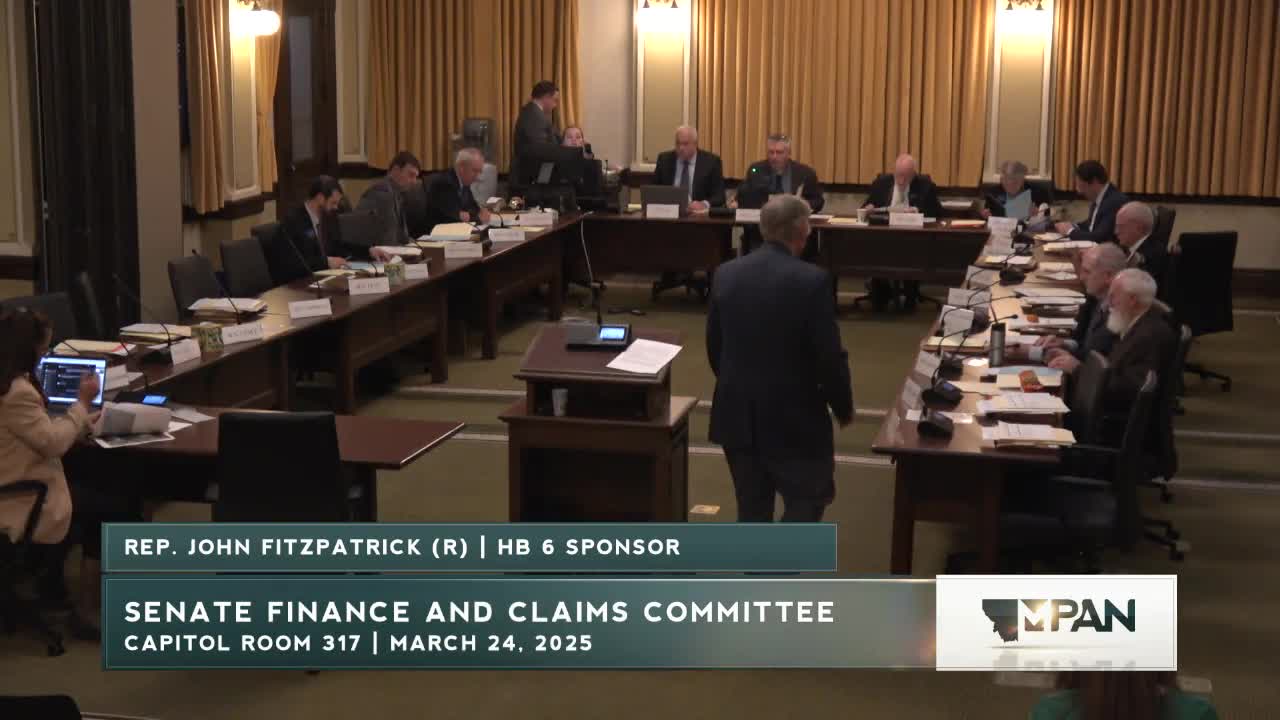
Representative John Fitzpatrick, House District 76, opened the Senate Finance and Claims hearing on House Bill 6, saying the bill is “one of 12 bills that make up the executive budget recommendation to the legislature.”
Representative John Fitzpatrick, House District 76, opened the Senate Finance and Claims hearing on House Bill 6, saying the bill is “one of 12 bills that make up the executive budget recommendation to the legislature.” The bill would appropriate grants from interest on the Resource Indemnity and Ground‑Water Protection (RIGW) trust for local water, wastewater and irrigation repairs and improvements.
The bill’s sponsor and agency witnesses told the committee the bill’s funding was cut after an error in the revenue estimate. “After the bill was introduced, it was discovered that there had been a significant error in the revenue estimate and it was necessary to reduce the scope of the bill and limit the number of projects that could be funded by, roughly 50% of the revenue anticipated in the original bill,” Fitzpatrick said. As printed for the committee, the bill funds project lists through the town of Ennis on the water/wastewater list and 21 irrigation projects through the Sunset irrigation project on the irrigation list.
Autumn Coleman, deputy administrator for the Conservation and Resource Development Division at the Department of Natural Resources and Conservation (DNRC), described the Renewable Resource Grant (RRG) programs included in the bill and how DNRC ranks and selects projects. “The purpose of the renewable resource grant loan program is to further the state's policies set forth in section 85‑1‑1101, Montana Code Annotated, regarding the conservation, development, and preservation and beneficial use of renewable resources,” Coleman said. She told senators DNRC received 71 grant applications for the current biennium and outlined program categories including project grants (up to $125,000), emergency grants, irrigation development grants, private grants that produce public benefit, and nonpoint source pollution grants.
Committee members questioned prioritization decisions after the reduction. Fitzpatrick and witnesses said two projects in Granite County were removed because they offered no local match; of the roughly 70 projects originally listed, those two were the only ones with no matching funds. Fitzpatrick said the House added voluntary language encouraging applicants to provide local match, which can improve ranking. He also said DNRC staff expect additional revenues in the next few weeks that could allow more projects from the ranked list to be funded.
Stakeholder witnesses uniformly supported the bill’s programs. Jennifer Olson, government affairs director for the Montana League of Cities and Towns, urged passage. Clayton Elliott of Trident Unlimited told the committee planning grants in the bill are critical for assembling design and funding packages. Mike Murphy of the Montana Water Resources Association and Ben Rigby, executive director of Montana Rural Water Systems, said the grants and planning dollars help rural operators and irrigation districts address aging infrastructure and attract additional federal and local funds. Jeffrey Tiberi for the Montana Association of Conservation Districts voiced support on behalf of conservation districts statewide.
Committee members also asked procedural questions about transfers and future funding. Fitzpatrick and staff said a transfer from another bill likely will be needed to close the gap between the original revenue estimate and available funds; they described such transfers as uncommon but possible. DNRC staff said projects are ranked on measurable public benefits, technical feasibility and financial feasibility and that many projects combine multiple funding sources.
The hearing closed with the sponsor noting DNRC would provide updated information about how many projects could be funded if additional revenues materialize.
Ending: The committee took testimony and closed the hearing on House Bill 6 without taking a vote; senators said they expect updated fiscal information and possible follow‑up when additional revenue details are available.