Get Full Government Meeting Transcripts, Videos, & Alerts Forever!
Get email alerts on the Permanent Fund Pomv Constitutional Amendment topic
No spam. Unsubscribe anytime.
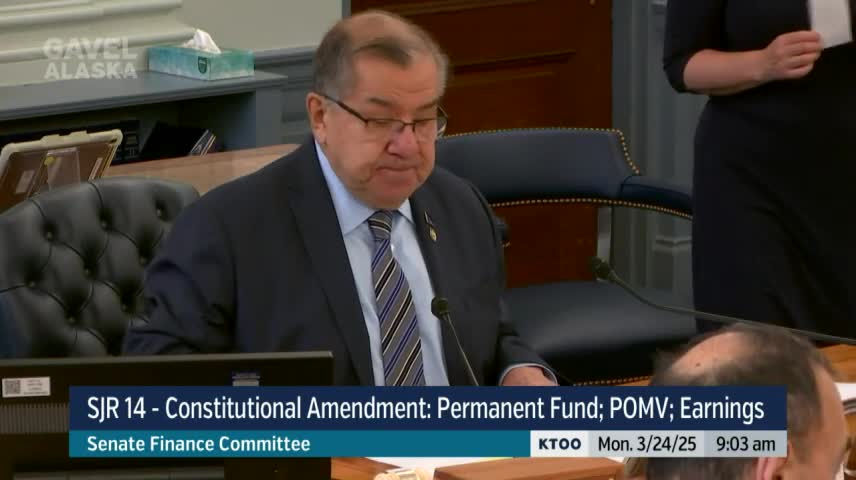
Senate Finance reviews SJR 14 to cap Permanent Fund withdrawals at 5%
Summary
The Alaska Senate Finance Committee on a March morning heard Senate Joint Resolution 14, a proposed constitutional amendment to consolidate the Alaska Permanent Fund’s principal and earnings reserve into a single fund and limit annual withdrawals to a percentage of market value, discussed in committee as a 5% draw.
The Alaska Senate Finance Committee on a March morning heard Senate Joint Resolution 14, a proposed constitutional amendment to consolidate the Alaska Permanent Fund’s principal and earnings reserve into a single fund and limit annual withdrawals to a percentage of market value, discussed in committee as a 5% draw.
Liz Harpold, staff to Chairman Olson, told the committee that “Senate Joint Resolution 14 will provide fiscal stability to the state by amending our state's Constitution to consolidate the principal and earnings reserve of the permanent fund into 1 fund, and limit the draw from the fund to a percent of market value, creating a well protected and reliable endowment style fund.” She said successful legislative approval would place the amendment before voters as a ballot measure in the November 2026 general election.
Devin Mitchell, chief executive officer and executive director of the Alaska Permanent Fund Corporation, told the committee the amendment “would be no impact on the process for appropriating money for a permanent fund dividend as a result of this constitutional amendment,” and said the proposal could make a regular transfer from the fund to the state more likely under a structured draw. He also said the amendment would “protect the principle of the Alaska Permanent Fund in a more robust fashion.”
Committee members questioned how a future Legislature might draw more than the capped rate. Senator Steadman asked what process would be required to exceed a 5% cap. A committee member responding through the chair said, under the current statutory POMV construct the Legislature could approve a larger draw by majority votes of both chambers and the governor’s concurrence; with the proposed constitutional cap, doing so would require voters to act at a general election or otherwise would require a new constitutional amendment, the committee agreed they would confirm the precise legal mechanism with counsel.
Senator Kauffman asked whether other draw-rate models or longer averaging periods have been modeled. Mitchell said substantial modeling occurred when the statutory POMV structure was created in 2018 and described 5% as roughly the maximum draw typically used for an endowment intended to exist in perpetuity; he said choosing a higher or lower draw is a policy decision that depends on whether the state prioritizes current needs or long-term growth.
Chairman Olson opened a public hearing; no members of the public offered testimony in the room or online. The committee took no formal vote on SJR 14 at the meeting and closed the hearing. Committee members noted they would consult counsel to confirm what legal steps would be required to access more than the capped draw should voters approve the amendment. The committee scheduled its next meeting for the following morning at 9 a.m., when it will receive an update from the Alaska Broadband Office.
The hearing included a one-page support document provided to the committee by the Alaska Permanent Fund Corporation summarizing potential effects of the proposal on the Permanent Fund Dividend; committee members received that document as part of the record.