Get Full Government Meeting Transcripts, Videos, & Alerts Forever!
Get email alerts on the Rail Infrastructure topic
No spam. Unsubscribe anytime.
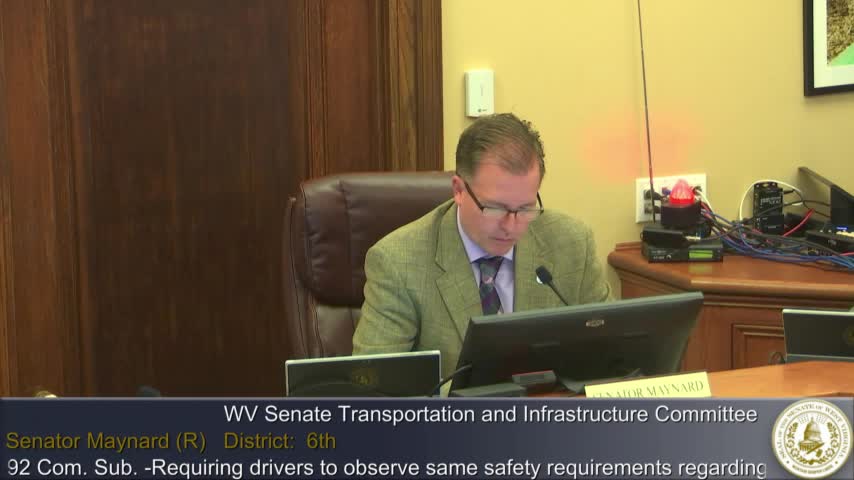
Senate committee backs reporting of bill to create West Virginia Short Line Railroad Modernization Act
Summary
The Senate Transportation Infrastructure Committee voted to report Senate Bill 7‑22 to the full Senate with the recommendation that it pass, sending the measure first to the Committee on Finance for its second reference.
The Senate Transportation Infrastructure Committee voted to report Senate Bill 7‑22 to the full Senate with the recommendation that it pass, sending the measure first to the Committee on Finance for its second reference.
The bill would establish the West Virginia Short Line Railroad Modernization Act and two state tax credits for eligible short‑line railroads — defined in the bill as class 2 or class 3 railroads located wholly or partly in West Virginia. Counsel to the committee, Mariah, told members the proposal would allow a maintenance credit limited to $5,000 multiplied by the number of miles of track a railroad owns, leases, or operates in West Virginia, and a separate new‑project credit equal to 50% of qualified new rail infrastructure expenditures, capped at $2 million per project and $5 million annually.
Why it matters: Sponsors and witnesses said the credits are intended to help low‑density branch lines keep freight connections open for rural communities and to attract businesses that rely on rail access. The bill includes application and processing rules, allows tax credits to be carried forward for up to five years, and permits credits to be transferred by written agreement; the bill also prohibits the tax commissioner from seeking recourse against a transferee for credits later disqualified in whole or part.
Committee discussion and fiscal notes
Mariah, counsel to the committee, told senators the tax department prepared two fiscal notes: about $2.4 million for the maintenance credit and $5 million for the new‑project credit, for a combined possible annual fiscal exposure of $7.4 million if short‑line railroads claimed the annual caps. Mariah also noted the department flagged an ambiguity about how the state would account for or verify federal tax credits when applying the state credit.
Trent Kingsbury, Business Development Associate and Financial Analyst at Mickelson and Company, told the committee the proposal follows an established model seen in other states and would be “an additive” to the existing federal qualified railroad‑track maintenance credit. Kingsbury said West Virginia has 12 class 2 and 3 railroads with roughly 700 track miles that provide first‑mile/last‑mile service to rural areas and that inflation has increased annual maintenance needs well above older federal credit levels.
Committee action and next steps
The vice chair from Taylor moved that the committee report the bill to the full Senate with the recommendation that it pass, with the original double committee reference to the Committee on Finance; the chair announced the ayes had it and declared the motion adopted. The bill will go first to Finance and then to the full Senate if referred.
Quotes from the hearing
Mariah, counsel to the committee: “The tax credit may not exceed an amount equal to $5,000 multiplied by the number of miles of railroad track owned, leased, or operated in West Virginia by the eligible taxpayer at the end of the calendar year.”
Trent Kingsbury, Business Development Associate, Mickelson and Company: “This legislation is doing is it's a proven model that helps small rural, low density branch lines stay connected to the national freight network.”
Ending
The committee did not amend the bill. Members agreed to refer the bill to the Committee on Finance for fiscal and constitutional review before further action by the full Senate.