Get Full Government Meeting Transcripts, Videos, & Alerts Forever!
Get email alerts on the Impact Fees topic
No spam. Unsubscribe anytime.
Committee advances private acts letting cities impose impact fees after extended Gallatin testimony
Summary
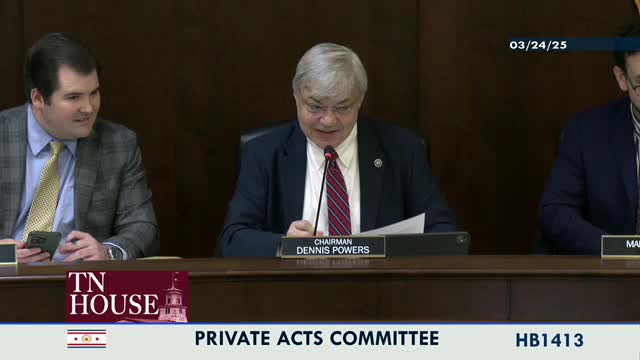
The House Private Acts Committee voted to advance two private acts that would let cities levy development impact fees — one for the city of Gallatin and one for Loudoun. Gallatin officials and legal counsel testified about how impact fees work, who pays them and how a professional study would set amounts.
The House Private Acts Committee on Oct. 12 advanced two private acts that would permit municipal governments to impose development impact fees and other developer charges.
The committee sent House Bill 14 13, which would allow the city of Gallatin to adopt impact fees, and House Bill 14 26, a private act for the city of Loudoun to impose fees on developers, on to the State and Local Government Committee. House Bill 14 13 passed the committee 5-2 with three members recorded present; House Bill 14 26 advanced on a 6-2-3 tally.
Supporters said the bills give cities a tool to pay for infrastructure tied to new growth. “I’m Paige Brown; I’m the mayor of the city of Gallatin,” Mayor Paige Brown told the committee. She said Gallatin faces rapid growth and rising property values, and she argued the city needs “tools to invest in the capital to expand our services and expand our infrastructure.” Brown said, “there’s probably no home under $350,000 that you’re going to find in the city of Gallatin.”
Gallatin’s witnesses emphasized that any impact-fee program would be based on a professional study. A city official testifying alongside the mayor said an outside consultant would analyze city needs and recommend how much could be charged. “If we get granted the opportunity to be able to do it, we have to hire an outside company who’s going to come study the city, study the needs, and they are going to tell us how much money we can request,” the witness said.
Legal counsel for the committee, Mark Dobies of the Office of Legal Services, responded to members’ questions about statutory limits. He told the committee that the state-level restrictions discussed earlier in the meeting do not extend to cities in the same way: “Impact fees, the restrictions do not extend to cities,” he said, and noted the bill’s language lists typical categories the fees could fund, including streets, water, stormwater, emergency services and other capital items.
Committee members questioned whether impact fees apply only to new development. Mayor Brown answered affirmatively: “Yes, they would,” she said, adding that legislative requirements govern administration and that fees are applied to new development.
Members also raised concerns about housing affordability. Brown and a Gallatin witness said supply is the primary driver of prices and that impact fees are intended to fund the infrastructure needed for more housing. Brown cited recent reassessments that have raised taxable values for some long-time homeowners and said that increased property values have shifted tax burdens onto moderately priced homes.
Representatives who opposed or questioned the bills expressed worry that impact fees could be used as an anti‑growth tool or could raise housing costs. The committee discussed a prior “tasker” study several members cited when debating the local effects of fees.
Both bills now move to the State and Local Government Committee for further consideration. The bills as advanced leave the specific fee amounts and detailed administration to the local governments and to professional studies they would commission.
Votes at a glance: House Bill 14 13 (Gallatin) — passed committee 5-2 with 3 present; House Bill 14 26 (Loudoun) — passed committee with 6 ayes, 2 no’s and 3 present not voting.
The committee’s legal advisory also flagged miscellaneous statutory references during the discussion, including Title VI and Title 67 (privilege and excise tax provisions), and advised members to read private-act text to see precise limits on fee categories and usage.