Get Full Government Meeting Transcripts, Videos, & Alerts Forever!
Get email alerts on the Public Safety 911 topic
No spam. Unsubscribe anytime.
Judiciary committee advances bill to allow warrantless arrest for repeated harassing 911 calls
Summary
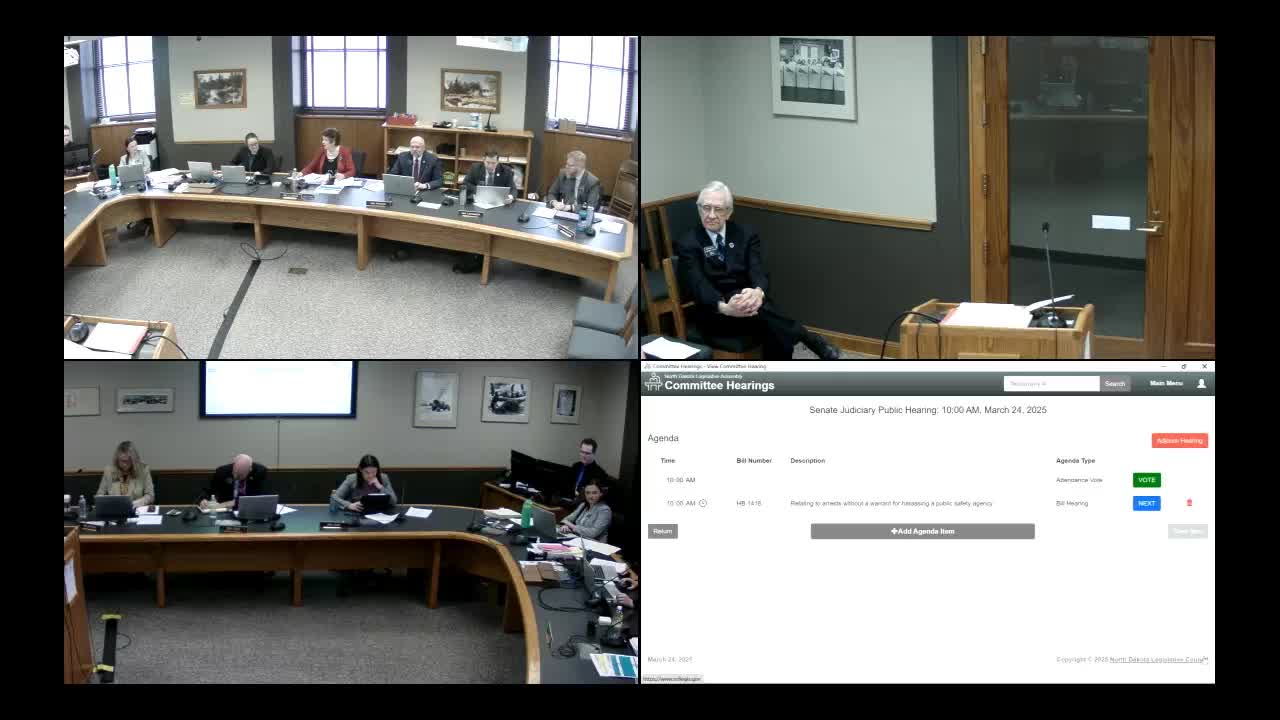
The Judiciary Committee voted to give House Bill 1418 a do-pass recommendation after witnesses and law-enforcement officials described repeated, harassing calls to 911 that can tie up dispatch centers and take hours or longer to address through the normal warrant process.
The Judiciary Committee voted to give House Bill 1418 a do-pass recommendation after witnesses and law-enforcement officials described repeated, harassing calls to 911 that can tie up dispatch centers and take hours or longer to address through the normal warrant process.
Representative Lawrence Clameen of District 47 (Bismarck), the bill sponsor at the hearing, told the committee the measure adds a misdemeanor exemption allowing a warrantless arrest for the offense of "harassing a public safety agency" or making a false report to a public safety agency under subsection 4 of North Dakota Century Code section 12.1-17-07. "This section deals with, when, an arrest can be made without a warrant," Clameen said, summarizing the change.
The bill matters to public-safety operations because subsection 4 of NDCC 12.1-17-07 defines a person who initiates communications with a 911 emergency line, a public safety answering point (PSAP) or an emergency responder communications system with intent to annoy or harass, or who makes a false report, as committing an offense. Under current statute that subsection is a class A misdemeanor, and committee witnesses said misdemeanor charges normally require a warrant when the offense does not occur in an officer's presence.
Jonathan Byers, representing the North Dakota State's Attorneys Association, told the committee the standard complaint-and-warrant route can be slow. "By the time all that's done, this whole day of harassment's been going on," he said, arguing the bill would let law enforcement "go to the house they know the call is coming from and arrest the person without having to wait for that long process."
Robert Root, sheriff of Ward County, testified the change would let dispatch centers return to normal operations faster. He described incidents in which callers rang dispatch repeatedly — one example given was 36 calls in one hour — and said most dispatch centers do not have sworn officers on site. "It is in the best interest of society to have the person tying up that line . . . be quickly arrested so that the 911 center can return normal operations," Root said.
Committee members questioned how the bill would work in practice. Senator Brownberger asked whether dispatch still has an obligation to respond; Byers said response depends on the call's content and that the bill is intended to address non-emergency harassment rather than legitimate reports. Senator Paulson and Senator Castaneda raised concerns about potential abuse and asked whether local policies or training would limit immediate arrests; witnesses replied they expected dispatch and state radio staff to use discretion and try de-escalation before seeking arrest. The sheriff and Mr. Byers both said mental-health evaluations and existing discretion would remain options in many cases.
Supporters summarized the expected operational effect: quicker on-scene intervention for callers who repeatedly and intentionally harass 911 or make false reports, without impairing responses to genuine emergencies. The committee closed the hearing after additional brief discussion.
The committee then moved to act. Senator Meerdal moved a do-pass recommendation on House Bill 1418, seconded by Senator Lueck. Roll-call votes recorded by name during the committee vote were: Senator Paulson — Aye; Senator Castaneda — Aye; Senator Corey — Aye; Senator Luke — Yes; Senator Bridal — Aye; Senator Brownberger — Aye; Chair Rosa Larson — Yes. The motion carried and the committee issued a do-pass recommendation.
What happens next: the committee recorded the recommendation to advance HB 1418; final enactment would still require floor action and any subsequent steps in the legislative process.