Get Full Government Meeting Transcripts, Videos, & Alerts Forever!
Get email alerts on the Tribal Warrants topic
No spam. Unsubscribe anytime.
Testimony on Tribal Warrants Act urges statutory time limit for state-court review, flags housing and funding questions
Summary
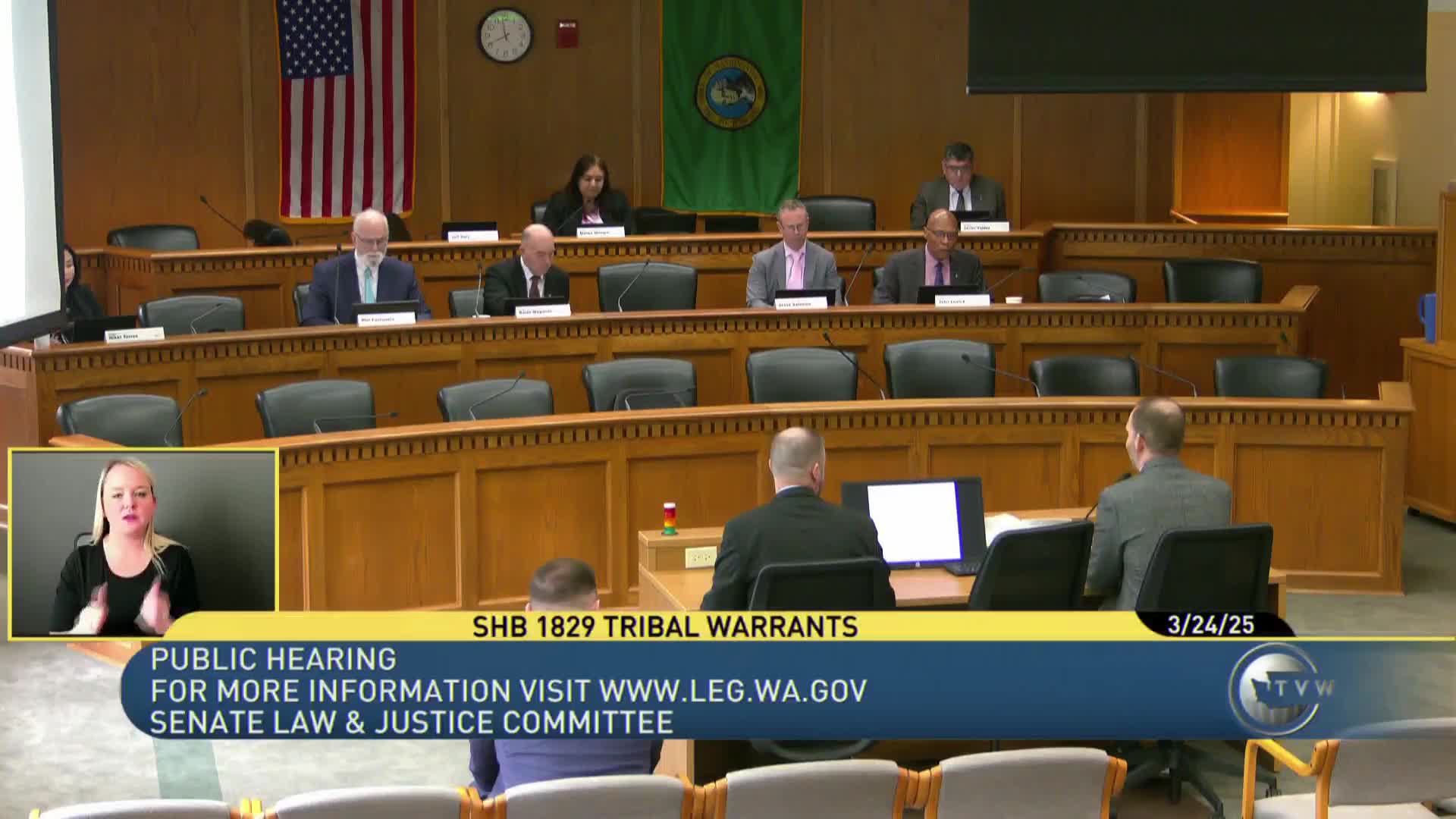
Witnesses testified in support of the Tribal Warrants Act (Engrossed Substitute House Bill 18-29), asking the Legislature to add a requirement that anyone arrested on a tribal warrant be seen by a state judge within one judicial day and to clarify funding for housing and transport when warrants cross jurisdictions.
Attorneys and tribal partners told the House Law & Justice Committee that they broadly support the Tribal Warrants Act but urged lawmakers to add statutory protections and funding clarity.
Russ, an attorney testifying in support of Engrossed Substitute House Bill 18-29, told the committee the bill contains many of the work group’s agreed recommendations but still needs “language needed to require an individual, even from a certified tribe who is arrested on a tribal warrant to see a state judge within 1 judicial day.” He said that requirement “helps to fulfill” habeas corpus and identity-protection concerns and provides a statutory recognition mechanism to implement the bill’s full-faith-and-credit principle.
The committee exchanged questions about how tribal warrants would operate alongside existing county-to-county warrant transfers. Senator Dhingra asked whether a person arrested in one county on a warrant issued in another county is transferred “on that warrant without a court hearing.” Russ responded that tribal warrants raise different sovereign issues and said, “Just because I pick up someone from Oregon and I'm in King County, I can't automatically transfer. They would have a right to a hearing. They would have a right to be in front of a court at least for the limited purposes of identity.”
Speakers who testified also asked for statutory cleanup to ensure noncertified tribes can enter warrants into state and national systems and for clarification that existing local agreements between tribes and counties (for example, Tulalip and Snohomish County) remain intact under the new law. Russ raised funding as a separate issue: he said the bill should address who pays for housing and transportation when a tribal member is held far from their home community, noting scenarios—such as a tribal member arrested in Spokane on a Tulalip warrant—that raise questions about whether the originating tribe, the state, or the receiving county covers detention and return costs.
The committee concluded public testimony on the bill without a formal vote during this hearing.
Ending: The record shows broad support among tribal partners and law enforcement for the bill’s goals alongside repeated requests for statutory language to guarantee a prompt state-court identity hearing and explicit funding or housing provisions for cross-jurisdictional detentions. Further bill language or fiscal notes may be expected in subsequent committee work.