Get Full Government Meeting Transcripts, Videos, & Alerts Forever!
Get email alerts on the School Restrooms topic
No spam. Unsubscribe anytime.
Lawmakers weigh penalties and plumbing rules to enforce school restroom law; districts warn of high retrofit costs
Summary
House Bill 11‑44 would add enforcement penalties and plumbing rules to a 2023 law about restroom use in schools. Sponsors said enforcement is needed after at least one superintendent publicly said he would not comply; school leaders and facilities experts warned amendments would force costly retrofits and intrude on local control.
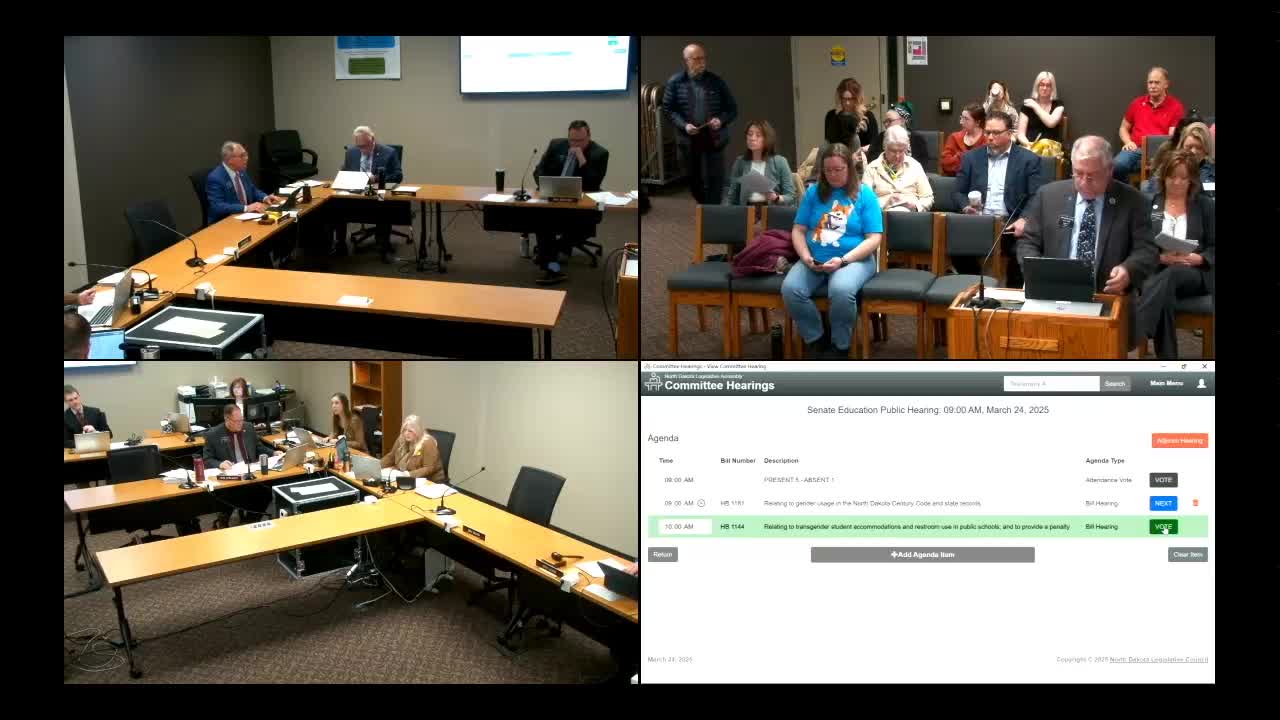
The Senate Education Committee took testimony on House Bill 11‑44, a proposal to amend section 15.1‑06‑21 of the North Dakota Century Code to add enforcement mechanisms, civil penalties and plumbing guidance intended to ensure school districts comply with an existing 2023 law governing restroom use and transgender student accommodations.
Representative Bill Twit, sponsor of HB 11‑44, told the committee the 2023 measure (House Bill 15‑22) lacked “teeth” and should be enforced after at least one school superintendent publicly said the district would not comply. Twit walked the committee through amendments adopted in the House that would: add a penalty assessment and enforcement process, clarify that district policies or guidelines — explicit or implicit — cannot require or prohibit restroom use inconsistent with the statute, and direct the attorney general to investigate complaints and levy civil penalties, up to $2,500 per violation. Twit said the measure would also address designs that some districts use to circumvent the law by removing gender labels and creating shared spaces.
Supporters said the bill restores the rule of law and protects the privacy and safety of girls. David Tamassee of the North Dakota Catholic Conference told senators “no one is above the law” and argued courts have not definitively extended employment‑law decisions (Bostock) to Title IX. Mark Jorritsma of North Dakota Family Alliance and Concerned Women for America’s Linda Thorson also urged passage, as did several parents who earlier testified that proposed new buildings in their districts had planned communal wash areas that they said compromised girls’ privacy.
Opponents warned the House amendments adopted to HB 11‑44 go beyond the original enforcement goal and would require widespread, costly changes to school facilities. Levi Bachmeier, business manager for West Fargo Public Schools, said the amendment broadened the bill and could effectively ban commonly used restroom designs, creating an immediate fiscal burden. Amy Copa of the North Dakota Council of Educational Leaders presented an estimate — provided to the committee during testimony — that renovating affected bathrooms across the state to comply with the House amendment could cost roughly $140 million to $200 million; a separate estimate cited during the hearing put the figure at about $147 million.
Devil’s Lake Superintendent Ned Kluton said his district had adopted single‑user restrooms in new construction to reduce bullying and vaping; he said the design choices were made before a local bond vote and with extensive community input and that the single‑user model reduced behavior incidents in his schools. West Fargo and other districts urged the committee to return the bill to its original form or to include a grandfathering provision allowing existing facilities to remain in place.
Several senators asked technical questions: Senator Axman asked whether the newly proposed enforcement process would duplicate or conflict with a separate Senate bill (Senate Bill 2104) that establishes procedures for handling school district noncompliance; Representative Twit said his bill is intended to operate separately but could be revisited if another bill becomes law. Committee members also queried architects and school leaders about plumbing distinctions — for example, whether sinks in a shared hallway outside single‑stall toilets should be considered “communal” and therefore covered by the amendment; witnesses said designs vary and that many modern school renovations use shared sink areas to increase supervision and reduce bullying.
No committee vote was recorded. The hearing included numerous requests for refinement: school administrators asked for clarity and for protection of existing facilities, facilities experts warned of large fiscal impacts, and mental‑health and parent witnesses emphasized student safety and privacy. The committee recessed with the bill pending further consideration.
Ending: The hearing left a clear split: sponsors and conservative advocacy groups argued for enforcement and penalties to uphold state law; many school administrators and education leaders urged the committee to limit statewide plumbing mandates or include grandfathering language to avoid large retrofit costs and preserve local control.