Get Full Government Meeting Transcripts, Videos, & Alerts Forever!
Get email alerts on the Finance And Taxation topic
No spam. Unsubscribe anytime.
Senate committee hears testimony on bill to raise North Dakota gas tax and increase electric-vehicle fees
Summary
Lawmakers heard pro and con testimony on House Bill 13 82, which would raise the state motor fuel excise tax by 3¢ per gallon (from 23¢ to 26¢), increase electric-vehicle registration fees, and direct the additional revenue to cities, counties and townships; the committee took testimony but did not take final action.
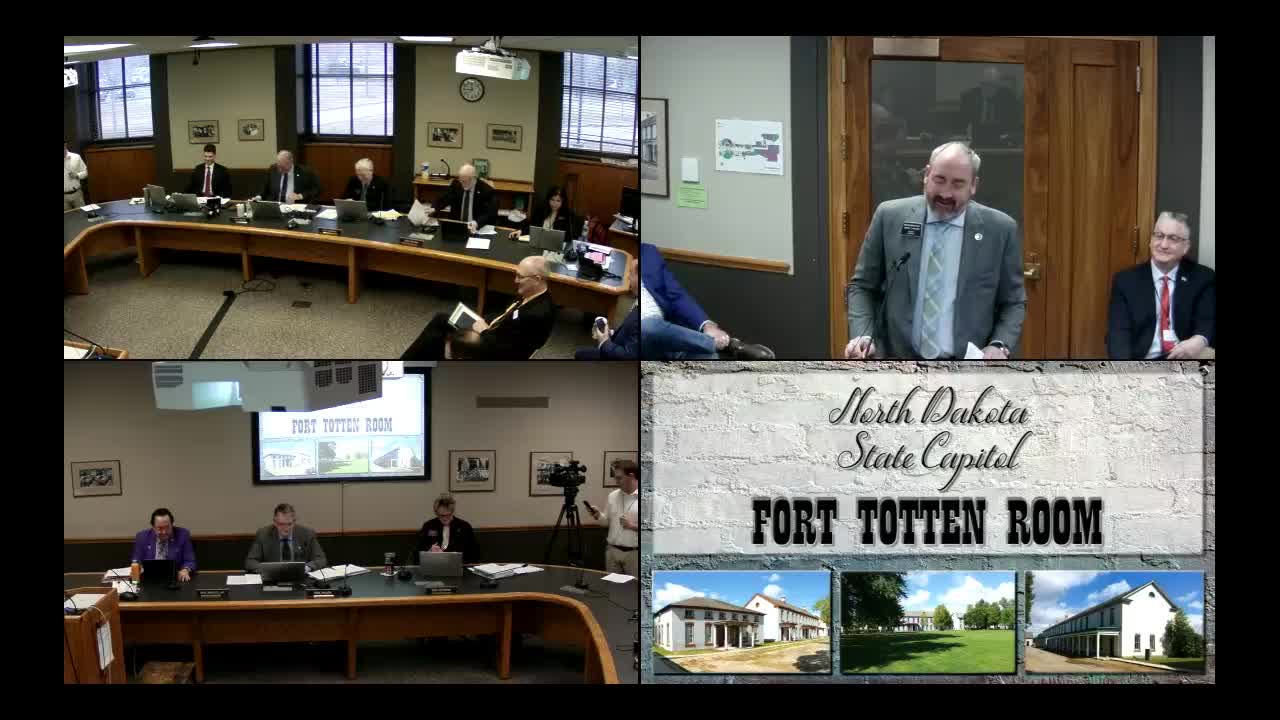
BISMARCK — The Senate Finance and Taxation Committee heard more than a dozen witnesses Feb. 24 on House Bill 13 82, a proposal to raise North Dakota's motor fuel tax by 3¢ per gallon and increase registration fees for electric vehicles as part of a package aimed at providing steady funding for city, county and township roads.
Representative Jared Haggart, District 20, introduced the bill, saying “the crux of House Bill 13 82 is to raise the North Dakota gas tax by 3¢. Moving from 23¢ to 26¢.” He said the increase is intended to create “a stable, reliable funding mechanism for our core roads and foundational roads” after the state’s motor fuel tax had not been raised since 2005.
Under the bill as described by Haggart and supporters, the 3¢ increase would be split so that 1¢ of each additional penny goes to cities, 1¢ to counties and 1¢ to townships. Haggart said the change would generate about $42,000,000 per biennium: about $18,000,000 for counties, $10,000,000 for cities and $14,000,000 for townships. The sponsor also distributed an amended version that would include oil-producing counties in the distribution.
Supporters included construction and local-government groups that said predictable, long-term revenue is needed to address maintenance backlogs. “We refer to this not as a gas tax but as a user fee. You pay according to how much you use,” Russ Hanson of the Associated General Contractors of North Dakota said. Jenny Dietzmann of the North Dakota Association of Counties cited a 2024 Upper Great Plains Transportation Institute study and the size of local infrastructure needs, and asked the committee for a favorable recommendation.
County and city officials and trade groups gave specific examples of cost pressures. Nick West, Grand Forks County engineer, said construction prices have risen sharply: “the cost of metal culverts doubled from 2017 to 2022.” Matt Gardner of the North Dakota League of Cities calculated that the 23¢ rate in 2005 would need to be about 38¢ today to match inflation.
Opponents, including small-business and fuel-industry groups, strongly urged the committee not to advance the gas-tax portion. “This is a $42,000,000 consumer tax on the driving public,” Mike Rood of the North Dakota Petroleum Marketers and Retail Association told the committee, asking for a do-not-pass recommendation. Matt Bjornsson, who identified himself as having family in the petroleum distribution business, testified in “strong opposition to the gas tax portion,” arguing residents already face higher property valuations and other pressures.
The bill also would raise annual registration fees on electric vehicles from $120 to $150, plug-in hybrids from $50 to $60 and electric motorcycles from $20 to $25. Don Larsen, representing General Motors, opposed Section 1 of the bill (the increased EV registration fee), saying the proposed fee would be higher than comparable neighboring states and that electric-vehicle owners already pay higher registration fees than typical gasoline vehicles.
Committee members asked technical questions about distribution formulas, how unorganized townships would be treated and the interaction of this proposal with other transportation funding programs such as Operation Prairie Dog and DOT allocations in the executive budget. Senator Patton asked how the 3¢ would be dispersed; Haggart pointed committee members to the amendment’s formula language. Committee members requested supplemental data on the current baseline distributions and construction-cost changes to help evaluate the bill.
Chairman Weber closed the hearing after receiving testimony and no committee vote or formal action was taken at the end of the session. Several senators asked staff to provide additional analysis of existing highway distribution allocations, the Prairie Dog and DOT budget proposals, and recent construction-cost data before they consider the bill further.
Votes at this hearing: no formal committee vote recorded; a revised amendment to include oil-producing counties was presented by the sponsor for committee consideration but was not acted on during the hearing.