Get Full Government Meeting Transcripts, Videos, & Alerts Forever!
Get email alerts on the Gender Definitions topic
No spam. Unsubscribe anytime.
Senate education committee hears bill to define “gender” as biological sex in century code
Summary
Supporters told the North Dakota Senate Education Committee the bill would codify a binary gender definition in state records and school materials; opponents and health advocates said it would harm transgender and intersex people and risk students’ safety and mental health. Lawmakers heard hours of testimony but took no vote.
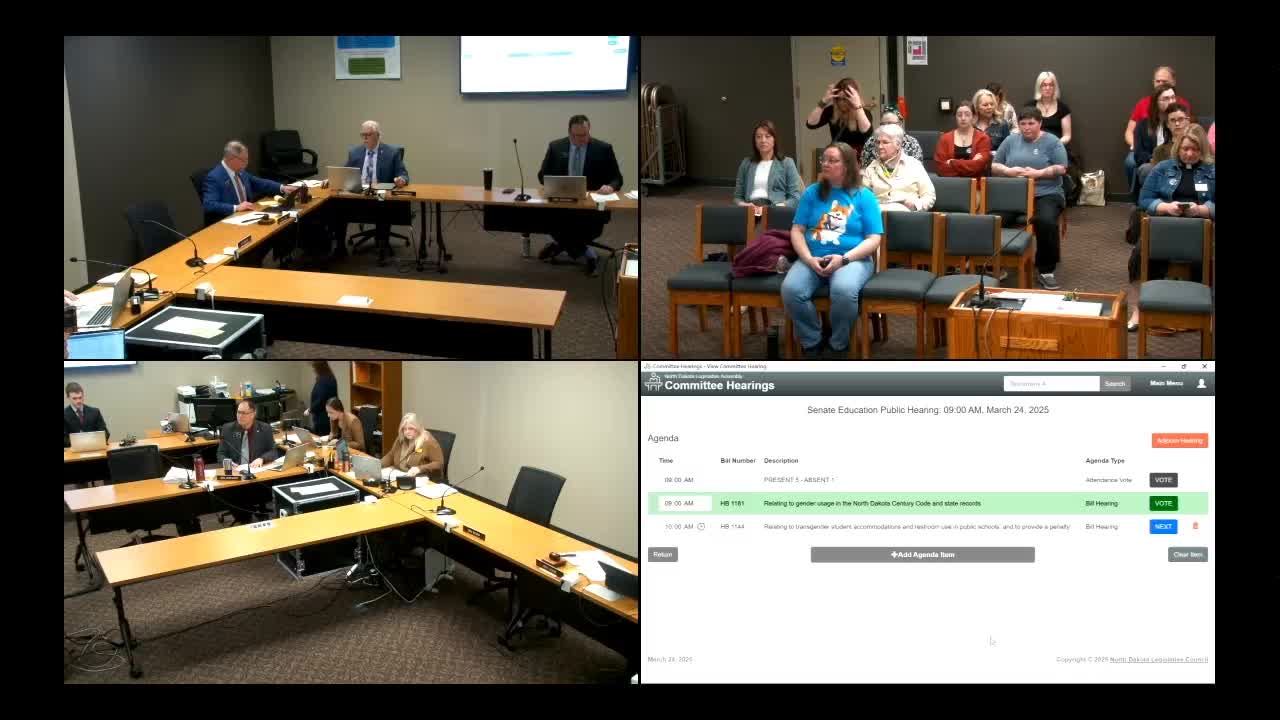
The North Dakota Senate Education Committee held a hearing on House Bill 11‑81, a proposal to amend the North Dakota Century Code so that words referencing an individual’s “gender” would be defined as that individual’s sex, and to require that definition for state policies, records and materials used by public schools, institutions under the State Board of Higher Education, and state agencies.
The bill’s sponsor, Representative Sue Ann Olson, told the committee the measure would “align state policy with federal policy” and argued that a binary definition of gender is “scientifically honest” and necessary to preserve opportunities and privacy for girls and women. Olson asked the committee for a “do pass” recommendation.
Supporters who testified said the change would provide clarity and protect female-only spaces. David Tamassee, executive director of the North Dakota Catholic Conference, said the church “insists that transgender persons should be treated with compassion” but that state definitions should reflect “the nature of the human person as either 1 of 2 sexes, male or female.” Linda Thorson, state director for Concerned Women for America Legislative Action Committee of North Dakota, said the bill would “affirm the dignity of women” and protect intimate spaces such as shelters, prisons and sports.
Opponents — including mental‑health and youth advocates, students and parents — said the measure would force school staff and state agencies to ignore students’ gender identity in records and communication and could increase risk of self‑harm among transgender students. Faye Seidler, a suicide‑prevention advocate who has worked with LGBTQ+ youth statewide, told the committee that excluding recognition of gender identity would reduce protective factors for at‑risk youth. Carter Gill of the North Dakota Student Association cited national research showing low overall prevalence of transgender adults in the state but warned the bill would make higher education less welcoming for transgender students. Several witnesses cited intersex conditions and the complexity of biological sex, with testimony noting that intersex variation affects roughly 1.7 percent of the population.
Senators pressed the sponsor about edge cases raised by witnesses. Senator Bauchay asked specifically about intersex individuals; Olson responded that she considered intersex conditions rare and said she expected “a determination has been made” at some point in infancy or childhood and that the Century Code’s existing definition of “sex” would apply. Critics said this answer did not address people whose biology or identity remains non‑binary across their lifetime.
Witnesses on both sides referenced a presidential executive order from Jan. 20, 2025; Representative Olson and several supporters described the order as supporting a two‑sex policy, while opponents said administrative policy can change and that courts and medical associations do not equate sex and gender. Several witnesses cited the 2020 U.S. Supreme Court Bostock ruling during discussion about how federal law applies to educational settings; attorneys and witnesses noted that Bostock addressed employment law and that courts remain divided on whether it extends to Title IX education claims.
No committee vote was recorded in the hearing. Sponsors and multiple supporters asked for a “do pass” recommendation; opponents urged lawmakers to reject or substantially revise the bill. The committee closed public testimony after hours of remarks and moved on to other business.
Ending: The Senate Education Committee heard extensive, often emotional testimony from both sides but did not take a vote during the hearing. Lawmakers will next consider committee deliberations and any amendments before deciding whether to advance the bill to the full chamber.