Get Full Government Meeting Transcripts, Videos, & Alerts Forever!
Get email alerts on the Budget And Operations topic
No spam. Unsubscribe anytime.
HHS business operations briefing: lawmakers press for clarity on IT costs, FTE block grant and underfunding choices
Summary
Department officials described recent unification work, reallocation of IT costs into program budgets, a parked $13.9 million operational underfunding and the governor’s proposed FTE block grant. Senators asked for clearer, position‑level detail before making underfunding decisions.
Department officials briefed the Senate Appropriations Human Resources Division on business‑operations changes following unification of health and human services functions, with a focus on IT cost allocation, a new FTE salary block‑grant approach and a set of one‑time carryovers from the prior biennium.
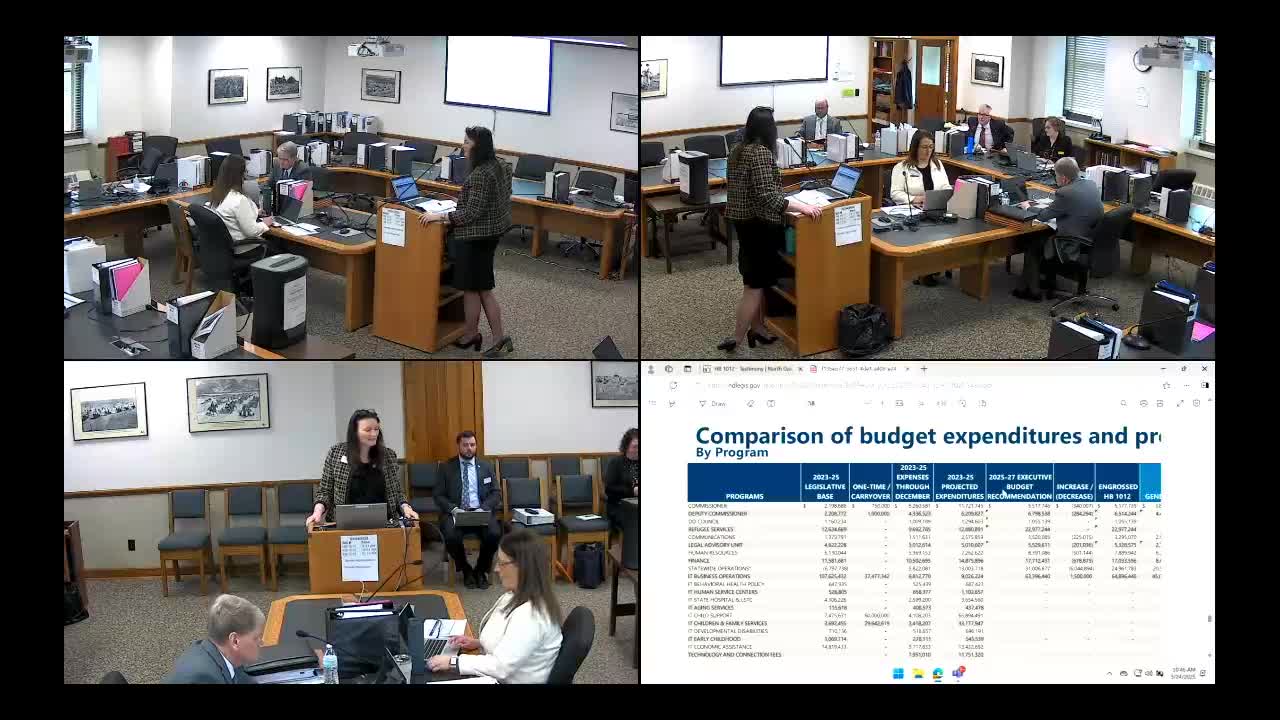
Deputy Commissioner Sarah Stoltz and Donna Auckland, who presented business operations slides, told the committee that the department consolidated many IT contracts and moved IT expenses into individual program budgets so program managers would have direct responsibility and line‑of‑sight over those contracts and expenditures. They said certain one‑time carryover items remain in a centralized section 25 request — including a $60 million child‑support IT appropriation and other multi‑year IT or systems projects — but many recurring IT costs are now budgeted inside the operating divisions.
Stoltz and Auckland described a staffing and salary accounting issue tied to the governor’s executive compensation package. The administration added a roughly $9.8 million FTE block grant in the executive budget to fund compensation adjustments; the House then adjusted (underfunded) that package in committee action. Department staff explained the arithmetic used to calculate a baseline payroll need — monthly payroll extrapolated to a 24‑month biennium plus the salary package — and said the department would prefer flexibility in the salary line to respond to program needs rather than deeper underfunding of personnel.
Auckland said some differences between the department’s projected expenditures and the executive recommendation reflect internal position moves and integration costs (finance and HR integration, contract work with Deloitte on cost‑allocation issues), plus one‑time project carryovers. She told senators the department moved several communications, finance and IT positions into a central business‑operations area to better coordinate functions but acknowledged that the reorganization makes year‑to‑year budget comparisons harder to read on a single slide.
Senators pressed for simpler, position‑level documentation: where personnel moved, which positions are new, and what a reduction in the department’s “operational underfund” would mean in personnel terms. Lawmakers said they want to see where the department could identify savings from reduced leased space, duplicative subscriptions and other back‑office costs — and staff told the committee they are running a ‘‘logistics’’ review of phone, printing, card‑access and office‑space costs to find savings.
Department officials emphasized the tradeoffs involved in the committee’s choices: underfund the salary package and the department will have fewer dollars to hire or retain critical positions; underfund operating and IT contracts and the department may need to reduce services, delay projects or cut back on contractor support. No formal budget decisions were taken at the hearing.
(Quotes in this article come directly from Sarah Stoltz’s and Donna Auckland’s testimony to the subcommittee.)