Get Full Government Meeting Transcripts, Videos, & Alerts Forever!
Get email alerts on the Cultural Plan topic
No spam. Unsubscribe anytime.
Montgomery County launches community engagement phase for 10‑year cultural plan
Summary
The Arts and Humanities Council and consultant METRIS outlined a year‑long public engagement effort to produce a 10‑year Montgomery County Cultural Plan, with targeted outreach, pop‑up events and a multilingual survey; adoption is planned for early 2026 and public review is expected in November 2025.
Anne Gadwin Nicodemus, consulting lead for METRIS Consulting, told the Education and Culture Committee on March 24 that Montgomery County has entered the discovery phase of a new cultural plan that will guide public and private investment, facilities, regulations and programs over a 10‑year horizon.
The plan, Nicodemus said, is anchored in three community‑backed priorities identified during two years of preparatory research: belonging, cultural sector resiliency and intersectionality. "Cultural planning is the practice of creating place‑based plans that identify priorities, guide investment, and inform local policies concerning arts and culture," Nicodemus said, summarizing a working definition used by the project team.
The Arts and Humanities Council of Montgomery County (AHCMC) and METRIS described a multi‑pronged engagement strategy intended to reach residents who traditionally have low participation in civic planning. "We're going to the community," said Joe Frandoni, deputy director and project manager, describing in‑person pop‑ups, community toolkits, translated surveys and focus groups. Frandoni said the team plans at minimum one Cultural Preserves pop‑up event in every council district and will use multilingual mailers targeted to ZIP codes in the county's cultural equity index.
Nicodemus described Cultural Preserves as a creative engagement method developed by artist Holly Bass: trained, multilingual facilitators invite passersby at farmers markets and other gatherings to contribute short stories written on rice paper that are preserved and later transcribed and analyzed. "You catch people in a way that you wouldn't normally get them," she said.
Committee members pressed the team on outreach to under‑represented groups and youth. Council Member Mink asked how the plan will reach residents identified as high interest but low influence; Nicodemus and Frandoni emphasized in‑person engagement at community events, small gatherings and translated physical mailers rather than relying solely on online surveys. Frandoni said the online survey will be plain language, translated into multiple languages (the team said it has landed on seven translations during the meeting) and will be paired with an incentivized raffle for respondents.
The project team also said it is coordinating with county agencies and community partners. Nicodemus said the plan will seek adoption by three bodies — AHCMC's board, the Maryland-National Capital Park and Planning Commission planning board (MNCPPC), and the County Council — and that the team expects a public review period in November 2025 and aims for formal adoption by February 2026. The team asked the Education and Culture Committee to consider a letter of endorsement during the public review period.
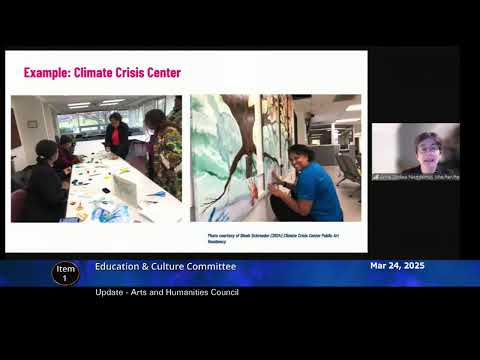
Committee members raised implementation examples the plan might reflect, from placing art in government buildings to embedding artists with county departments to design traffic‑calming interventions and public‑facing services. "Artists in residence in many departments" was offered as an example of how policy and practice could intersect to address transportation, health and civic engagement goals.
Nicodemus and AHCMC staff said the project will document methods and lessons learned so other county agencies and outside jurisdictions can reuse successful outreach techniques. Nicodemus told the committee METRIS selected Montgomery County in part because of the depth of AHCMC's preparatory research, including Cultural Asset Mapping and Reflective Conversations on Arts and Culture.
The committee did not take a formal vote on the plan during the briefing. The presenters asked county council members to help promote the survey, pop‑ups and the youth town hall described to the committee.