Get Full Government Meeting Transcripts, Videos, & Alerts Forever!
Get email alerts on the Voting Rights topic
No spam. Unsubscribe anytime.
Speakers at Montgomery 60th-anniversary program urge renewed voting action as turnout lags
Summary
At Montgomery City’s commemorative program marking the Selma to Montgomery march, speakers including Mayor Steven L. Reed and Martin Luther King III warned of low Black turnout and urged votes, donations and organization to protect rights gained in 1965.
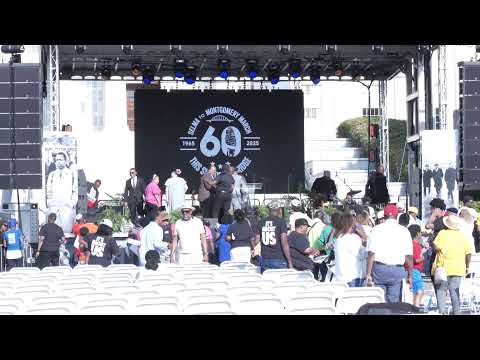
At a public commemoration on Dexter Avenue in Montgomery City, speakers at the 60th anniversary of the Selma to Montgomery march urged renewed voter engagement and resource mobilization to defend voting rights and other programs they said are under threat.
Mayor Steven L. Reed opened the program by linking the annual remembrance to current turnout numbers and civic responsibility, saying, "As pastor Jamal Harrison Bridal shared with us just yesterday, 9,000,000 black voters stayed at home in the November election, more than enough to make up the difference of where we are right now." He encouraged those present to treat commemoration as a prompt to act.
The keynote speaker, Martin Luther King III (speaker), framed the anniversary as a reminder that each generation must protect civil rights. "a vote less people is a powerless people," King said, urging sustained participation and civil engagement. King also warned attendees of policy changes he said could harm programs such as Medicaid and the Department of Education, linking turnout to broader policy outcomes.
Jeton Bosby Gilchrist, identified in the program as executive director of the ACLU of Alabama, recalled the legal and organizing work that enabled the 1965 campaign and said the modern fight requires the same mix of litigation, organizing and legislative advocacy. He framed the present moment as a call to maintain civic institutions and legal protections.
DeMarq Liggins, president of the Southern Christian Leadership Conference, told the crowd that commemoration must convert to resources and sustained organizing. "Reaction is fine, rage is fine, But resource is better," he said, urging attendees to donate time and money to civil-rights organizations and to vote.
Speakers stressed specific actions rather than legal prescriptions: they urged higher turnout in local and national elections, financial support for civil-rights groups, and strategic organizing. Several speakers pointed to civic education for young people and stepped-up outreach to historically underrepresented voters.
The program included reflections on the 1965 campaign’s legal and practical legacy (including the Voting Rights Act of 1965) and repeated calls to convert remembrance into tangible civic participation. Organizers and speakers did not propose or vote on any new municipal measures during the program.
The event closed with a reminder that preservation of voting access and related programs depends on ongoing public engagement, not only commemoration.