Get Full Government Meeting Transcripts, Videos, & Alerts Forever!
Get email alerts on the Tax Stabilization topic
No spam. Unsubscribe anytime.
Smithfield council approves tax-stabilization package for Organogenesis after weeks of negotiation
Summary
The Smithfield Town Council approved a tax-stabilization agreement (TSA) to bring Organogenesis to a vacant 100,000-square-foot site, after debate over clawback language and whether the deal should be enacted by ordinance or resolution. Supporters cited jobs and new investment; critics warned of taxpayer risk if the company left early.
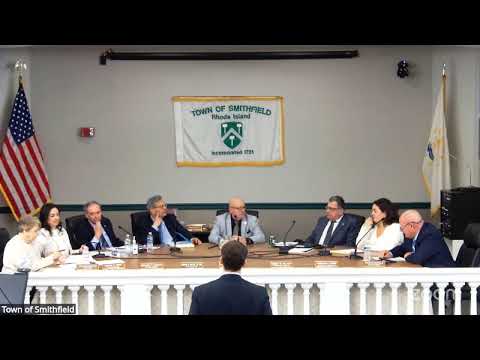
The Smithfield Town Council approved a tax-stabilization agreement on March 6 to support Organogenesis Inc.’s planned renovation and occupancy of a roughly 100,000-square-foot facility at 100 Technology Way in Smithfield.
The vote came after more than three hours of public comment and extended discussion among council members, the town solicitor and Organogenesis representatives over the deal’s term, a proposed early-termination option and how a recapture ("clawback") provision should apply if the company left in the early years.
The agreement is intended to stabilize Organogenesis’s tax burden while the company converts a vacant building into a manufacturing, quality-control and product-development campus. Organogenesis representative Jeremy Savage said the project is expected to cost about $97,500,000 over three years and create “100 plus jobs” with an average salary of about $110,000. Savage said the TSA would produce an average annual tax payment to the town of roughly $807,000 over the TSA term and would protect the town from an immediate decline in revenue from the currently vacant property, which he said now produces about $340,000 a year (roughly $117,000 of which Organogenesis’s team said is attributable to personal property that may no longer be on site).
The core dispute at council was procedural and legal as well as financial: whether to enact the deal as a stand-alone ordinance that would explicitly supersede parts of Smithfield’s general tax-stabilization ordinance where they conflict, or to require the agreement to conform exactly to the existing ordinance. Solicitor Anthony Galone told the council that under Rhode Island law a specific provision can control where it conflicts with a general provision, citing the state rule that “wherever a general provision shall be in conflict with a special provision … the special provision shall prevail.” He advised the council that the legal effect depends on how the council frames and adopts the measure.
Council members split on the best path. Several councilors said the town’s tax-stabilization ordinance — adopted in 2022 and amended multiple times since — exists to protect taxpayers and to provide a transparent, repeatable process. Councilwoman Bovis said, “I think the purpose of the ordinance is to draw businesses to the town, but it’s also to protect the taxpayers,” and she pressed for language that would preserve the town’s ability to recapture revenue if a serious default occurred. In response to those concerns, Organogenesis offered a negotiated modification limited to the early construction period: if the agreement were terminated within the first three years, the company proposed to be liable for the difference between taxes paid under the TSA in those years and the unstabilized tax amount that would have been due without the TSA (the company and its counsel characterized that amount as roughly several hundred thousand dollars over the first three years).
Public testimony at the meeting was strongly in favor of the project. Ben Dodge, a Smithfield resident who said he had worked in biotech for 25 years, told the council Organogenesis would be an “anchor” for other life-science investment and “good paying jobs.” Anthony Cherry of the building trades and other union speakers expressed support and said the project would generate construction work that would likely employ Smithfield residents. Tom Hodgkins, a resident who addressed tangible-versus-real-property risks, warned that if the TSA stabilized tangible personal property that could be removed later, much of the town’s immediate benefit could disappear if the tenant departed.
After debate the council approved the application as presented with the following principal elements: conversion of an extension option into an early-termination option tied to the tenant’s lease term (the application and related redlines moved the early-termination option to a date in 2041); language clarifying that the town manager could execute a final agreement consistent with the council’s direction; and a limited recapture provision applicable only if termination occurred within the first three years, calculated as the difference between taxes actually paid and the unstabilized tax amount for those years. The council also authorized moving a related ordinance forward so the agreement could be codified pending final ministerial edits and the town manager’s execution of the instrument.
Organogenesis representatives and state commerce officials emphasized that the project has additional state-level supports and that the company and state had already committed other incentives and infrastructure assistance; Jim Bennett of Commerce RI described approximately $400,000 in infrastructure/technology support tied to broader economic development efforts in the area. Town staff said preliminary permitting and construction-related fees would produce significant near-term cash benefits to Smithfield, and one council member cited an estimate of roughly $1.3–$1.4 million in near-term cash benefit from fees and related receipts.
The council’s action does not finalize every term: the council’s approval accepted the application subject to the edits described at the meeting and left limited items for finalization by town administration with solicitor review. Council members who voted against the motion cited concerns about process and consistency with the town’s existing ordinance. Organogenesis said it treated the version presented as a best-and-final offer and sought certainty that the TSA could be codified as an ordinance; the company’s representative said it would not entertain further material changes beyond the negotiated offer.
Votes at a glance: - Application: Motion to approve Organogenesis’s tax-stabilization application as amended at the hearing (to include early-termination option and three-year limited recapture language) — outcome: approved by the council (voice vote; several councilors opposed). - Ordinance: Motion to adopt the enabling ordinance to codify the TSA and authorize the town manager to execute the final agreement (subject to the changes adopted at the hearing and solicitor/town-management ministerial edits) — outcome: approved by the council (voice vote; several councilors opposed).
What’s next: Town staff will finalize the agreement text consistent with the council’s instructions, the town manager will be authorized to execute the final instrument after solicitor review, and council members signaled plans to revisit the town’s general tax-stabilization ordinance in coming weeks to create clearer tiers and recapture language for future large investments.
The project’s supporters pointed to jobs and investment, while critics warned councilors to preserve taxpayer protections in future TSAs. The council left on the table a legislative review of Smithfield’s overall tax-stabilization ordinance to address the broader policy choices that this project highlighted.