Get Full Government Meeting Transcripts, Videos, & Alerts Forever!
Get email alerts on the Housing topic
No spam. Unsubscribe anytime.
Wexford County commissioners back pursuing countywide Brownfield TIF authority to spur housing development
Summary
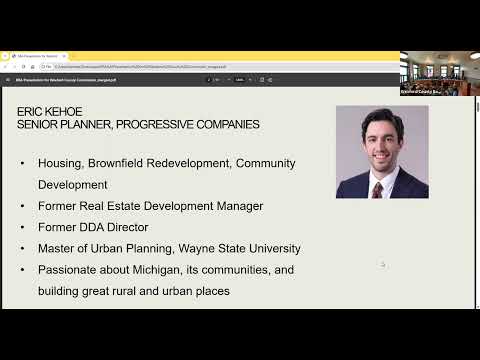
Commissioners heard a presentation from developer Rob Longer and consultant Eric Kegel on using a countywide Brownfield tax-increment financing (TIF) authority to close a local housing finance gap, and voted 9-0 to pursue a grant and next steps to retain a consultant and start the process.
Wexford County commissioners heard a joint presentation from developer Rob Longer and consultant Eric Kegel on creating a countywide Brownfield tax increment financing authority to support housing redevelopment, and voted to pursue grant funding and next steps, passing the motion 9-0.
Supporters said the county faces a persistent housing shortfall because local wages and current housing stock make new construction unaffordable without subsidy. Eric Kegel, a senior planner with Progressive Company working with Housing North, told commissioners that "the tax increment financing can basically fill the gap between what it costs to build and what you're able to get, rent and sale revenue." He described TIF as a performance-based reimbursement mechanism that does not produce an upfront grant but pays back developers from new tax revenue once a project is complete.
Developer Rob Longer described how TIFs made higher-quality projects financially viable in similar communities. "Brownfield TIF allowed me to spend a little bit extra, and I'm gonna get it back eventually," Longer said. He added, "I'm not supportive of land banks," explaining his preference for a TIF mechanism that recoups redevelopment investment over time.
Presenters gave examples and specifics. Kegel cited a Grand Rapids project that used a housing TIF to reimburse roughly $3,000,000 over 23 years and described Cadillac Lofts as a traditional brownfield redevelopment; the base tax revenue in that TIF plan was indicated as about $32,000 per year. Commissioners and presenters discussed how increment calculations work: one example in the presentation compared a property taxed at $4,000 annually that, after redevelopment, would be taxed at $20,000 — leaving an increment of $16,000 per year that could be used to reimburse the developer for cleanup, construction, or infrastructure costs.
Kegel said the maximum TIF term is 30 years in some cases and that term length is determined project by project based on the funding gap. He also outlined next steps to establish a countywide Brownfield Redevelopment Authority (BRA): the county would need to consult townships and local units of government to secure concurrence, hold public hearings and resolutions, and create a BRA board of approximately five to nine members to be appointed by the county administrator.
After discussion, a commissioner asked staff to pursue a grant to retain Kegel and help launch the process; the motion as presented in the meeting text requested that the administrator follow up on the grant that Commissioner Kaylor would sign and bring information forward. Commissioners voted in roll call and the motion passed 9-0.
The county indicated it will bring grant details back to the board, begin outreach with townships about participation, and prepare the formal public-hearing and resolution steps necessary to establish a countywide BRA.