Get Full Government Meeting Transcripts, Videos, & Alerts Forever!
Get email alerts on the Measles Preparedness topic
No spam. Unsubscribe anytime.
Board of Health reviews measles preparedness as local vaccination coverage lags state target
Summary
Public health staff briefed the Board of Health on national measles outbreaks and local preparedness steps, noting county childhood measles vaccination rates below the 95% herd‑immunity target and discussing testing, school exclusion periods and messaging.
Cascade County Public Health staff warned the Board of Health on March 5 that national measles outbreaks require preparedness planning because measles is highly transmissible and can lead to hospitalizations.
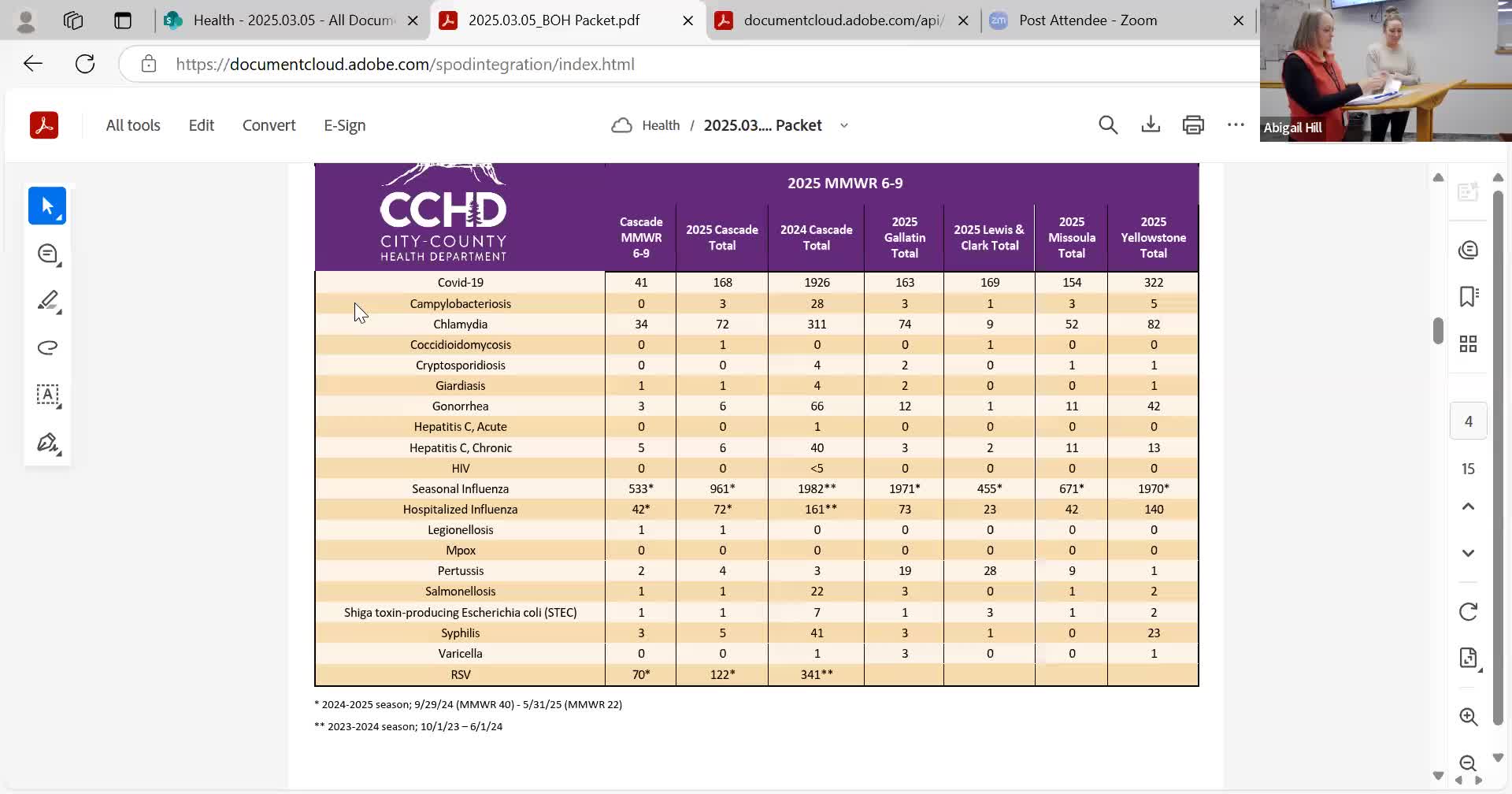
Sarah, who gave the communicable‑disease update, reported that county influenza counts recently rose and that measles outbreaks in several states prompted county planning. “Measles [is] highly transmissible, that's why it's of concern and the impact 1 in 5, you know, being hospitalized,” she said, adding that measles is airborne and can remain in a space for hours after an infected person leaves.
Staff told the board the county's documented MMR vaccination coverage is well below public‑health targets: 76 percent for children aged 24–35 months and 48 percent for children aged 12–15 months in available county records. Sarah cautioned that not all providers report to the state immunization registry, so those figures are a snapshot rather than a complete census.
Presenters reviewed exposure and exclusion practices: a non‑immune person exposed to measles may be excluded from school or work for up to 21 days because symptoms can appear up to two weeks after exposure; people are contagious roughly four days before the rash and four days after. Staff encouraged organizations to identify communication channels with schools, hospitals and daycare providers and to determine testing and isolation logistics.
Board members asked whether filtration and negative‑pressure rooms used during COVID would protect against measles; presenters said standard air filtration is not a reliable defense because measles is truly airborne and can circulate beyond typical droplet precautions.
Staff recommended vaccination outreach and said the health department offers walk‑in immunization hours. “After your first dose, 93 percent effective, second dose, 97 percent,” Sarah said when explaining vaccine effectiveness. She urged early vaccination because it takes two weeks after a dose to confer full protection.
Ending: Staff said they are preparing outreach materials, will coordinate with school districts and partners on isolation/testing routes if a local exposure occurs and will return to the board with updates.