Get Full Government Meeting Transcripts, Videos, & Alerts Forever!
Get email alerts on the Quarrying And Environment topic
No spam. Unsubscribe anytime.
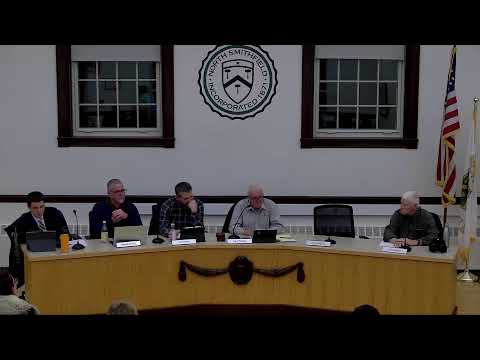
Planning Board Hears Expert Blasting Testimony on Pound Hill Quarry Proposal; Public Hearing Continued to April 10
Summary
The North Smithfield Planning Board continued March 13 consideration of a proposed zoning overlay to allow quarrying at Pound Hill Realty after testimony from the applicant and an industrial seismologist; the board requested additional air‑quality and monitoring reports and set a continuation for April 10, 2025.
The North Smithfield Planning Board continued a March 13 public hearing on a proposed zoning text and map amendment to create a Special Management District (SM‑1) for quarrying and earth removal on property owned by Pound Hill Realty.
Attorney William Landry, representing the applicant, told the board the proposed overlay would create reporting and transparency requirements to the town for blasting, monitoring, dust control and regulatory contacts that are currently handled at the state level. Landry said the applicant has been preparing and will provide additional expert studies, including an air‑quality/particulate testing program and a dust‑mitigation plan.
The hearing included invited expert testimony from industrial seismologist Richard J. Grohl. Grohl said he has monitored blasting at the site since February 2003 and explained common regulatory monitoring practices: he places multiple seismographs (typically no fewer than four) at receptor points, sends blast reports to the State Fire Marshal’s office and to the quarry and contractor, and informs nearby property owners when blasts are planned. Grohl described how each blast consists of timed charges and that a full blast sequence is typically less than half a second in duration. He told the board his monitoring shows the quarry’s recorded peak particle velocities have been well below thresholds associated with structural damage and that an example recorded vibration level was 0.11 inches/second at a nearby test (Western Sand & Gravel) in his report.
Grohl also described air‑overpressure monitoring (a microphone sensor) and said windows are the structure's most vibration‑sensitive component. He explained that the United States Bureau of Mines blast‑damage study commonly used in industry establishes thresholds for different building materials and that blast designs are normally set so predicted vibration at the nearest structure is well under damage thresholds.
Applicant representatives and their experts addressed public concerns about dust, blasting and noise. Landry said the applicant will provide annual transparency reports listing permits, inspections, test results, complaints and responses; he also said additional pending reports (air quality and dust testing) might be available to the board within a few weeks.
Several residents spoke during the public comment period with concerns about early‑morning truck arrivals, dust and visible white clouds after blasts, potential silica exposure and the adequacy of buffers. Resident Rebecca Cristoforo said she routinely felt vibrations before 7 a.m., and requested documentation regarding the composition of the white cloud; Leigh Ann Gillette urged the board to enforce the comprehensive plan and avoid “spot zoning.” Other speakers described wildlife and road‑use concerns and urged preservation of vegetated buffers.
Board members and staff asked the applicant to provide recent test reports and supporting documentation in advance of the next meeting; the applicant agreed to provide a packet of the most recent reports to planning staff for distribution. The board also discussed peer review and the value of an independent technical review; members recommended the council consider independent peer review of scientific reports before any final town decision.
After discussion the board voted unanimously to continue the public hearing to April 10, 2025, to allow the applicant to produce additional expert analyses and for the planning office to receive and circulate the reports. The board noted it is only making a recommendation to the town council; any final decision on an overlay district or ordinance change will be made by the council.