Get Full Government Meeting Transcripts, Videos, & Alerts Forever!
Get email alerts on the Public Health Budget topic
No spam. Unsubscribe anytime.
JFAC recommends $25.08 million in public health enhancements, adds 4 FTE
Summary
The Joint Finance‑Appropriations Committee voted to give a due‑pass recommendation for FY2026 public health enhancements totaling $25,083,000, adding four full‑time positions and funding immunizations, rural physician incentives, home visiting and other programs.
The Joint Finance‑Appropriations Committee voted Wednesday to give a due‑pass recommendation for FY2026 enhancements to the Department of Health and Welfare’s Division of Public Health Services totaling $25,083,000 and four full‑time equivalent positions.
Alex Williamson, a budget policy analyst with the Legislative Services Office, told the committee the division’s request consolidates funding for multiple programs, including immunization services, suicide prevention, drug overdose prevention, Alzheimer’s and dementia services, HIV and hepatitis prevention and several ARPA‑funded grants. “The enhancement requests include program restoration for several public health programs and funding to grow the Idaho immunization program,” Williamson said.
The motion adopted by JFAC moves a package of restoration and one‑time funds (ARPA and communicable disease actions), adds $2,236,300 ongoing from the General Fund and roughly $20.2 million in federal funds, plus dedicated funds for the immunization program. The package also includes a $500,000 ongoing governor’s initiative for the rural physician loan repayment program and a $2.5 million appropriation tied to the immunization assessment fund.
Supporters emphasized local prevention services. Representative Furness, who initially moved a version of the package, said the rural physician incentive “helps pay for loans…up to $25,000 a year over a four‑year period” and cited retention rates among program recipients. Senator Wintrow said the division often serves as the pass‑through applicant for funding to the state’s seven public health districts and stressed that predictable, ongoing funding matters for programs such as home visiting.
Opponents pressed for scrutiny and temporary funding mechanisms. Representative Tanner, who offered the substitute motion that JFAC approved, said moving some items to one‑time appropriations “gives JFAC the ability to go back and look” and conduct a deeper review of multi‑program bundles. Wintrow warned that repeated one‑time designations can undermine long‑term hiring and program planning.
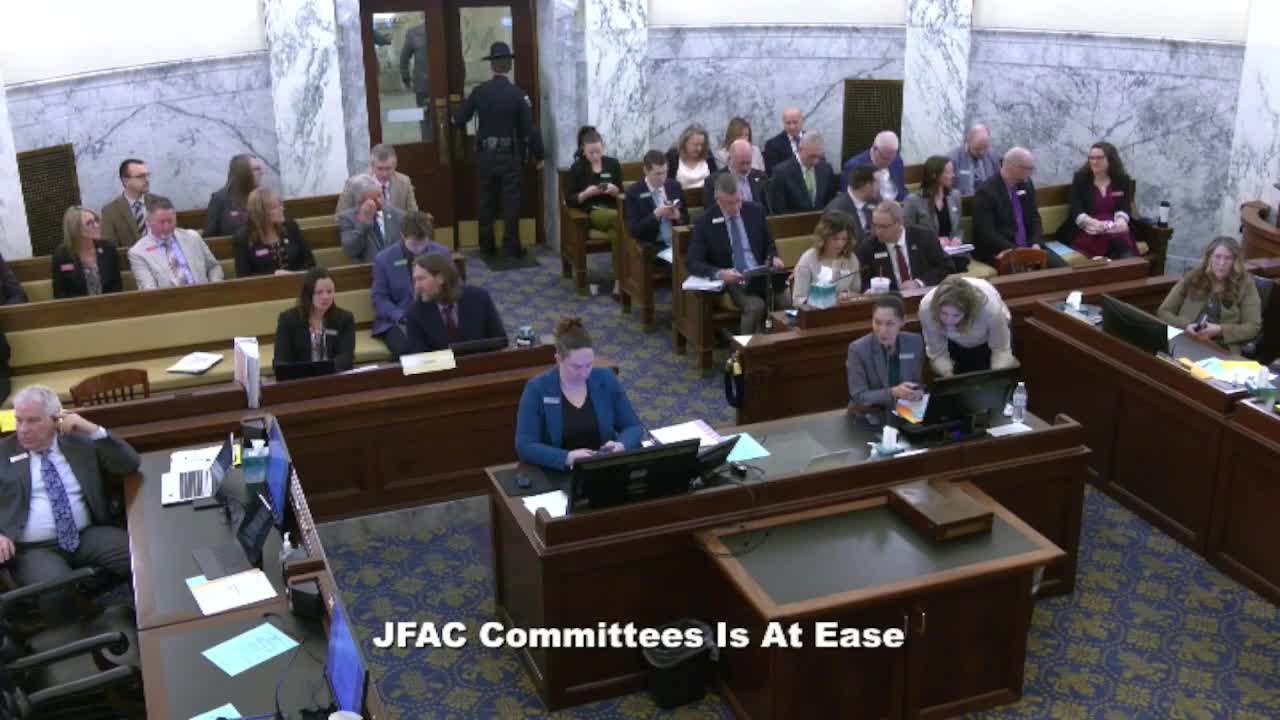
The committee approved the substitute motion (mover: Representative Tanner; second: Senator Zieterville) on a roll call that totaled 14 ayes, 4 nays and 2 absent/excused; JFAC will forward a due‑pass recommendation to the next step in the process.
The packet also included multiple sections of language tied to these appropriations. The committee accepted language requiring the department to notify legislative health committee chairs on federal grant applications, and directed staff to report on program transitions and administrative issues — for example, reviewing transitions of pass‑through clinical service grants to federally qualified health centers and identifying any instances of duplicate billing between federal grants and Medicaid.
What’s next: JFAC’s due‑pass recommendation moves as part of the FY2026 budget cycle; separate statutory or trailer language will accompany any required policy changes.