Get Full Government Meeting Transcripts, Videos, & Alerts Forever!
Get email alerts on the State Legislation topic
No spam. Unsubscribe anytime.
Idaho Senate approves cloud-seeding transparency, corrections funding and multiple bills in March 20 session
Summary
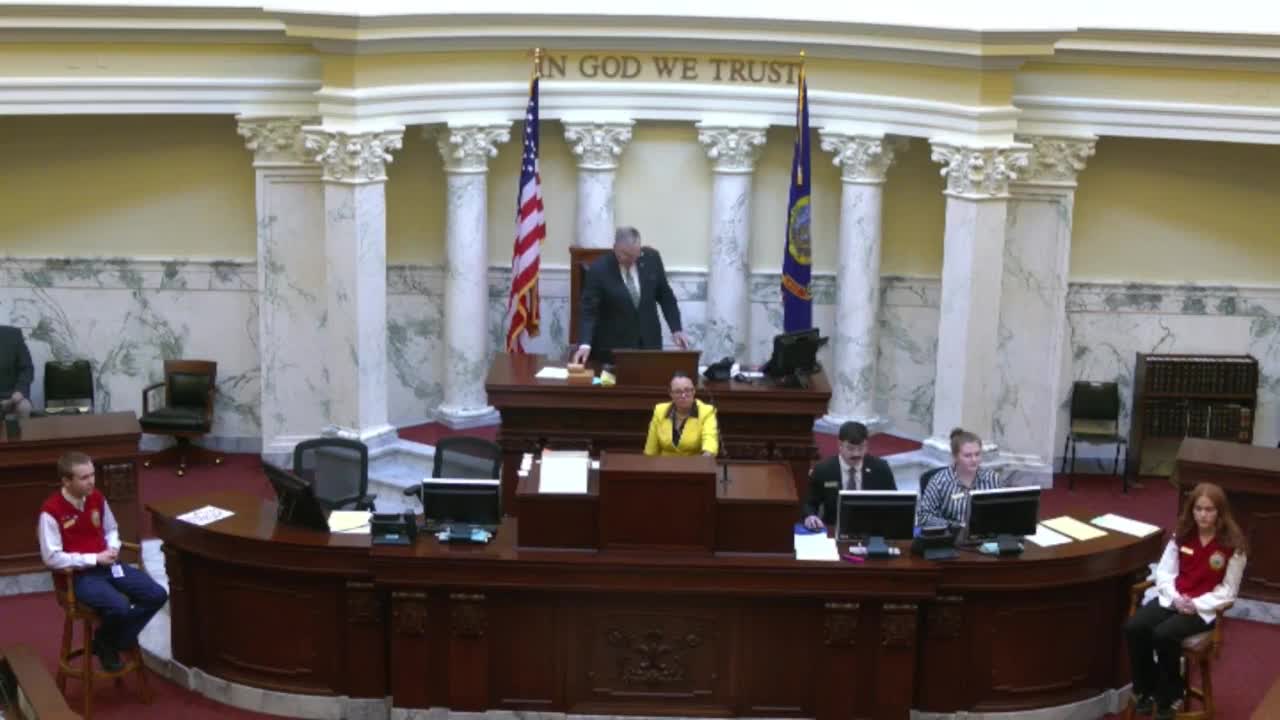
During a March 20 floor session the Idaho Senate passed a package of bills ranging from cloud-seeding transparency and school enrollment rules to corrections funding, building‑inspection reforms and appropriations for licensing and aging services. Several measures passed unanimously; a corrections funding bill passed on a narrower margin.
The Idaho Senate on March 20, 2025, passed a series of bills and resolutions covering cloud‑seeding oversight, school enrollment rules, appropriations for corrections and several administrative and licensing measures, and advanced or returned multiple bills to the House of Representatives.
The measures the Senate approved included Senate Bill 10-64 (cloud seeding), House Bill 2-36 (school attendance/denial), Senate Bill 11-75 (supplemental/appropriation for the Department of Correction), House Bill 2-66 (building inspection reforms), and a slate of other appropriations and technical bills. Several bills passed unanimously or nearly so; the corrections appropriation was approved on a closer, contested vote.
Why it matters: the package addresses public‑facing rules (cloud-seeding reporting), local control and school safety (school enrollment denial provisions), and large budget and public-safety decisions (corrections funding and inspection/ licensing changes). The actions include both policy changes and one‑time or ongoing appropriations that affect state agencies and local providers.
Cloud‑seeding transparency (Senate Bill 10-64)
Senate Bill 10-64, described on the floor as a transparency and reporting bill for Idaho’s cloud‑seeding program, passed the Senate. Sponsor Senator Nichols said the bill “establishes transparency requirements for the cloud seeding program” and requires the Idaho Water Resource Board to publish an annual operational report, align reporting between state‑sponsored and independent operators, and present the report to the board. Nichols told colleagues she worked with stakeholders, including “the power company, the water resource board, [and] Idaho Water Association.” The bill passed by voice/roll call with 34 votes in favor and one absent; the clerk recorded the bill as passed and to be transmitted to the House.
Self‑storage lien notice changes (Senate Bill 11-26)
Senate Bill 11-26, an amendment addressing notice requirements for self‑storage defaults, was brought up for third reading and passed. Sponsor Senator Woodward described the bill as concerning “self storage and the notification requirements, when a person has defaulted on their payments on their self storage unit.” The Senate recorded the vote as 29 in favor, 3 against and 3 absent; the bill was transmitted to the House.
Education: school attendance and disclosure (House Bill 2-36)
House Bill 2-36, carried on the floor as an amendment clarifying school boards’ authority to deny enrollment in narrowly defined and serious circumstances, passed unanimously in the Senate. The sponsor explained the bill updates existing authority to add two specific circumstances, preserves protections for students with disabilities and due process, and does not permit access to court records or require disclosure of low‑level offenses. The Senate vote was recorded as 35 in favor, none against; the bill will be returned to the House.
Appropriations and budgets: corrections, licensing, aging, constitutional officers
Senate Bill 11-75 (Department of Correction appropriation): The Senate considered an enhancement appropriation for the Department of Correction that sponsors said would fund mail‑scanning systems, drone‑detection software, transport safety and training, Recidiviz case‑management software and related items. Sponsors told the chamber that the enhancements respond to new smuggling risks (for example, drones and contaminated mail) and to transport‑safety concerns raised after an incident that injured staff. Debate included concerns about growth in enhancement budgets and comparisons with the private sector; the bill passed by a recorded vote of 18 in favor, 15 opposed and 2 absent.
Senate Bill 11-77 (Division of Occupational and Professional Licenses): This enhancement appropriation was described as funded wholly from dedicated (agency) funds and not using General Fund dollars. The bill includes several items: an ongoing inspector pay increase for building‑construction inspectors, a one‑time vehicle‑replacement allocation, and desktop/hardware replacements recommended by ITS. Sponsors said the measures aim to retain trained inspectors and reduce permit delays. The Senate approved the bill on a voice and roll call with a recorded tally of 24 in favor, 11 against.
Senate Bill 11-78 (Commission on Aging): The Senate approved an enhancement package for the Commission on Aging that included a $500,000 one‑time federal (ARPA) grant distribution to local service providers, and $162,600 ongoing general‑fund support for area agencies on aging. Sponsors characterized the one‑time federal funds as targeted modernization and service grants for local senior centers and aging services, and asked colleagues to vote yes. The Senate recorded 23 in favor and 12 against.
Building inspections and permitting (House Bill 2-66)
House Bill 2-66, amended in the Senate, codifies best practices including live virtual re‑inspections (using video such as Zoom or WhatsApp) and a process allowing a qualified third‑party inspector to perform an inspection and trigger a refund to the permit applicant if an inspection is late. Sponsor Senator Galloway said the change was modeled on an Idaho City practice and is intended to speed approvals and reduce travel and time costs for reinspections. The Senate passed the amendment package and returned the bill to the House with 34 votes in favor and one absent.
Other notable floor actions
- Several bills were returned to the House or transmitted after the Senate recorded passage with unanimous or near‑unanimous votes: House Bill 1-85 (search‑and‑rescue reimbursement increases), House Bill 2-49 (appropriations to constitutional officers), House Bill 2-68 (state employees classification adjustments), House Bill 2-42 (primary care preceptor continuing education credits), House Bill 3-11 (video remote interpreting standards), and more. Where roll‑call tallies were recorded on the transcript, those counts are included in the votes section below.
Votes at a glance (selected bills with recorded outcomes)
- Senate Bill 11-26 (self‑storage notice changes): Passed — yes 29, no 3, absent 3. (Sponsor: Sen. Woodward.) - Senate Bill 10-64 (cloud‑seeding transparency): Passed — yes 34, absent 1. (Sponsor: Sen. Nichols.) - House Bill 2-36 (school attendance/denial): Passed — yes 35, no 0. (Sponsor identified on floor.) - House Bill 1-85 (catastrophic search reimbursement caps increased): Passed — yes 35, no 0. - House Bill 2-82 (homestead exemption revision): Passed — yes 35, no 0. - House Bill 81 (liability limits for recreation clubs): Passed — yes 35, no 0. - House Bill 1-36 (drug pricing reporting / 340B transparency): Passed — yes 32, no 3. - House Bill 2-49 (appropriations to constitutional officers, FY2026): Passed — yes 35, no 0. - House Bill 2-68 (state employee classification adjustments): Passed — yes 35, no 0. - House Bill 1-28 (muzzleloader projectiles / hunting): Passed — yes 28, no 7. - House Bill 2-42 (primary care preceptor CE credits): Passed — yes 35, no 0. - House Bill 3-11 (video remote interpreting registration/licensing): Passed — yes 35, no 0. - Senate Bill 10-21 (juvenile termination procedure amendments, amended in House): Passed — yes 34, absent 1. - House Bill 2-66 (building code / live virtual reinspections): Passed — yes 34, absent 1. - Senate Bill 11-75 (Dept. of Correction appropriation/enhancements): Passed — yes 18, no 15, absent 2. - Senate Bill 11-77 (DOPL appropriation, dedicated funds): Passed — yes 24, no 11. - Senate Bill 11-78 (Commission on Aging enhancements): Passed — yes 23, no 12. - Multiple resolutions and memorials were adopted by voice or unanimous consent, including House Concurrent Resolution 5 (stance regarding federal pardon and state prosecutions), House Joint Memorial 6, House Concurrent Resolution 12 (recognizing Boise State football), Senate Resolution 111, and Senate Concurrent Resolution 112; the clerk recorded adoption for each and they will be transmitted or filed as appropriate.
What legislators emphasized in debate
- Transparency and stakeholder engagement: Senator Nichols framed SB 10-64 as shorthand for bringing cloud‑seeding operations into an annual, public reporting cycle and aligning state and independent operators with federal reporting practices; he named utilities and the Idaho Water Resource Board as stakeholders.
- Public safety and corrections operations: Senators who spoke on SB 11-75 and related amendments described new and evolving contraband threats (for example, drones and contraband concealed in mailed materials), transport‑safety training needs and investments in case‑management software that the Department of Correction said would reduce manual paperwork and improve reentry decisions.
- Process and efficiency in permitting: Sponsors of HB 2-66 argued virtual re‑inspections and clarified reinspection processes would reduce delays in permits and lower costs to builders and governments, while providing quality safeguards (third‑party inspections and partial refunds if timely inspections are not performed).
What the record shows and what it does not
The Senate’s journal shows final passage for the bills listed above and records the vote tallies where a roll call was taken. The transcript captures floor descriptions, sponsor statements, and recorded counts; it does not provide the full engrossed text for each measure, nor does it list every amendment language in full. Where the transcript reported stakeholder names, vote tallies and dollar figures those are reflected above; if the transcript did not include a count for a measure the votes are reported as recorded on the floor (for example, “passed” with no roll‑call tally printed). The Senate journal and enrolled bills will be the official source for final statutory language and scheduling.
Next steps and scheduling
The Senate adjourned the March 20 session and announced it would reconvene at 10:00 a.m. on the next scheduled session day. Measures that passed will be transmitted to the House or enrolled and sent to the governor as noted by the clerk on the floor.
Ending
The floor session on March 20 covered a wide range of technical and budgetary matters. Several bills focused on transparency and modernizing agency practices (cloud‑seeding, 340B drug reporting, video interpreting), while the appropriations reflected both immediate public‑safety priorities and investments in agency capacity to deliver services.