Get Full Government Meeting Transcripts, Videos, & Alerts Forever!
Get email alerts on the Vehicle Safety Airbags topic
No spam. Unsubscribe anytime.
Committee presses sponsors on scope, rural impacts of bill criminalizing counterfeit or nonfunctioning airbags
Summary
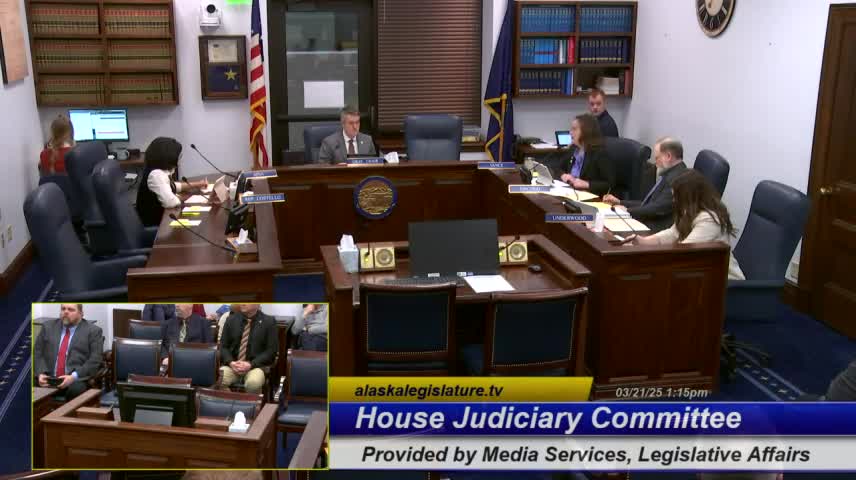
The Alaska House Judiciary Committee took testimony Friday on House Bill 74, a proposal to criminalize the manufacture, sale or installation of counterfeit or nonfunctioning airbags. Committee members pressed sponsors and witnesses on the bill’s definition of “nonfunctioning,” rural repair access and an insurance carve-out.
The Alaska House Judiciary Committee took testimony Friday on House Bill 74, a proposal to criminalize the manufacture, sale or installation of counterfeit or nonfunctioning airbags. Committee members pressed sponsors and witnesses on the bill’s narrow definition of “nonfunctioning,” whether recalled original equipment would be covered, and how the measure would affect rural Alaskans who have limited access to dealers and repairs. The committee postponed amendment work to a later date.
Legislative Legal Services attorney Claire Radford told the committee that Alaska currently has no statute specifically addressing airbags and that whether existing crimes could apply would be “fact specific.” Radford summarized the bill’s draft definition of nonfunctioning airbags: the term covers a replacement airbag that is inoperable, damaged or recalled, “has previously been deployed,” causes the vehicle diagnostic system to inaccurately indicate a functioning airbag, or results in an electrical fault detected after installation. Radford also said that, as drafted, a private person could legally sell a vehicle with a nonfunctioning airbag only if the seller lacked knowledge that the airbag was nonfunctioning.
Craig Orlan, representing American Honda Motor Company, described the bill as narrowly focused on replacement airbags and counterfeit parts, which he said are used by a small number of bad actors to install unsafe airbags filled with debris such as styrofoam or clothing. “This bill was always designed to be fairly narrow in scope,” Orlan said, adding the goal is to let customs and law enforcement intercept counterfeit airbags at the border and to prosecute knowingly fraudulent sellers and installers. Orlan said automakers have worked on similar measures in about 37 states and that prosecutions have been relatively rare.
Committee members repeatedly asked whether the bill would criminalize selling a vehicle with an airbag that had previously deployed. Radford said the draft language could be read to cover previously deployed replacement airbags; she also acknowledged a possible conflict in how the definition applies when a previously deployed airbag has been removed from the vehicle. Representative Gray said those ambiguities and other unanswered legal questions were the reason the committee would not consider amendments today and would invite Department of Law to assist at a later hearing.
Randy Mayhew, manager of Chaz Limited Auto Body in Fairbanks, told the panel his shop obtains replacement airbags from dealerships and replaces airbags about one to two times per month. Mayhew said reputable shops generally use OEM parts, and that handling airbags requires trained technicians because of safety and deployment risks.
Jennifer Muse, state counsel for State Farm, described an insurance-industry carve-out in the bill that would protect insurers when they take possession of vehicles declared total losses and sell them with junk titles under existing Alaska regulations. Muse cited Alaska regulation 2 AAC 92.170 as governing the insurance transaction and said the carve-out aims to prevent insureds or insurers who legitimately transfer junked vehicles from facing criminal liability.
Committee members raised Alaska-specific concerns: Representative Gray and others noted that many Alaskans live in communities without dealers or repair shops, and asked how those residents could comply with recalls and replacement requirements. Honda’s representative said the company had made repair efforts during the Takata recall and is willing to coordinate with dealers and customers, but committee members stressed the logistical and cost challenges of replacing airbags in remote communities.
After questioning witnesses, the committee closed the hearing on House Bill 74 and postponed amendment consideration until Legislative Legal Services, the Department of Law and additional stakeholders can clarify definitions and enforcement implications.