Get Full Government Meeting Transcripts, Videos, & Alerts Forever!
Get email alerts on the K 12 Education topic
No spam. Unsubscribe anytime.
House panel advances bill to let districts list voluntary chaplains after heated debate
Summary
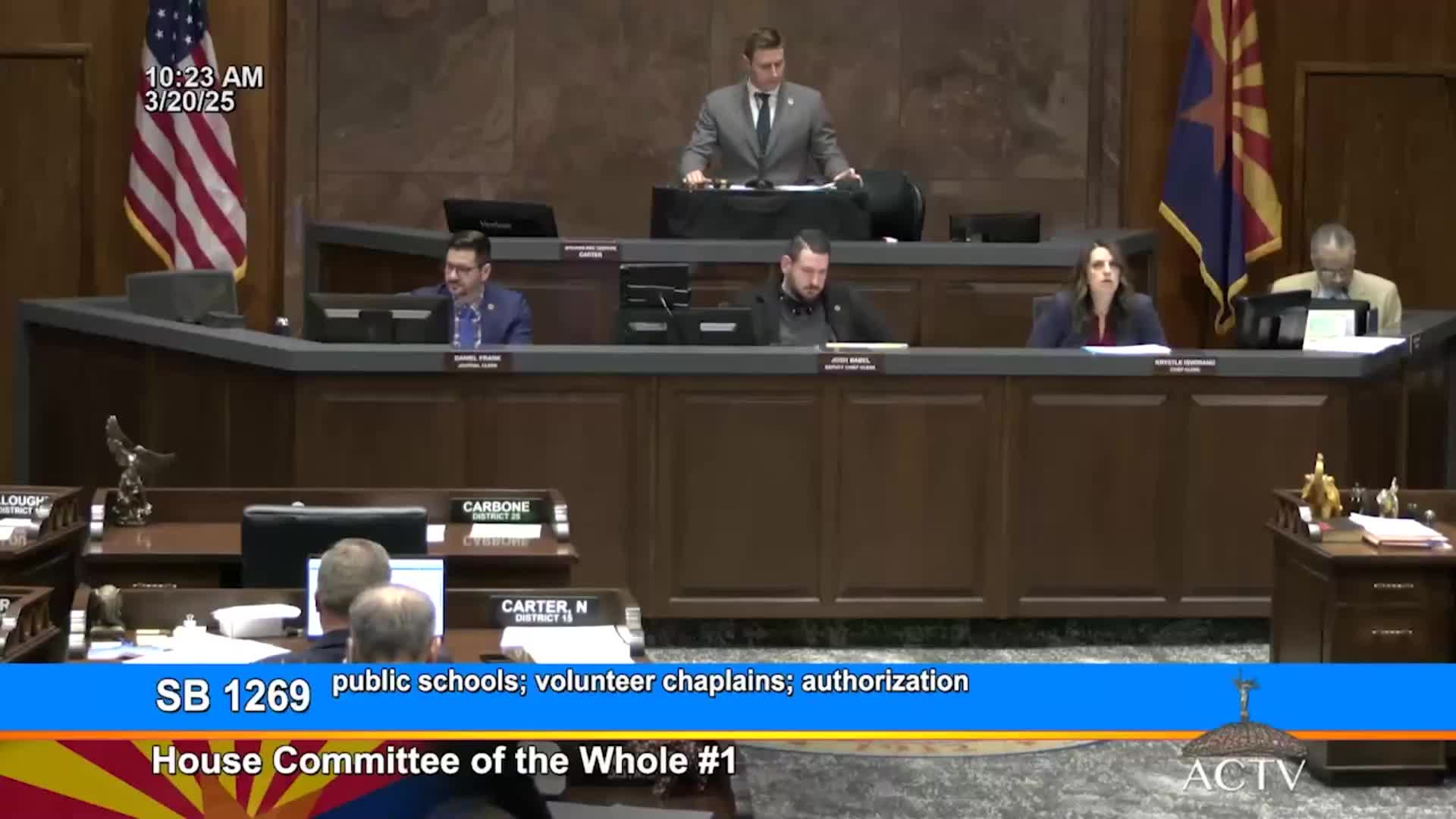
The Arizona House Committee of the Whole voted March 20 to advance Senate Bill 12-69 as amended, a measure that would let school districts post voluntary lists of qualified chaplains for students with parental consent.
The Arizona House Committee of the Whole on March 20, 2025, gave Senate Bill 12-69 a do-pass recommendation as amended, advancing a proposal that would let school districts maintain voluntary lists of chaplains available to students on an opt-in basis.
Supporters said the measure would add an extra, voluntary source of trusted adults for students who seek faith-based guidance. Representative Ben Gress, sponsor of the House motion, said, "This bill says that voluntary chaplains can be put on a list, reviewed by the school district, reviewed by the principal, and meeting certain requirements around, your training and your time in the community leading a community of faith, that can be made available to students, who on a voluntary basis can say, I would like to talk to a chaplain." He added the bill "prohibits any proselytizing. This bill only allows for trusted adults trained in spiritual practices to be there available for our students."
Opponents raised constitutional and training concerns. Representative Symicek argued, "Courts have repeatedly ruled that it is unconstitutional for public schools to invite religious leaders to engage in religious activities with students and to promote religious indoctrination of students. It violates the First Amendment Establishment Clause by giving preferential treatment to people of faith over those who have none." Representative Symicek also said chaplains lack the specialized training of school psychologists and social workers and warned the measure could invite litigation.
Several lawmakers described personal experiences on both sides. Representative Pamela Carter, who identified herself as an ordained chaplain, told the House that faith mentors helped her in high school: "Young Life literally saved my life." Representative Santos, who said she has friends who are chaplains, cautioned they are not substitutes for social workers: "They are not trained to take the jobs of social workers, psychologists, and counselors, and our public schools." Representative Taylor and others emphasized safeguards added in the committee amendment, including written parental consent and a prohibition on proselytizing.
The committee amendment added explicit qualifications and parameters for inclusion on the voluntary list and directed that districts review applicants; proponents said the language mirrors other public chaplaincy programs. Representative Gress told colleagues the list would be voluntary for both chaplains and students and that parents would be asked to provide written consent before a student could meet with a chaplain.
The bill drew sustained floor debate that split members across concerns about the Establishment Clause, parental rights, counselor training, and student access to supports. After debate, the Committee of the Whole adopted the amendment and reported Senate Bill 12-69 as amended with a do-pass recommendation. The committee chair announced the bill was referred to engrossing for further floor consideration.
The measure now moves to the next steps of the legislative calendar; the House must consider the engrossed bill on a future reading and vote. No final determination on third read or final passage by the full House is recorded in the committee debate transcript excerpt.