Get Full Government Meeting Transcripts, Videos, & Alerts Forever!
Get email alerts on the Human Trafficking topic
No spam. Unsubscribe anytime.
Public testimony splits over bill to create Alaska council on human trafficking
Summary
The House Judiciary Committee heard public testimony for and against House Bill 118, which would establish a statutory council on human trafficking. Supporters said the council would centralize expertise; opponents said the council could be unaccountable and exclude survivors and labor voices. The committee set the bill aside for future action.
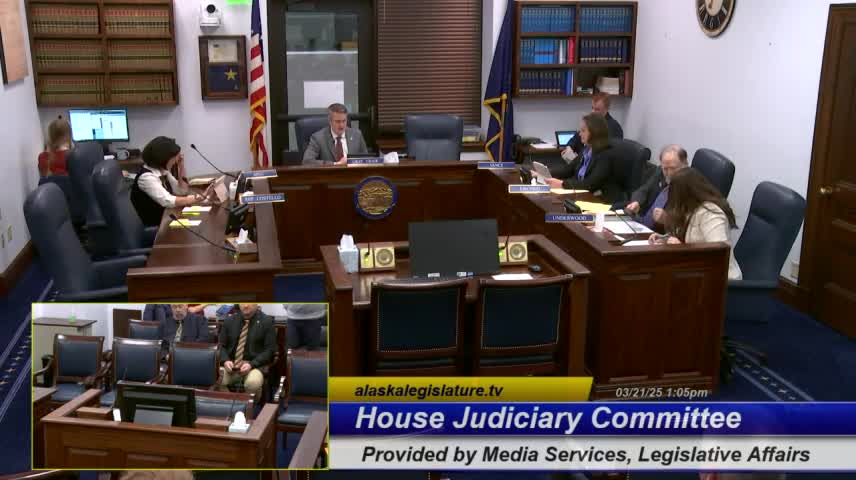
The Alaska House Judiciary Committee heard public testimony on Friday on House Bill 118, a bill to create a statutory Council on Human and Sex Trafficking, with witnesses offering both support and opposition before the committee set the bill aside for consideration at a later date.
Supporters said the council would centralize expertise and attention on trafficking. Brenda Stanfield, executive director of the Alaska Network on Domestic Violence and Sexual Assault, told the committee she had worked on the council’s strategic plan and supported creating a standalone council "because these are correlated as we know a lot of our social issues are, but also very separate." Stanfield said she stepped away from the planning process only because the work required more time than she could give.
Other witnesses urged changes to ensure the council addresses labor trafficking and includes labor representation. Chris Diamond, lead representative for the Western States Regional Council of Carpenters in Alaska, told the committee, “labor needs to be included in the discussion” and asked the sponsor to add two seats for labor representatives to help the council identify on-site indicators of trafficking in construction and other industries.
Opponents said the council could entrench misleading narratives and exclude people it claims to represent. Maxine Dugan, with Community United for Safety and Protection, said her group opposed the bill both this year and last, arguing the council’s membership has been “handpicked to promote false and misleading narratives” and that members with organizational affiliations could have conflicts of interest that would distort resource allocation.
Sponsor Representative Vance responded to questions after testimony, saying labor trafficking is included in the bill’s definition of human trafficking and that the measure names a Department of Labor representative so the council will not exclude labor-related cases. Vance also noted the bill authorizes the governor to appoint public members, allows for quarterly meetings, and makes the council subject to the Open Meetings Act, which he said would allow public participation.
The committee closed public testimony and “set aside” House Bill 118 for future action; no amendments or votes were taken during the hearing.
The committee’s next steps, according to the chair, will include scheduling follow-up work when committee members have had an opportunity to review additional materials and stakeholder concerns.