Get Full Government Meeting Transcripts, Videos, & Alerts Forever!
Get email alerts on the School Construction Major Maintenance topic
No spam. Unsubscribe anytime.
Lawmakers hear that Alaska school buildings face large deferred‑maintenance backlog; DEED outlines grant rules and appeals process
Summary
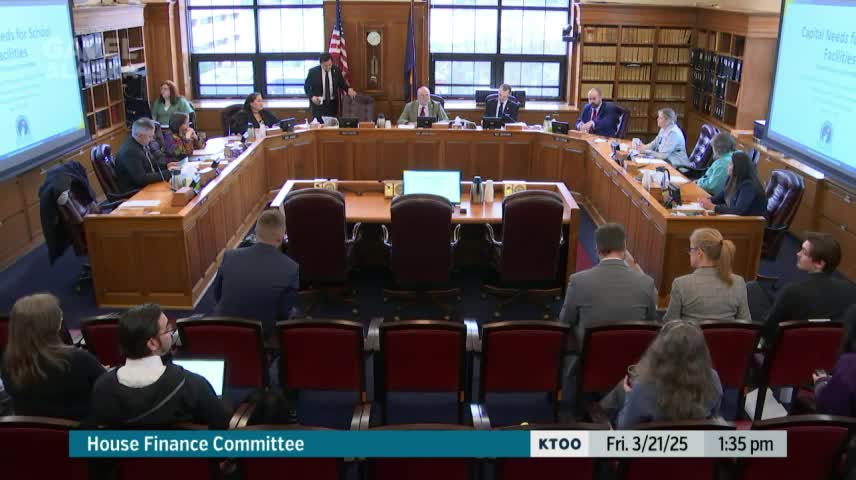
At a March 21 House Finance Committee hearing, the Department of Education and Early Development described how school construction and major‑maintenance grants are allocated under AS 14.11, while administrators and superintendents urged restoring bond debt reimbursement and more state support to address a multi‑hundred‑million‑dollar backlog.
Juneau — At a March 21 meeting of the Alaska House Finance Committee, the state Department of Education and Early Development (DEED) detailed the statutory grant programs and ranking process used to fund school construction and major maintenance, while school administrators and district superintendents testified that years of limited capital investment and staff reductions have left hundreds of millions of dollars in deferred maintenance and dozens of schools in poor repair.
DEED staff described how the department implements the statutory funding framework in Title 14, chapter 11 (AS 14.11), including two primary grant funds — the School Construction Grant Fund (established 1990) and the Major Maintenance Grant Fund (established 1993) — and the Regional Educational Attendance Area (REAA) and Small Municipal School District Fund, created in 2010 after a court settlement to improve capital funding equity. DEED staff said the REAA fund capitalization and operating budget for the current year is about $22,900,000 and that the debt‑reimbursement program has been under a moratorium since 2015.
Why it matters: District witnesses and the Alaska Council of School Administrators told the committee that deteriorating roofs, failing boilers, mold, and seismic and erosion risks in some communities are affecting student safety, learning conditions and teacher retention. Districts and the Council urged the legislature to reinstate school bond debt reimbursement and increase ongoing capital support.
Key elements of DEED’s presentation
DEED said projects funded under AS 14.11 must come from one of six statute‑defined categories and that districts must meet eligibility rules, including a six‑year capital improvement plan, a functioning asset inventory, proof of property insurance, and a certified preventative maintenance and facility management program. DEED explained that districts must share in project costs: REAAs have a 2% participating share and municipal school districts have a larger local share that DEED summarized as a range (transcript: "between 5–35%" per district type).
DEED outlined the application calendar and review steps: districts file CIP grant applications by Sept. 1; DEED reviews and ranks applications and publishes an initial ranking list in early November; districts may seek reconsideration from DEED, and if dissatisfied may appeal to an administrative hearing officer and ultimately to the superior court. DEED cited Kivalina’s recent appeal as an example: the district submitted a roughly $100 million project, DEED reduced the funded scope to about $43 million, an appeal was filed, and a subsequent hearing resulted in roughly $50 million being allowed for the project.
DEED noted two ways the state has historically authorized debt reimbursement: by setting reimbursement rates (historically authorized rates of 60–70% before the 2015 moratorium) and by setting population‑based project allocation caps (used primarily between 1990 and 2006). DEED told the committee that new reimbursement rates are set to take effect July 1, 2025, and described those rates verbally as 40–50% (as stated to the committee).
District capacity and DEED assistance
Committee members pressed DEED on how districts with limited staff or technical resources can complete applications. DEED staff said professional engineers or architects are not explicitly required for every application if district staff have sufficient qualifications and can document conditions; DEED provides templates, a condition survey, a cost‑estimating tool, annual training, and planned monthly Q&A sessions to help districts prepare applications. DEED also said it compiles districts’ six‑year plans into statewide snapshots of need but cautioned that not all districts submit plans each year.
Funding and backlog figures presented
DEED said the FY26 major maintenance list totals more than $330,000,000 in projects listed by districts; department materials cited nearly $1.8 billion in six‑year plan requests from districts that submitted (DEED said that figure represents about 60% of districts). DEED also reported that in the most recent decade the department received an average of about 117 applications per year and funded roughly 16% of requests; by contrast, DEED said the program funded about 25% of requests in an earlier decade.
Administrator and district testimony
Lisa Paradis, executive director of the Alaska Council of School Administrators, told the committee that many districts — particularly REAAs and other rural districts — face high application costs and lack in‑house capacity to prepare competitive project submissions. Paradis said some districts pay outside firms tens of thousands of dollars just to prepare an application and that an incomplete picture of need exists because roughly 40% of districts did not submit six‑year plans in the most recent cycle. "Students are going to buildings that are partially condemned, that have leaky roofs, black mold," Paradis said.
Superintendents and district operations officials described condition‑specific and region‑specific challenges. A speaker identifying himself as superintendent Andrew Anderson (listed in the meeting as superintendent of a rural district) said his district has more than 130 buildings, roughly a billion dollars in replacement‑cost assets, and a deferred‑maintenance estimate of about $314,000,000; he described accelerating riverbank erosion that has forced school demolition and resettlement work in villages including Newtok and the resettlement site (discussed during testimony). Andy DeGraw, chief operations officer for Fairbanks North Star Borough School District, testified that his district’s deferred maintenance is about $367,000,000 and described widespread original‑system boilers, lost preventative‑maintenance capacity after staff cuts, and multiple emergency mechanical failures. Juneau School District Superintendent Frank Hauser said Juneau’s maintenance backlog exceeds $7.5 million, that three schools were closed in FY25 as part of consolidation, and urged reinstating bond debt reimbursement to help fund large projects.
Requests and proposals
Witnesses urged the committee to restore the bond debt reimbursement program, increase annual funding for major maintenance, and provide technical support (engineering and architectural services or grant‑writing assistance) to districts that cannot afford professional consultants. The Alaska Council of School Administrators asked the committee to reject any continued moratorium on debt reimbursement and to consider changes to DEED’s application process that would reduce upfront costs for small and rural districts.
Committee administrative action
At the close of the hearing the committee chair set an amendment filing deadline for the operating and mental‑health budgets under the committee’s work drafts (bills cited in the record as House Bill 53 and House Bill 55) and instructed members to file amendments through the legislative amendment system by the deadline announced to the committee (the chair announced a Tuesday at 5 p.m. deadline in the hearing record; the transcript did not include a full calendar date).