Get Full Government Meeting Transcripts, Videos, & Alerts Forever!
Get email alerts on the Public Pensions topic
No spam. Unsubscribe anytime.
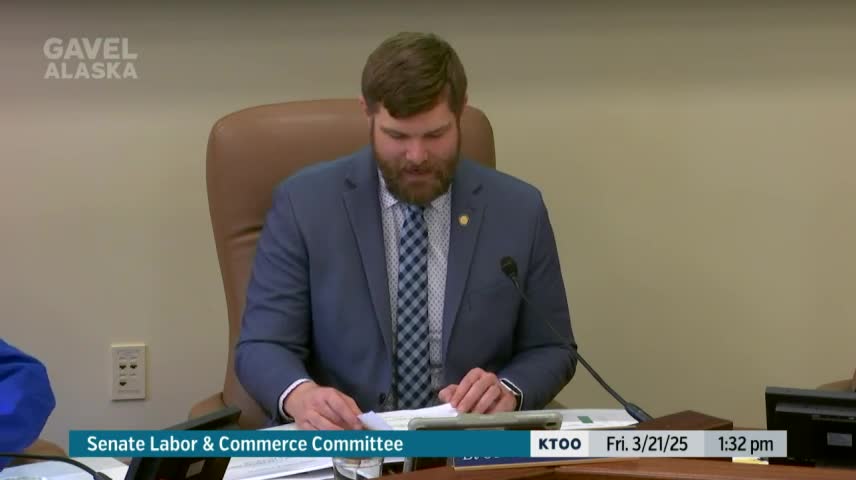
Senate committee hears proposal to create shared‑risk pension to bolster Alaska public workforce
Summary
Senator Kathy Giesel, sponsor of Senate Bill 28, told the Senate Labor and Commerce Committee on March 21 that the bill would create a new shared‑risk defined benefit retirement option to address workforce shortages across Alaska state and local government.
Juneau — Senator Kathy Giesel, sponsor of Senate Bill 28, told the Senate Labor and Commerce Committee on March 21 that the bill would create a new shared‑risk defined benefit retirement option to address workforce shortages across Alaska state and local government.
Giesel said the proposed plan, developed over more than a decade with stakeholders, is intended to improve recruitment and retention for positions such as teachers, public defenders and long‑term care staff and to reduce reliance on unsustainable hiring bonuses.
The bill would start employee contributions at 8% of wages and keep employer contribution floors at current levels (22% for most public employees and about 12.56% for teachers). The Alaska Retirement Management Board (ARM board) would be empowered to adjust contribution rates if the fund falls below a 90% funding target, Giesel said. The proposal includes separate accounting and subtrusts for the new plan, a health reimbursement arrangement (HRA) funded solely by employers at roughly 3% of wages, and disability and death benefits including a 40% gross‑monthly compensation benefit for occupational death or disability.
"This is a shared risk public employee retirement plan," Giesel said during her presentation. She argued that pooled, professionally managed benefits provide higher salary‑replacement rates than defined contribution accounts, citing division of retirement and benefits and actuary data showing lower replacement for many defined contribution participants.
Giesel reviewed the plan's eligibility and benefit formulas: vesting at five years for both teachers and other public employees; retirement eligibility for regular PERS and teachers at age 60 or 30 years of service; and earlier retirements for some public safety employees — for example, age 50 with 25 years of service or age 55 with 20 years of service depending on role. Benefit multipliers would mirror earlier defined‑benefit tiers: public safety would begin at 2.0% of final salary for the first 10 years and rise to 2.5% thereafter; regular PERS and teachers would use a 2.0%/2.25%/2.5% stepped formula with highest‑five‑year salary for public safety and highest five nonconsecutive contract years for teachers.
Giesel warned the plan would not include an automatic cost‑of‑living adjustment (COLA). Instead, a post‑retirement pension adjustment ("PURPA" in the bill) would permit the ARM board to adjust inflation protections based on funding status; nonresident retirees would receive 50% of that adjustment under the proposal.
Giesel recounted the history that led Alaska away from a fully funded defined‑benefit system, saying errors by a then‑actuary, Mercer, in the early 2000s caused a precipitous funding decline and subsequent litigation. "We did actually sue Mercer over that error," she said, adding that the state recovered only a small amount relative to the losses. She said the state now uses Gallagher as its actuary and that the ARM board obtains independent actuarial review on a regular schedule to guard against repeat errors.
Giesel also cited data reported to the ARM board showing recent, large withdrawals from defined contribution accounts: over roughly seven months, about $105,000,000 was withdrawn, with roughly $70.6 million from PERS and $32 million from TERS, and 90% of withdrawals occurring at five‑year vesting. She said those withdrawals indicate employees are leaving public service after achieving vesting.
On cost, Giesel presented fiscal analyses from multiple actuaries and consultants and noted differing assumptions about retention. She said Pension Trust Advisors and other fiscal notes show higher near‑term costs driven primarily by payroll (retained, higher‑paid employees). She also cited an academic estimate that restoring a defined‑benefit option could yield savings from reduced recruiting and turnover, while stressing the bill includes multiple safeguards and contribution adjustments to protect employers and the fund.
Committee members asked technical questions about assumed investment returns. Senator Yount asked whether the defined‑benefit projection used the same assumed rate of return as the defined‑contribution comparison; Giesel said the ARM board sets the benefit plan target and that she believed it was about 7.5%.
There was no formal committee vote on SB 28 during the March 21 hearing. The presentation closed after committee questions and the sponsor directed members to a packet of slides and an index to help navigate the proposed 50‑plus page statute text.
The committee did not act on the bill; no motion or vote was recorded during the hearing.
What happens next: SB 28 remains before the Senate Labor and Commerce Committee for further consideration; the sponsor and agency materials are part of the committee packet for follow‑up review.
Speakers: Senator Kathy Giesel, sponsor; Senator Bjorkman (chair); Senator Yount; Senator Young; Intimio Harbison (staff).