Get Full Government Meeting Transcripts, Videos, & Alerts Forever!
Get email alerts on the Public Safety Workforce topic
No spam. Unsubscribe anytime.
Senate committee considers $3.5 million ‘Back the Blue’ continuation to aid recruitment and retention of local officers
Summary
Members heard testimony supporting continuation of a $3.5 million appropriation for recruitment and retention grants to local law enforcement and regional correctional facilities; supporters said the program helps keep officers in rural communities, while some senators asked about program design, matching funds and measurable retention outcomes.
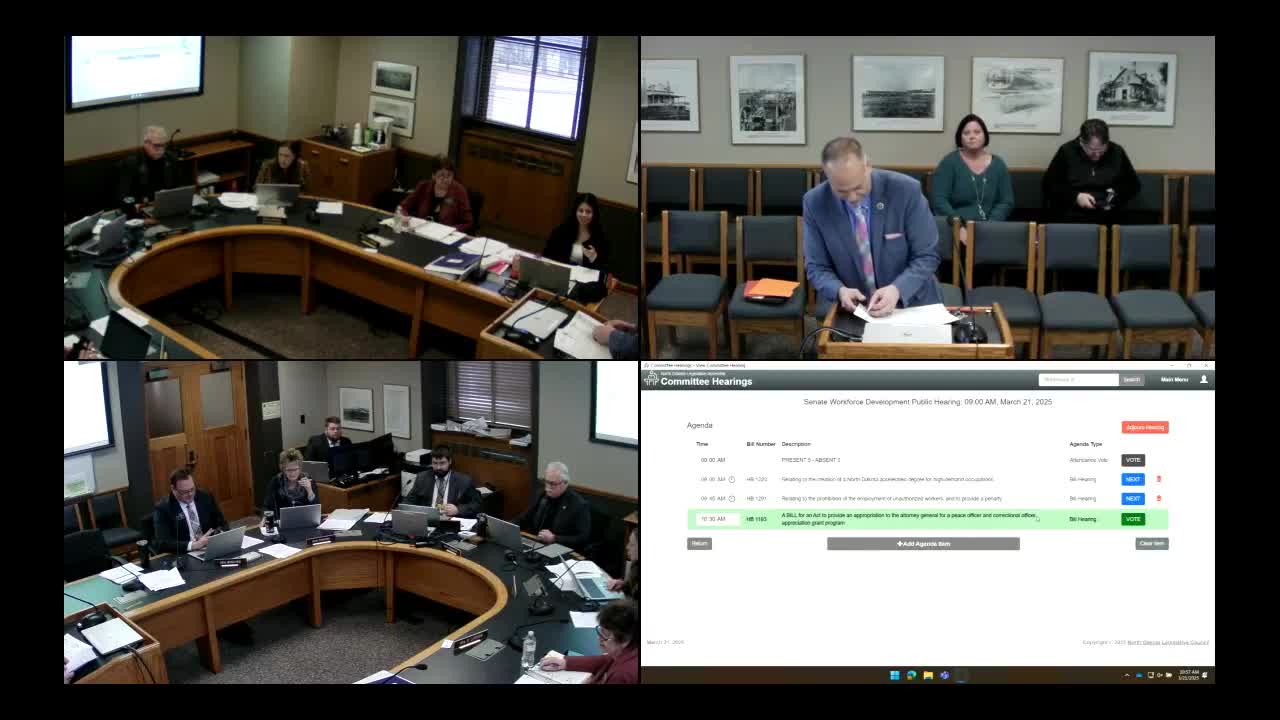
The Senate Workforce Development Committee heard testimony on House Bill 1193, a $3.5 million appropriation to continue a grant program that distributes funds to local law enforcement and county correctional facilities for recruitment, retention and training.
Representative Steve Vetter, sponsor of the measure, said his preferred amendment would focus on retention by providing higher, targeted bonuses to officers who remain at the same agency for four years or more. "Our good and experienced police know their neighborhoods and know who the bad guys are," Vetter said, arguing a retention‑focused pilot for smaller agencies would prevent poaching and preserve community policing.
County and local law enforcement representatives told the committee the program had been useful. Danelle Presky, executive director of the North Dakota Association of Counties and executive director of the North Dakota Sheriffs and Deputies Association, said a recent survey of participating counties found the prior Back the Blue grants went to 2,197 officers and that 70 percent of responding agencies rated the program’s effectiveness at a 7 or higher on a 10‑point scale. She said 93 percent of respondents used funds for retention; some counties supplemented grant money with local funds to increase incentive amounts.
John Nelson, who sits on Appropriations and represents Rugby, said the program helps counties that are housing state‑sentenced inmates under contract and struggling to attract correctional staff in rural areas. Chiefs and sheriffs told the committee they used the flexibility in the earlier grants for a mix of recruitment and retention efforts and that smaller departments found the extra per‑officer dollars especially meaningful.
Questions from senators focused on program design: whether local matching should be required; the choice between an across‑the‑board appreciation payment versus targeted retention bonuses; and how to measure whether the money produced lasting retention rather than short‑term boosts. Representative Vetter said he favors a pilot targeting smaller agencies within the existing $3.5 million appropriation and suggested the program could be expanded if metrics showed the approach preserved staffing and reduced downstream criminal‑justice costs.
The Office of the Attorney General’s finance director told the committee the current bill mirrors last session’s appropriation and raised an administrative concern: if the sponsor’s amendment created multi‑year payout obligations, the AG’s office would need to model year‑by‑year distributions carefully to avoid underspending in a later year.
No committee vote was recorded in the hearing transcript. The hearing record shows broad local law enforcement support for continued state assistance, with questions remaining about whether to prioritize retention bonuses, require local matching, or keep the simpler per‑officer distributions used in the prior program.