Get Full Government Meeting Transcripts, Videos, & Alerts Forever!
Get email alerts on the Immigration Enforcement topic
No spam. Unsubscribe anytime.
Immigration enforcement bill prompts legal and practical concerns; committee to study next steps
Summary
House Bill 1291, proposing penalties for employment of unauthorized workers, prompted lawyers and immigration experts to warn the Senate Workforce Development Committee that state enforcement would be largely preempted by federal law and could impose heavy costs and legal exposure; sponsor said he intends to turn the measure into a study.
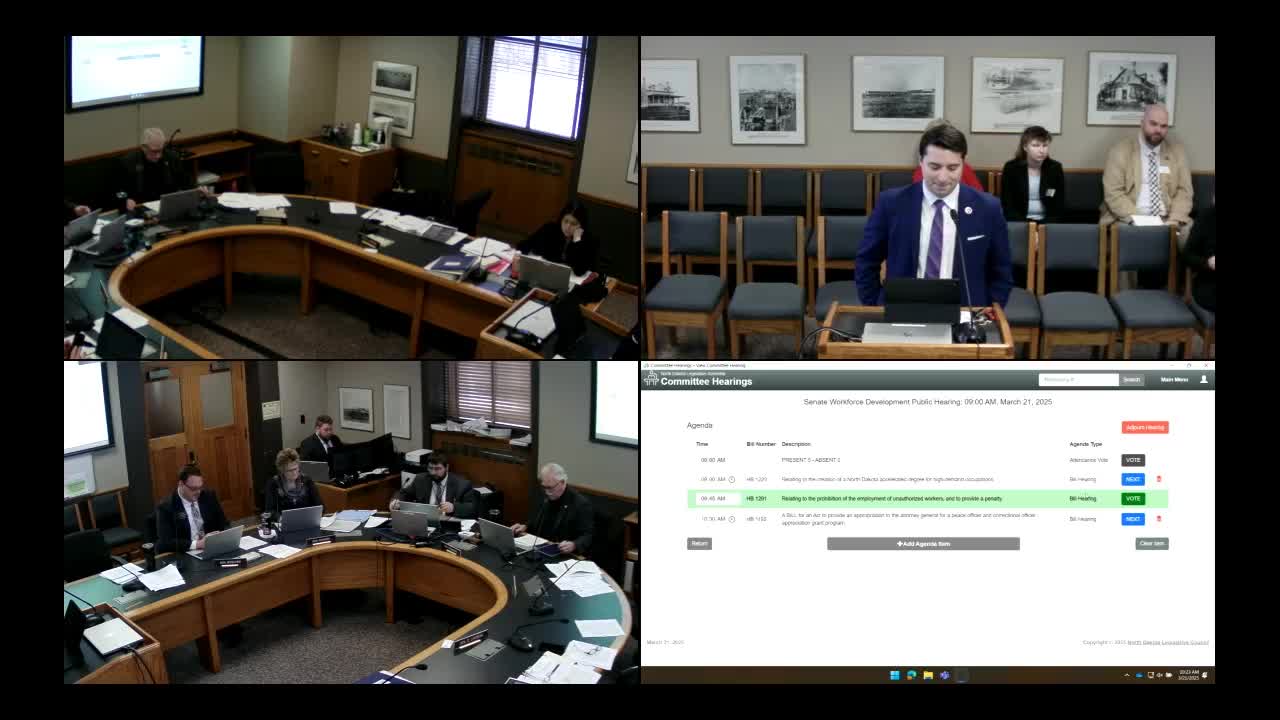
Senate lawmakers opened a hearing on House Bill 1291, which would prohibit employment of unauthorized workers and impose penalties, and quickly heard legal warnings that much of the proposal would be preempted by federal immigration law.
Representative Matt Heilman, sponsor of the bill, said he met with the attorney general and secretary of state and plans to convert the measure into a study to resolve complex logistical and legal questions. "There’s just a lot of logistical questions that need to be answered," Heilman said.
Immigration attorneys who testified said federal I‑9 enforcement, national case law and administrative processes limit what a state may do. Sue Swanson, an immigration attorney from Grand Forks, told the committee that I‑9 auditing and enforcement are federal processes typically handled by ICE, the Department of Justice’s Office of the Principal Legal Advisor and federal administrative law judges. "The state cannot conduct a state investigation without the federal," Swanson said, warning that a state enforcement scheme would require hiring auditors and lawyers and could expose the state to litigation should the state itself become a defendant.
Anna Marie Stinson, also an attorney with immigration practice experience, warned that the bill would send a countervailing message to workers and employers at a time when North Dakota is recruiting legally authorized workers under special programs. She said the bill appears vulnerable to federal preemption under the Immigration and Nationality Act and noted the Supreme Court decision in Chamber of Commerce v. Whiting (2011) limits state authority to sanction employers except through licensing schemes.
Witnesses highlighted additional practical issues: errors are common on I‑9 forms even for compliant employers; federal I‑9 investigations can be resource‑intensive, and settlements and litigation costs can be high. Swanson described scenarios in which an employee’s work authorization changes after hire and said strict liability elements of I‑9 compliance can expose employers to heavy penalties even when they initially acted in good faith.
The sponsor told the committee he had no intention of rushing enforcement language and would work with the attorney general and secretary of state to craft study language; he asked for committee feedback on the scope of that study. After testimony, the committee closed the hearing on HB 1291; the sponsor said he would circulate amendment language for a study and continue discussions with the AG’s office and other stakeholders.
No formal committee vote or new statutory language was adopted during the hearing; legal witnesses urged caution, recommended consulting federal authorities, and flagged potential costs and civil‑rights and discrimination risks if a state enforcement mechanism were adopted.