Get Full Government Meeting Transcripts, Videos, & Alerts Forever!
Get email alerts on the Higher Education Workforce topic
No spam. Unsubscribe anytime.
Senate committee hears divided testimony on bill to allow ‘compressed’ degrees for high‑demand jobs
Summary
Lawmakers and stakeholders debated House Bill 1220, which would allow optional reduced‑credit bachelor’s programs for designated high‑demand occupations; supporters said it could speed workforce entry and reduce student debt, while educators, licensing boards and unions warned of licensure, accreditation and quality risks.
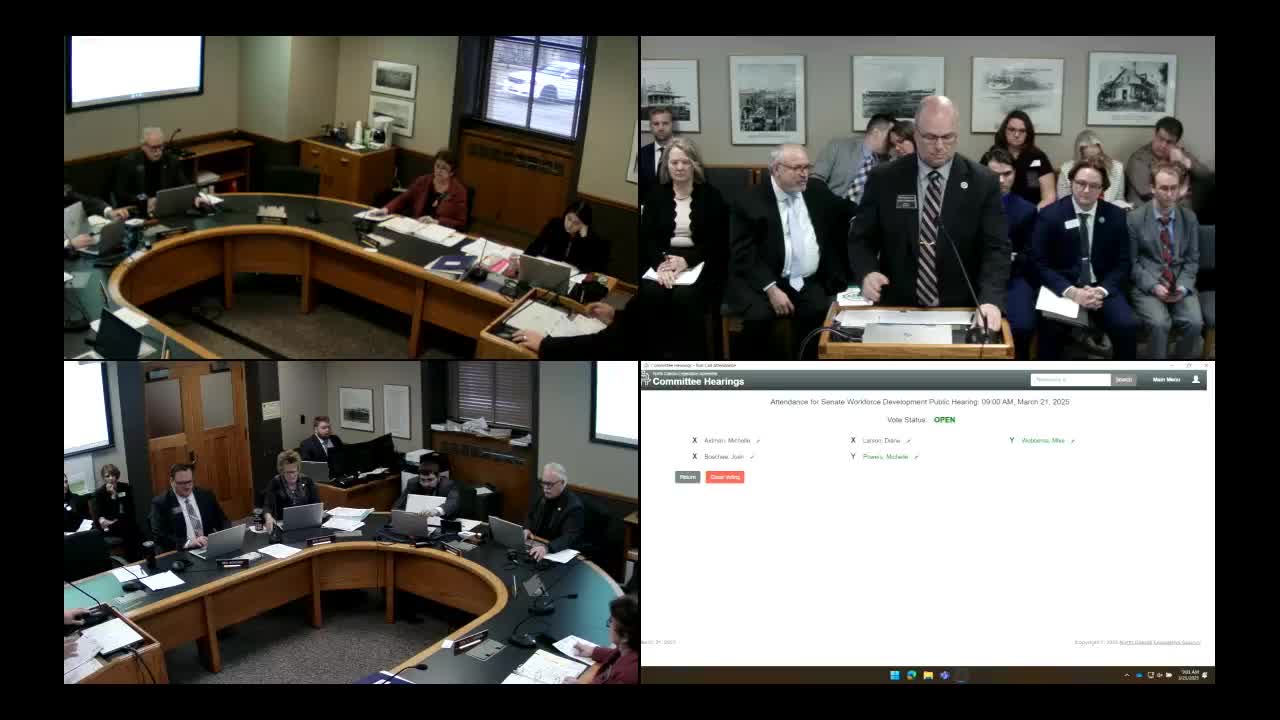
House Bill 1220, which would let colleges offer optional “compressed” bachelor’s degrees for designated high‑demand occupations, drew lengthy testimony and sharply divided views at a Senate Workforce Development Committee hearing.
Proponents, including the bill sponsor Representative Mike Machenbacher, the Greater North Dakota Chamber and the North Dakota Long Term Care Association, said the proposal would let industry, colleges and licensing boards jointly design narrower degree pathways to get graduates into jobs faster and with less debt. "This is completely optional," Machenbacher said, adding the bill would include student protections so programs already enrolled would be allowed to finish. Eric Spencer, president and CEO of the Greater North Dakota Chamber, told the committee the idea merited exploration because employers report widespread hiring difficulty.
Opponents — including the North Dakota State Board of Dental Examiners, the North Dakota Board of Medicine, nursing educators and the state’s largest teacher union — said the bill as written could undermine licensure, reduce degree portability and risk public safety in regulated fields. "Creating accelerated degrees in the field of education will undermine the quality of teacher preparation programs," Nick Archuleta, president of North Dakota United, told the committee. David Scheibley, executive director of the State Board of Dental Examiners, said dentistry and dental hygiene require CODA‑accredited programs and national exams; a reduced‑credit program would prevent graduates from taking the national exam and therefore from being licensed in other states.
Committee witnesses described the bill’s main features and protections: it would be permissive (institutions and occupational boards would not be required to participate), exclude general education credits from the compressed curricula as a likely mechanism for reducing overall credits, require student protections (so enrolled students could complete the program), and allow the State Board of Higher Education to adopt implementing rules. Machenbacher said the phrase “compressed degree” better describes the proposal than “accelerated degree,” because the plan reduces total credits rather than merely speeding time to degree completion.
University system and accreditors cautioned that reduced‑credit bachelor’s degrees raise complex accreditation, transfer and licensure issues. Lisa Johnson, vice chancellor for academic and student affairs for the North Dakota University System, noted recent guidance from the Higher Learning Commission (HLC) and said HLC expects institutions to address transfer pathways, graduate‑school access and licensure implications when reducing credit requirements. She said existing accelerated pathways already used by North Dakota institutions keep the full general education requirement (36 semester hours) and that the HLC guidance on reduced‑credit degrees is new and still being digested.
Health‑care speakers emphasized downstream effects. Dr. Billy Madler, associate dean of nursing at the University of Mary, cited research linking higher proportions of bachelor‑prepared nurses to better patient outcomes and warned that removing or diminishing general education requirements could harm patient safety and reimbursement. The Board of Medicine and medical and PA programs told the committee that bachelor’s prerequisites and national accreditation requirements mean an abridged bachelor’s could leave students ineligible for graduate‑level health professional programs.
Several witnesses suggested narrower, field‑by‑field approaches and stronger roles for occupational or professional boards in approving any compressed program. Scheibley asked for a specific approval role for licensing boards; the board of dentistry’s testimony recommended carve‑outs if the committee moved forward so professional mobility and national exam eligibility would not be unintentionally harmed.
The committee took public testimony from students and campus leaders who warned employers value general education skills — critical thinking, communication and adaptability — and questioned whether compressed degrees would meet employer expectations over a full career. Connor Ferguson, student body president at the University of North Dakota, said shortening the bachelor’s could remove workplace‑valued skills and observed that throughput (the number of graduates produced statewide) would not increase without greater input into the system.
No final vote or committee action was recorded during the hearing; the bill sponsor said he planned to offer clarifying amendments and had already circulated materials to the committee.
The committee recessed the hearing after extensive testimony and moved to the next agenda item. The record shows strong support from parts of business and some healthcare employers for experimental or optional pathways, and equally strong opposition from licensure boards, nursing and medical educators and teachers’ unions concerned about public protection and graduate‑school eligibility.
Looking ahead, witnesses urged careful, occupation‑specific design, early coordination with licensing boards and accreditors, and close attention to HLC guidance so that any pilot or program does not unintentionally leave graduates ineligible for licensure or for work outside North Dakota.