Get Full Government Meeting Transcripts, Videos, & Alerts Forever!
Get email alerts on the Transportation Noise Enforcement topic
No spam. Unsubscribe anytime.
House rejects reconsideration of engine-brake restriction after floor debate
Summary
The North Dakota House voted 46-39 to deny a motion to reconsider Senate Bill 22‑53, which restricts use of engine brakes in certain areas; supporters cited public‑nuisance enforcement while opponents argued for driver safety and local control.
The North Dakota House of Representatives on March 19 voted down a motion to reconsider its earlier approval of Senate Bill 22‑53, a measure that restricts the use of engine brakes (sometimes called "Jake brakes") in certain zones.
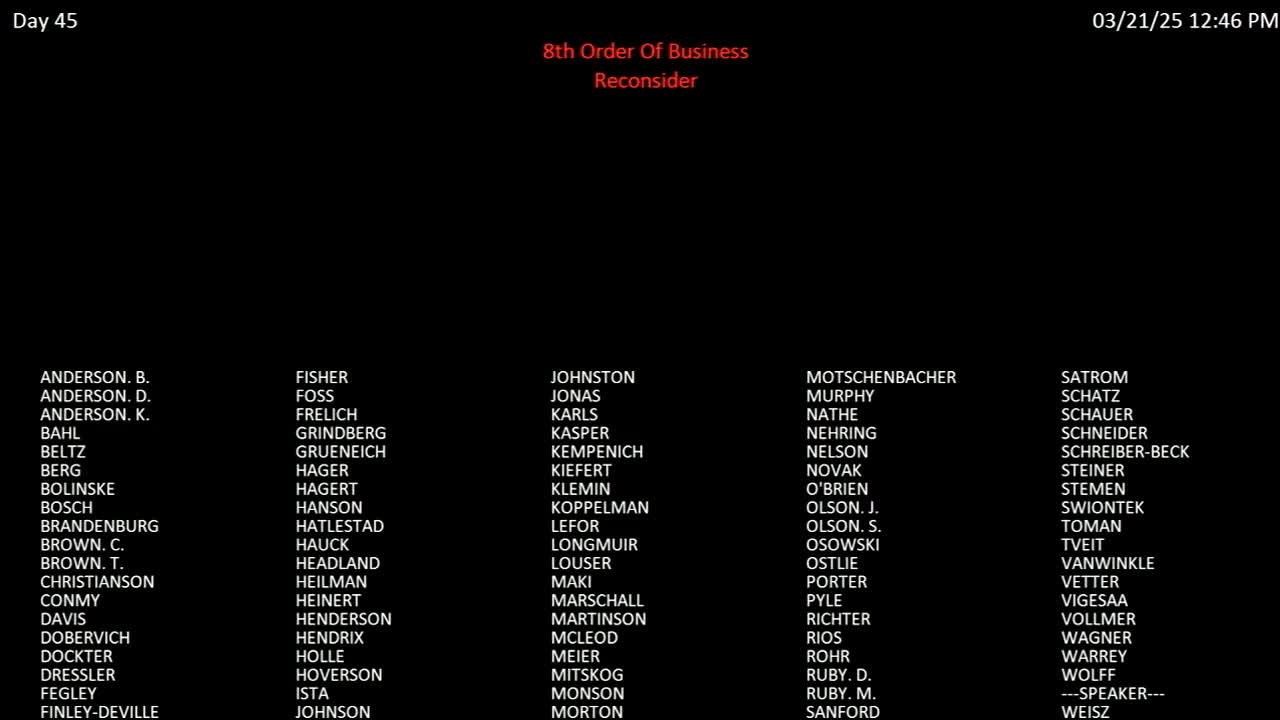
The motion to reconsider, made by Representative Kevin Hout, failed on a roll call of 46 yeas and 39 nays, leaving the bill as previously passed on the House calendar.
Supporters of reconsideration urged caution about criminalizing a driver’s split‑second judgment. "It is a judgment call on the part of the peace officer, and I would like to err on the side of the driver, using the engine brake, and doing so for the safety of the load that he is being hauled," Representative Hout said during floor remarks.
Opponents of reconsideration argued the bill gives clearer enforcement guidance for local officers and targets only egregiously loud use. "This takes away the judgment call by... taking that guesswork out," Representative D. Ruby said, adding that the measure will allow officers to ticket only when engine brake use is "obnoxiously loud" in restricted zones. Ruby noted the maximum fine discussed on the floor was $50.
Representative Fraley urged respect for local authority and warned that the measure applies statewide across diverse terrain and industries, saying the bill "is going to impact all across the state and all across all those industries." Representative Houck requested a recorded roll call vote; the clerk opened the key and recorded the vote that resulted in the failed reconsideration.
The motion to reconsider was properly seconded and debated on the floor before the recorded vote. With the House declining to reconsider, the earlier action on Senate Bill 22‑53 remains in effect according to the chamber's calendar.
Floor discussion centered on enforcement discretion, noise impacts on residents, and local control versus a uniform state standard. No amendment to the underlying bill was adopted during the reconsideration sequence on March 19.
The House then recessed briefly before moving on to the next items on the calendar.