Get Full Government Meeting Transcripts, Videos, & Alerts Forever!
Get email alerts on the Refugee Services topic
No spam. Unsubscribe anytime.
Refugee office reports rising arrivals and program growth as federal contracts shift to new model
Summary
Holly Triska Dolley, State Refugee Coordinator, told the Senate Appropriations Committee that North Dakota’s Office of Refugee Services expanded geographically in federal fiscal year 2024, served approximately 800 refugee‑eligible individuals and invested about $3.5 million in grants while the U.S. Department of State changes its resettlement contracting model.
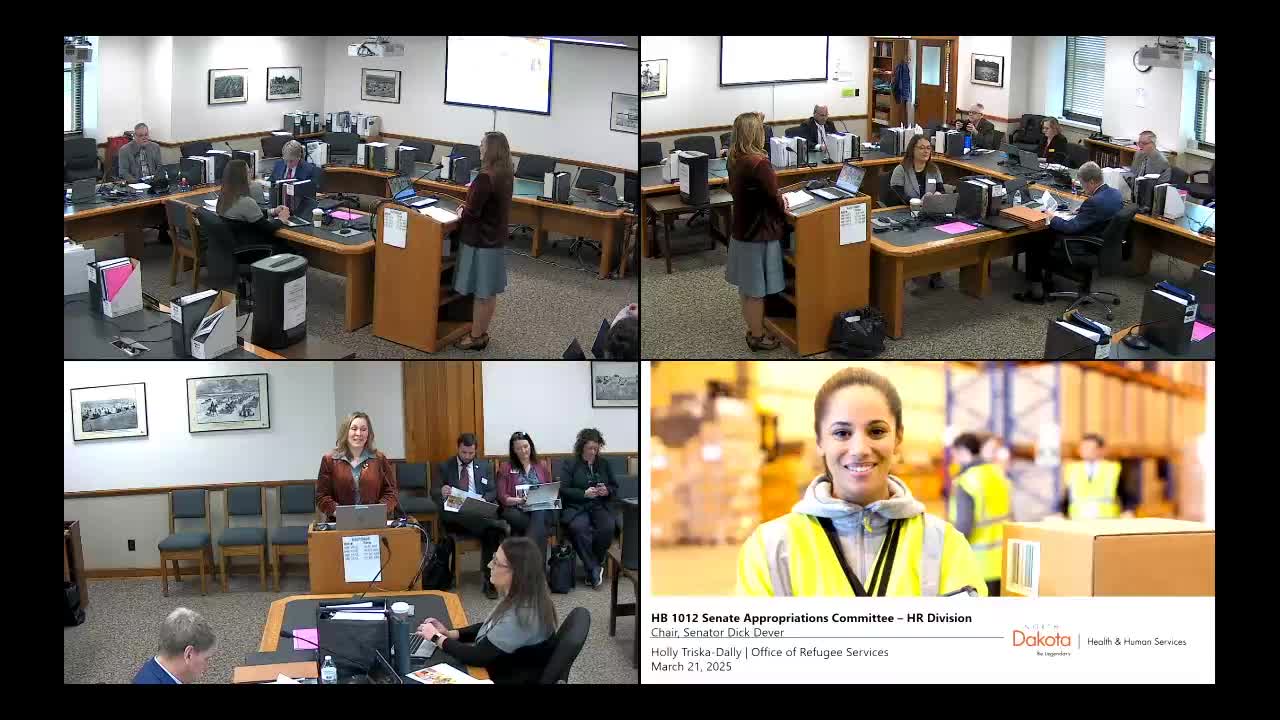
Holly Triska Dolley, State Refugee Coordinator for North Dakota, told the Senate Appropriations Committee the Office of Refugee Services has expanded services across the state and is preparing for federal changes to how initial resettlement services are contracted.
“Chapter 50 of North Dakota Century Code gives the authority to administer refugee services in our state of North Dakota,” Dolley told the committee as she described the office’s mission to build community collaborations that help newcomers become economically self‑sufficient.
Why it matters: Changes at the U.S. Department of State — including termination of prior contracts with national resettlement agencies — will shift more decisions about placement and initial reception toward states and local jurisdictions, affecting how and where newcomers are resettled and how state grants must be managed.
Program size and staffing: Dolley said the office has seven full‑time staff and one temporary staffer. The state’s refugee work covers employment assistance, English language learning, community integration, refugee health screening, and an unaccompanied refugee minor foster care program. She said refugee resettlement involves lengthy overseas vetting overseen by the U.S. Department of Homeland Security and that fewer than 1 percent of refugees are ultimately referred for U.S. resettlement.
Arrivals and outcomes: Dolley said federal fiscal year 2024 saw a geographic shift in arrivals: while Cass County (Fargo/West Fargo) received the largest share, “45% last year was outside of Cass County,” she said, noting broader distribution to smaller communities. She gave employment metrics for FY24: 636 employable adults arrived, the average time to first employment was about 90 days, and the average wage for the very first job was $18.53 per hour. Top employment sectors listed included manufacturing, retail, hospitality, construction, healthcare and education.
Program investments and services: Dolley said the office invested about $3,500,000 in grants in FFY24 and launched a refugee data management system in October 2024 to centralize provider reporting and outcomes. She described a remote English language learning pilot that loaned iPads with data plans and a virtual adult education specialist who supported learners in small communities. She highlighted a new pre‑CNA medical terminology class launched in Bismarck with Bismarck State College that had eight enrollees who then became CNAs.
Federal contract change and state role: Dolley said the Department of State has terminated the previous contracts with ten resettlement agencies and is preparing a new notice of funding opportunity. “We know that they are procuring through competitive process a new aid agency to manage that reception and placement first 90 days… but the notice of funding opportunity hasn't been released,” she said. She cautioned the committee that the new model will involve greater state and local jurisdiction involvement in decisions about who and how many people are resettled.
Funding and limits: Dolley said refugee services are “100% federally funded.” She and Deputy Commissioner Sarah Stolt told senators that most direct services and case management for newly arriving refugees are financed through federal grants; the grants line in the state budget has seen the most growth because it distributes funds to community partners, adult learning centers, job service and other local providers.
Community priorities and next steps: Dolley said the office is prioritizing transportation solutions, digital literacy, and expanded English language learning tied to employment. She noted uncertainty about future arrival numbers and procurement outcomes and estimated a planning trajectory of about 1,200 individuals served annually under the budget model, though actual funding will adjust based on arrivals and federal guidance.
Ending: Committee members praised the economic contributions of refugees and asked for follow‑up on specific program costs, data system details and how the state will adapt as the federal resettlement model changes. No formal committee vote was taken on the refugee presentation.