Get Full Government Meeting Transcripts, Videos, & Alerts Forever!
Get email alerts on the Local Government Accountability topic
No spam. Unsubscribe anytime.
Committee approves bill to clarify oversight, elections and petition audits for water districts
Summary
The committee recommended a due pass for Senate Bill 2,299 to add certain water districts to the list of political subdivisions subject to state audit, set petition thresholds and clarify election processes; the committee voted 10-0 with three absent and directed the bill toward the floor.
The House Political Subdivisions Committee voted to give a due-pass recommendation to Senate Bill 2,299, a measure that clarifies governance, election procedures and audit authority for water districts organized under chapter 61‑35 of the North Dakota Century Code.
Sponsor Senator Bob Paulson, R‑Minot, said the bill codifies several elements that water districts and their members have identified as unclear, including making water districts subject to the state auditor’s oversight for fiscal audits, setting a petition threshold for triggering a state audit, and clarifying nomination and vacancy procedures for district boards.
Dan Cox, director of audit services in the state auditor’s office, and Auditor Josh Gallagher (testimony identified as Josh Galley in the record) testified that adding water resource districts to the statutory list of political subdivisions would primarily require submission of audit reports for review and would have minimal impact on districts that already obtain audits. Cox said the petition‑audit provision is helpful because water districts cross county boundaries and the bill clarifies how to calculate petition thresholds.
Sponsor Paulson said the bill’s provisions include: adding water districts subject to chapter 61‑35 to the entities audited under N.D.C.C. 54‑10‑14; allowing a petition audit when at least 10% of participating members — or 300 members, whichever is fewer — sign a petition; requiring a participating member seeking election to submit a petition with signatures of 10 participating members at least 45 days before the election; and clarifying that vacancies are filled by appointment until the next annual meeting where members elect a director for the unexpired term.
John Peach, a member of North Prairie Water, described contested local election practices and urged the committee to adopt the bill to standardize access, transparency and ballot procedures. Eric Volk of the North Dakota Rural Water association and Lance Gaby of the North Dakota Farmers Union testified in favor after stakeholder negotiation produced the version before the committee.
Auditor Gallley noted changes to petition-audit language adopted in the prior session and emphasized the auditor’s practice of coordinating with private-sector auditors and avoiding redundant audits that would impose extra cost on local governments.
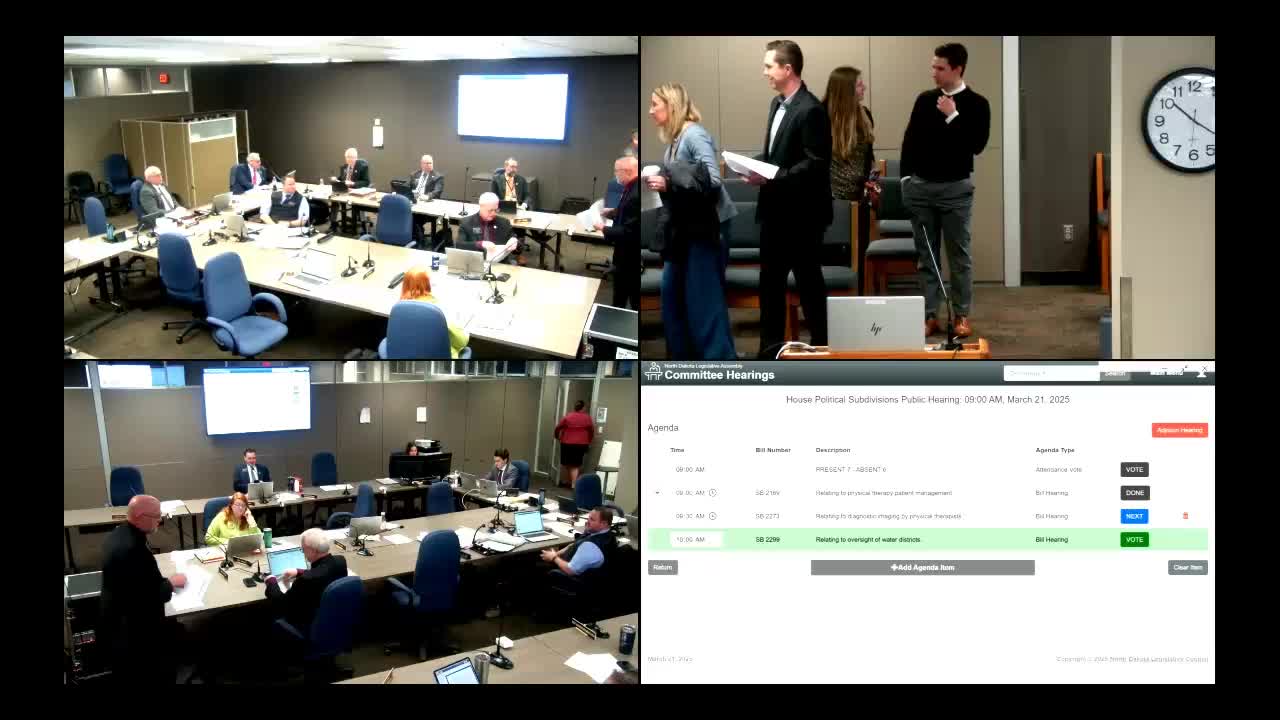
Representative Bosley moved a due‑pass recommendation; Representative Moshenberger seconded. The clerk reported the vote as 10 yea, 0 nay, 3 absent or not voting. The committee directed that SB 2,299 go to the floor. No recorded opposition speakers appeared at the committee hearing following stakeholder revisions.