Get Full Government Meeting Transcripts, Videos, & Alerts Forever!
Get email alerts on the Disability Determination Services topic
No spam. Unsubscribe anytime.
State disability determination office reports backlog, says hiring and funding controlled by Social Security
Summary
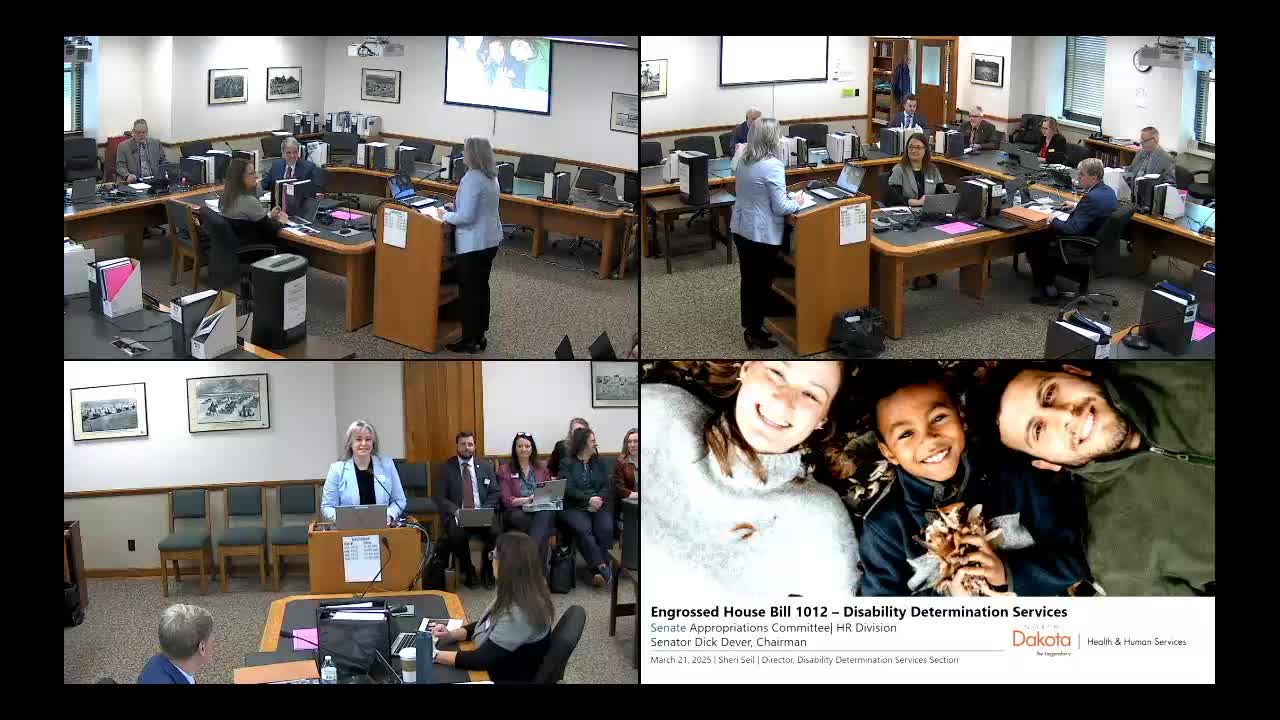
Sherry Seil, Director for Disability Determination Services Section in the Human Services Division of Health and Human Services, told the Senate Appropriations Committee that the state’s Disability Determination Services is "100% federally funded" and faces a backlog of about 1,300 claims driven by higher initial claim receipts and limits on Social Security Administration hiring authority.
Sherry Seil, Director for Disability Determination Services Section in the Human Services Division of the Department of Health and Human Services, told the Senate Appropriations Committee that the state’s Disability Determination Services (DDS) makes medical determinations for Social Security disability claims and is “100% federally funded.”
Seil said the program is responsible for initial claims, reconsiderations and continuing disability reviews (CDRs) and that the volume of work is set by the Social Security Administration (SSA). “When they make the decisions to provide us our budget, it's all built around how many decisions we're gonna make in a year and how many they're going to ask us to do,” she told senators.
Why it matters: North Dakotans who apply for Social Security Disability Insurance (SSDI) or Supplemental Security Income (SSI) must wait for the DDS medical decision before benefits can be awarded. Limits on SSA hiring authority and increases in initial claims have contributed to a state backlog and longer waits for decisions.
Seil described the office’s staffing and operations: 23 full‑time equivalents, one temporary employee and three current vacancies; an intensive training pipeline that can take roughly two years before an analyst reaches full productivity; and five part‑time contracted medical consultants who must concur on medical decisions. She said internal quality assurance and federal sampling measure accuracy against a federal benchmark (90.6 percent) and that North Dakota has “historically … really good quality” on its decisions.
On the backlog and processing times, Seil said the DDS currently had about 1,300 claims in its backlog, with roughly 1,000 of those initial claims; the oldest pending claim she cited dated to October and was roughly 153 days old in January. She said average processing time once a claim is assigned is about 68 days. Seil also described a national context: SSA has a national backlog of more than one million claims and directed some offices to prioritize initial claims over CDRs last year.
Funding and limits on state action: Seil emphasized that the DDS budget and hiring authority come from SSA, not the state. “We are in that position … because all of our dollars come from SSA. Without their approval to hire, to spend the dollars, how we do it — you know, again, how many decisions we make in a year — all of those directives come from Social Security,” she said. Committee members asked whether the state could supplement the program; Seil responded “Correct, cannot,” when asked if state dollars could be used to fill positions when SSA has restricted hiring.
Budget request detail: Seil said the DDS requested a $676,317 increase for the next budget period, with the largest portions directed to salaries and benefits (including step increases tied to training) and to the grants line that covers costs for medical evidence and consultative examinations, including travel reimbursement when providers are more than 50 miles round trip.
Other operational notes: Seil described the Cooperative Disability Investigation unit for suspected fraud (one state staffer aligned with two SSA and two attorney general/BCI staff) and said some work has been temporarily supplemented by assistance from South Dakota’s DDS, which has taken some North Dakota claims to help reduce the backlog. She also said staff have worked overtime funded by SSA when available.
No formal committee action or vote was recorded on the DDS presentation. Chairman Deaver moved the hearing on to refugee services after Seil finished.
Ending: The committee received updated metrics and a budget request; members pressed the limits of state authority when federal funding and hiring decisions come from SSA. The department said it will continue to seek SSA approval to fill vacancies and to accept external assistance while maintaining federally mandated quality controls.