Get Full Government Meeting Transcripts, Videos, & Alerts Forever!
Get email alerts on the Healthcare Access Imaging topic
No spam. Unsubscribe anytime.
Hearing held on expanding diagnostic-imaging referral authority for physical therapists
Summary
Senate Bill 2,273 would allow trained physical therapists to order advanced diagnostic imaging, including MRI and CT, beyond current plain‑film x‑ray authority; proponents argued it would improve access and timeliness of care, while the North Dakota Radiological Society raised concerns about possible increased imaging and costs.
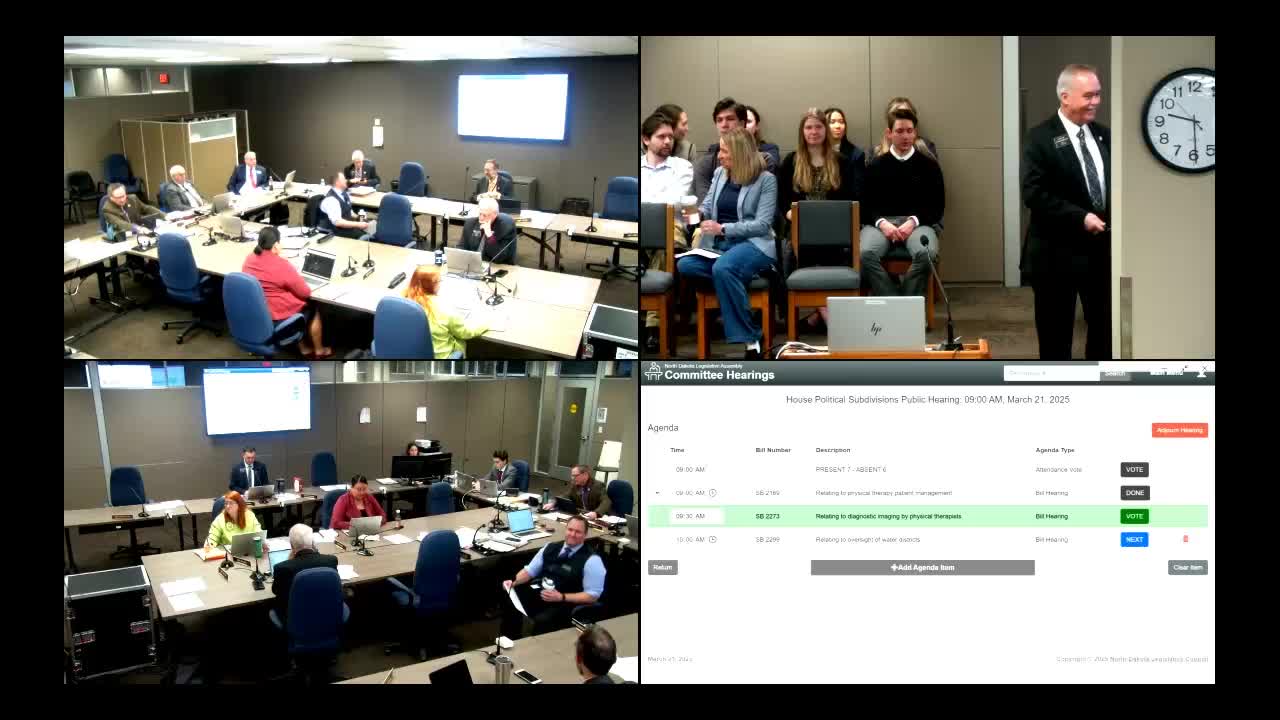
The House Political Subdivisions Committee held a hearing on Senate Bill 2,273, which would expand referral authority for diagnostic imaging by physical therapists to include MRI and CT scans for those with a clinical doctorate or board‑approved imaging training.
Senator Brad Bechkendahl, R‑Williston, introduced the bill as building on 2021 legislation that allowed doctoral‑level or specially trained physical therapists to order plain‑film radiographs. Proponents — including Mitch Walden, a professor in the Doctor of Physical Therapy program at the University of Jamestown, and Scott Brown, director of therapy and rehabilitation at Sanford Health — testified that expanding the referral privilege would reduce treatment delays and improve care coordination, particularly in rural areas.
“Right now physical therapists are the only first contact provider that cannot make the guideline‑based referral for an MRI,” Mitch Walden told the committee, saying the limitation can delay care and add cost when therapists must refer patients back to physicians for advanced imaging.
Supporters noted that roughly a dozen states and territories already allow similar privileges and that doctoral education and required imaging coursework prepare physical therapists to make appropriate imaging referrals. Scott Brown described a case in which timely MRI referral expedited surgical treatment and likely prevented permanent nerve damage in a rural patient.
Opposition materials were presented from the North Dakota Radiological Society, which cited studies suggesting non‑physician ordering can increase imaging utilization and raise costs; the society expressed concerns about increased radiation exposure and repeat exams. Committee members asked witnesses about reimbursement, prior authorization, training and oversight; witnesses said insurers have reimbursed appropriate referrals in other implementations, prior authorization processes already exist, and the North Dakota Board of Physical Therapy would approve board‑level training programs for those without doctoral degrees.
Committee members discussed language in the bill that would permit either a clinical doctorate or completion of a board‑approved medical imaging training program; some members expressed concern that the “or” provision could allow substantially shorter training paths and asked whether the training would be sufficiently rigorous. Witnesses said the board‑approval process would vet course content and that the intention was to recognize experienced clinicians who lack a newer doctoral credential but can complete board‑approved training.
No final committee vote on the bill was recorded in the hearing transcript; the matter was left after testimony and questions.