Get Full Government Meeting Transcripts, Videos, & Alerts Forever!
Get email alerts on the Healthcare Policy topic
No spam. Unsubscribe anytime.
Committee backs bill to add informed-consent requirement to North Dakota Physical Therapy law
Summary
The House Political Subdivisions Committee recommended a due-pass for Senate Bill 2,169, which would add an explicit informed-consent requirement to the North Dakota Physical Therapy Practice Act; the committee voted 9-0 with four absent and placed the bill on the consent agenda.
The House Political Subdivisions Committee on an unspecified date voted to recommend a due pass for Senate Bill 2,169, a bill that would add an explicit informed-consent requirement to the North Dakota Physical Therapy Practice Act.
Senator Randy Burkhart, R‑Minot, introduced the bill and asked the committee to adopt language that would add “the standard of patient informed consent” to chapter 43‑26.1 of the North Dakota Century Code. Jack McDonald, representing the North Dakota Association of Physical Therapy, and Heather Lundin, a practicing physical therapist and faculty member at the University of Mary, testified in support.
The bill would require that a physical therapist communicate the overall plan of care and obtain informed consent from the patient or the patient's legally authorized representative. Proponents said the language aligns state law with the American Physical Therapy Association’s model practice-act language and the APTA Guide for Professional Conduct, and that it would remove ambiguity about consent requirements.
“As highly trained health care professionals, physical therapists are acutely aware that we must be obtaining informed consent prior to any treatment,” Heather Lundin said. Lundin described informed consent as grounded in patient autonomy and shared decision-making and said written consent is typically included in the patient’s documentation and plan of care.
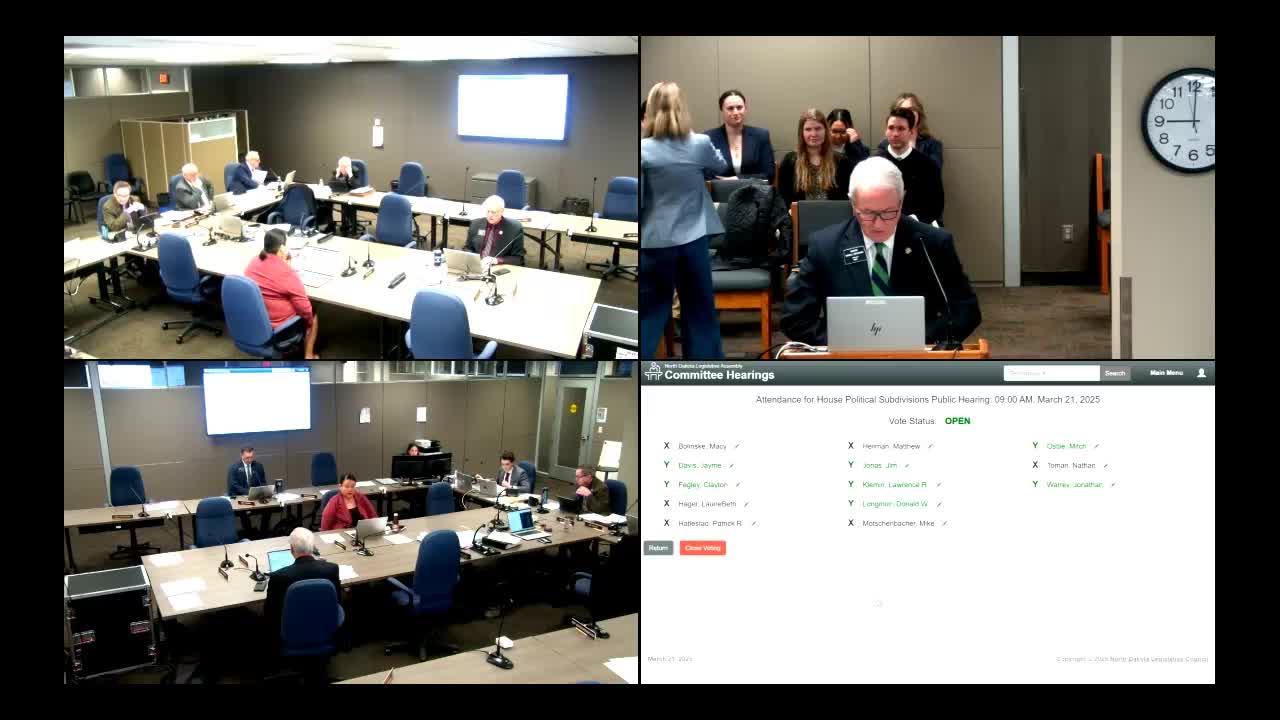
Representative Warrie moved a due-pass recommendation; Representative Davis seconded. The clerk reported the committee vote as 9 yea, 0 nay, 4 absent or not voting. The committee directed that the bill be placed on the consent agenda and named Representative Davis as the backup on the bill.
Supporters said the requirement largely codifies common practice in larger health-care facilities and professional standards; opponents did not appear during the hearing and no formal opposition was recorded. The committee’s approval sends the measure to the next stage in the legislative process.
The committee hearing record shows proponents from the profession and a request that the committee recommend a due pass; committee members asked about how informed consent is documented and were told it is typically a written consent accompanied by documentation in the plan-of-care notes.