Lifetime Citizen Portal Access — AI Briefings, Alerts & Unlimited Follows
Appropriations committee reviews CTE budget, hears VR career-exploration pitch and funding requests
Loading...
Summary
Lawmakers reviewed the Career and Technical Education portion of Senate Bill 2019, heard a virtual-reality career-exploration demonstration from a private company, and questioned agency and center representatives about several funding requests, including reimbursement rates, TrainND expansion, capital for new programs, and work-based learning coordinators.
The Appropriations — Education and Environment Division held an extended review of the Career and Technical Education budget contained in Senate Bill 2019, heard a virtual-reality career-exploration pitch, and questioned agency officials about a series of funding requests.
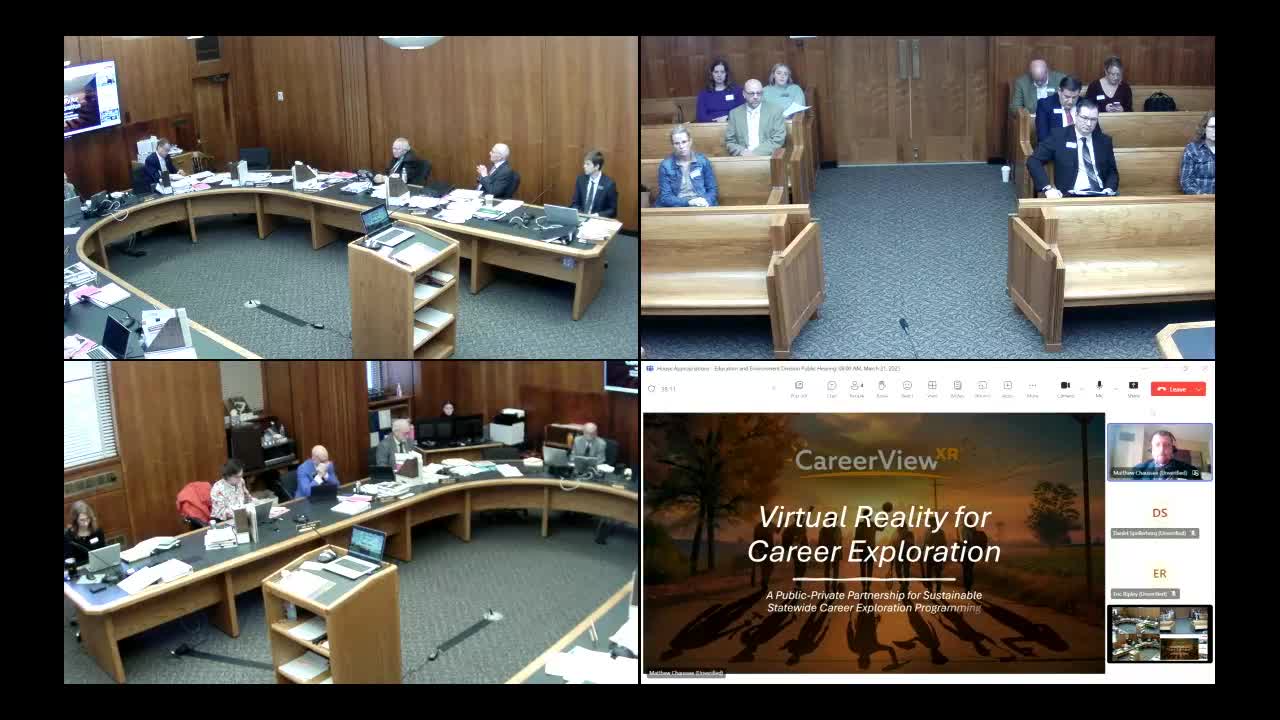
A remote presenter, Matthew Chelsea of Be More Colorful (the CareerVXR/ CareerView product), described a statewide pilot that used immersive media and virtual reality headsets to expose K–12 students to careers. Chelsea said the private company and partners had deployed nearly 100 virtual field trips, installed an immersive room at the Red River Valley Fairgrounds, and developed a professional-development course at North Dakota State University for teachers. He said the state’s prior appropriation of $500,000 leveraged roughly $2,000,000 of in-state production spending, helped secure $9,900,000 in federal funding for Bismarck State College, and attracted headset donations that supplied a device to every middle and high school in the state. Chelsea asked the committee to restore a CTE line item intended to support virtual-reality career exploration (the agency requested $2,000,000; the Senate included $1,000,000 in the long sheet).
Committee members then worked through CTE budget line items with agency staff. Key points:
- Cost-to-continue for CTE reimbursement rates: The agency requested $4,000,000 to maintain reimbursement rates for CTE centers and high schools (historically reimbursed at 40% for centers and 27% for high schools). The department proposed splitting that $4,000,000 across the biennium to preserve program funding and to consider quality/access-adjusted reimbursements.
- TrainND expansion / satellite locations: TrainND asked to expand regional satellite positions. The agency’s original request was $1,600,000; the Senate provided $750,000. Agency testimony said $750,000 would be tight but could support staff to begin satellite operations; the original $1.6 million request would better cover first-year costs.
- New and expanding secondary CTE programs (capital/program growth): The department asked for $22,000,000 to support new center projects and program expansions; the Senate provided $3,000,000. Agency staff explained that an existing line in the budget (about $41.5 million) funds ongoing secondary grants and that needs vary by project (Cass County, Grand Forks, Devil’s Lake, Valley City, Bismarck, Jamestown, Williston). The department said additional dollars would support program starts, satellite sites and capacity increases at growing centers.
- Work-based learning coordinators: The department described an initiative launched with prior funding that created a grant to place work-based learning coordinators in regions. The department said the program trained more than 70 coordinators and funded 16 positions; the ask included sustaining and expanding coordinators to additional economic development regions. The agency requested $1,500,000 (the governor proposed $500,000; the Senate left it at $0). Internal tracking by the department shows rapid growth in sustained work-based placements after the initial roll-out (from dozens to thousands of student placements in recordings provided to the committee).
Officials from regional CTE centers and college partners testified about program growth, mobile training assets (CDL trucks, mobile meat and ag-processing trailers), and partnerships that supplement state funds with industry or federal grants. Lyle Krueger (Central Regional Area CTC) and Dan Spelberg (Southeast Region CTC) described enrollment increases, the variety of programs offered (agriculture, aviation, health sciences, welding, IT, precision ag), and how mobile units expand rural access. Eric Ripley (Grand Forks CTE) described the Career Impact Academy and said the new facility will allow the region to meet demand in health sciences and add new programs such as manufacturing and culinary arts.
Committee members asked about instructor shortages, program churn caused by teacher departures, the role of middle-school exposure in building interest, and parent engagement. Agency staff confirmed that statute requires each high school to provide access to at least one CTE pathway, either directly or through a center, and stressed that some enrollment fluctuations are caused by instructor recruitment challenges rather than lack of student interest.
Ending: The committee did not vote on SB 2019 line items during this session of the meeting. Lawmakers asked staff to return with more detailed fiscal breakdowns, and members signaled support for continued discussion about funding levels, especially for work-based learning coordinators and the readiness of TrainND satellite expansions.