Get Full Government Meeting Transcripts, Videos, & Alerts Forever!
Get email alerts on the Hoa Access Privacy topic
No spam. Unsubscribe anytime.
Bill would require HOAs to get homeowner permission before entering private property; committee hears support and approves concurrence
Summary
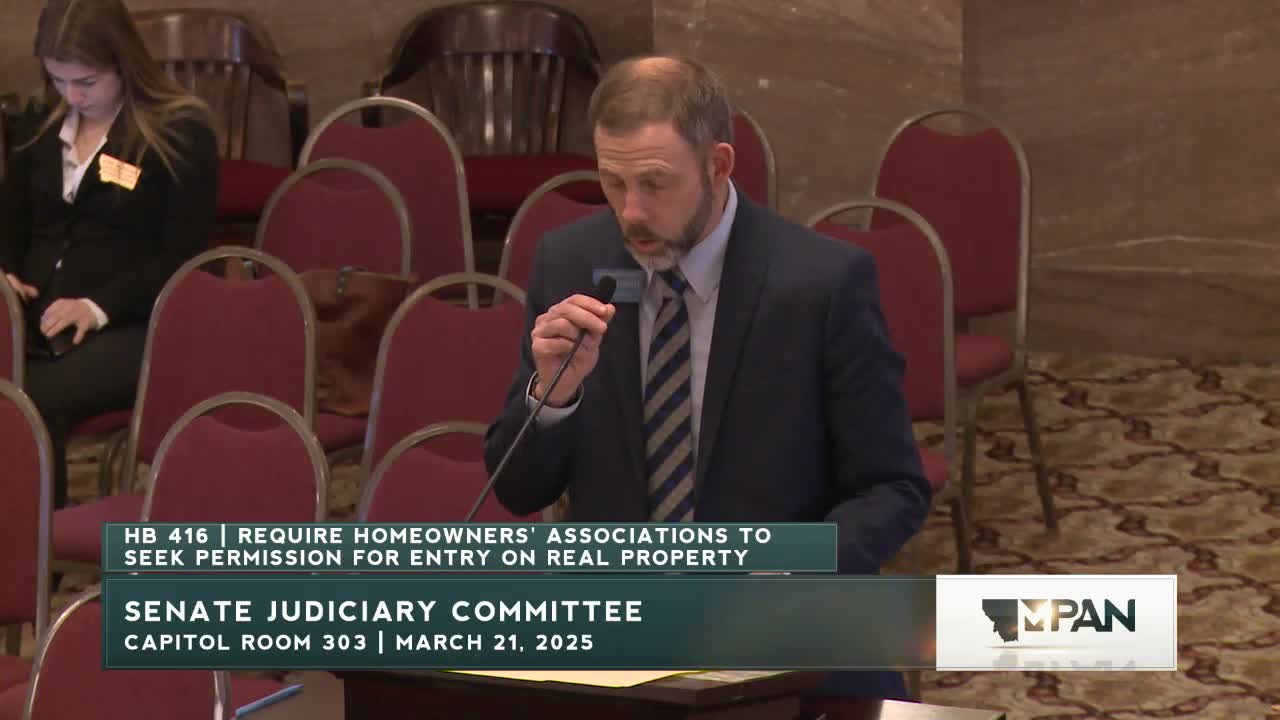
Representative Jedidiah Hinkle told the committee HB 416 would protect homeowner privacy by requiring homeowners association boards or their committees to obtain permission before entering a homeowner’s private premises; the committee later concurred in the bill during executive action.
Representative Jedidiah Hinkle introduced House Bill 416 to the Senate Judiciary Committee, saying the measure would require homeowners association (HOA) boards or design review committees to obtain a homeowner’s permission before entering private areas of the homeowner’s property.
Hinkle said he filed the bill after constituents told him HOA covenants in his district had language granting review committees “full access to the property.” He told the committee the bill simply clarifies expectations about privacy and board entry and includes carve‑outs for condominiums and recorded easements that “specifically benefit the homeowners association.” He said the measure passed the House and carried bipartisan support there.
Proponents included tenants’ and landlord‑law advocates and a private attorney. John Sinrude testified a landlord–tenant statutory regime already requires notice before entry into a tenant’s domicile and said HB 416 is “common sense.” Attorney Stephanie Bacchus, who said she represents both owners and HOAs in dispute matters, said she had seen committees enter interior spaces and that the bill is “a reasonable limitation on the powers of HOAs under their contracts and their covenants.” No opponents appeared to testify in the hearing record.
Committee members asked about the scope of the bill’s exceptions, particularly how the “easements of record that specifically benefit the homeowners association” carve‑out would operate in practice. Hinkle said the language was intended to keep the bill focused on HOA matters and not open up unrelated access across adjacent private property; he said condo common elements and recorded easements for utilities are not intended to be restricted by the bill.
During executive action the committee voted to concur in HB 416. The roll call on concurrence recorded five yes votes and three no votes; Vice Chair Ricky and Chair Usher voted yes, Vice Chair Olsen voted no, and Senator Newman voted no. Senator Ricky volunteered to carry the bill on the Senate floor.
The committee record shows amendments were considered in the House earlier and the sponsor said the language excludes condominiums where common elements require access and recorded easements that were intended to benefit an HOA.