Get Full Government Meeting Transcripts, Videos, & Alerts Forever!
Get email alerts on the State Land Water Rights topic
No spam. Unsubscribe anytime.
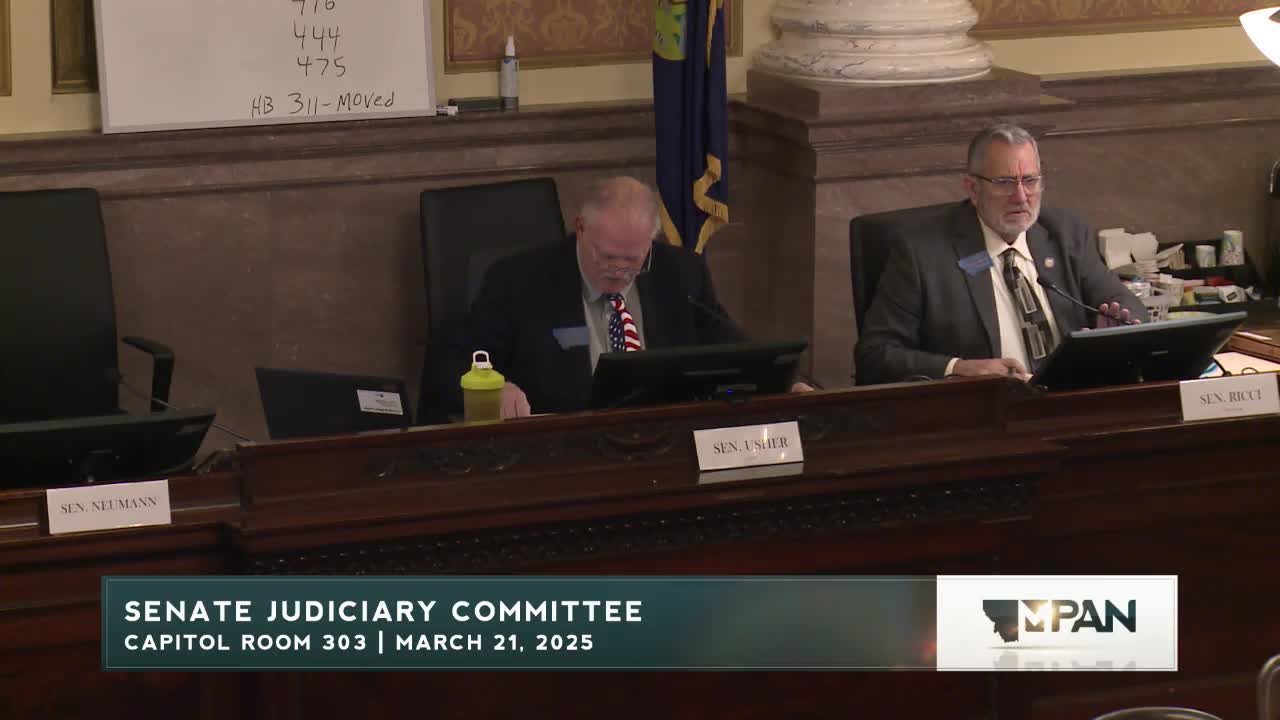
Senate Judiciary hears hours-long debate over House Bill 676 on water rights, land sales and ending water court
Summary
The Senate Judiciary Committee heard hours of testimony on House Bill 676, a proposal to limit state claims on private water rights used on state leases, set a deadline for the Montana Water Court, and allow the sale of isolated state trust parcels to raise funds for education.
The Senate Judiciary Committee heard more than two hours of testimony on House Bill 676, a wide-ranging bill that would (1) bar the state from asserting ownership of private water rights used on some state leases, (2) set a five‑year termination date for the Montana Water Court (an element the sponsor said he might accept striking), and (3) allow the sale of landlocked state trust parcels with proceeds directed toward property-tax relief for education.
The bill’s sponsor told the committee HB 676 would “disallow the board or the land board to seize any private water right that is being used on state land” and defended a proposal to sell “landlocked” parcels so proceeds could be invested for school funding. The sponsor said he would be “friendly” to amendments removing the water‑court termination but urged the committee to protect private lessees who invest in improvements on leased state land.
Supporters largely were ranching and landowner groups who said current practice discourages private investment on state leases. Jocelyn Cahill, testifying for the Senior Ag Water Rights Alliance and identifying herself as “a rancher in Broadwater County,” told the committee, “I urge you to support house bill 6 76 because it provides much needed clarity on state ownership of water rights.” Ross Morgan of the Rocky Mountain Stock Growers Association argued the state’s taking of water rights removes the incentive to invest in improvements and said, “The state doesn't farm. The state doesn't fish. The state doesn't grow potatoes. The people do.” Several proponents urged sale of isolated parcels and offered financial arguments for investing sale proceeds to produce ongoing returns for schools.
Opponents included the lieutenant governor, state and conservation groups, school‑funding coalitions, and public‑lands and sportsmen’s organizations. Lieutenant Governor Kristen Juras, appearing “on behalf of Governor Gianforte in his capacity as chair of the state land board,” told the committee, “I want to set the record straight. The state land board is not stealing any private property rights.” She argued the bill as drafted contains no “safety net” if the water‑court adjudication is not complete by the proposed termination and warned that missing federal approvals — including a pending tribal compact — could leave pending federally related claims in legal jeopardy.
Opponents repeatedly flagged two legal and practical risks: (1) ending or truncating the Montana Water Court’s adjudication before final decrees are issued could undermine the state’s primacy over federal water claims (invoking the McCarran Amendment) and leave many rights unresolved; and (2) section 11’s noncompetitive sale language could force sales of trust land that now produce ongoing revenues and public access. Brian Thompson of the Senior Water Rights Coalition said ending adjudication “somewhat arbitrarily in 2031, leaves a lot of people in a lurch” and raised the McCarran Amendment concern. Margaret Byrd of Advocates for School Trust Lands cited a string of Montana Supreme Court decisions that require full market value for trust land dispositions and urged the committee not to approve the bill.
Education and school‑funding groups, including the Montana Quality Education Coalition, opposed forced sales, calling them a one‑time gain that risks long‑term revenue. Doug Reisig said selling isolated parcels “represents a one time influx of funds. Once these parcels are sold, the state loses a potential ongoing revenue from leases and other uses of these lands.” Conservation and access groups warned section 11 would amount to a “fire sale” of public trust land and cited the importance of those acres for recreation and habitat.
Several witnesses also gave fiscal and scale figures during testimony. A witness identified as Jerry Hoover summarized the bill’s fiscal note testimony by saying the “cost to the Montana taxpayer is estimated to be $2,000,000 in operational expenses and $7,000,000 to $9,000,000 in lost revenue annually.” Multiple opponents noted DNRC and the water court have invested decades and tens of millions of dollars in adjudication and said an arbitrary deadline would put long‑standing investments and legal stability at risk.
DNRC officials were in the room as informational witnesses. Ryan Weiss, deputy administrator for state trust lands at DNRC, said the agency classifies lands by highest and best use and that, from a revenue perspective, retained assets generate long‑term returns; he also said that if land were sold the proceeds would go into the permanent fund and generate roughly 3 percent annually, while productive agricultural lands have historically appreciated faster. Water Resources Division Administrator Anna Pakenham Stevenson and other DNRC staff answered committee clarifying questions about wells sited on private land that deliver water to state leases.
The committee did not take a vote on HB 676 at this hearing; the sponsor said amendments are possible and several groups told the panel they would oppose the bill as written. The hearing record shows broad and organized opposition from school, conservation, and farm‑and‑ranch organizations, while supporters were primarily agricultural lessees and pro‑sale advocates who argued the proposals would protect private property and increase funds for education.
The committee closed the hearing with procedural notes about a pending amendment and scheduling; the land board itself had not taken a formal position on HB 676 during the hearing, the lieutenant governor said.
Votes at a glance from this meeting: the committee conducted later executive actions on unrelated bills (see separate articles).