Get Full Government Meeting Transcripts, Videos, & Alerts Forever!
Get email alerts on the Health Gbay Medical Ethics topic
No spam. Unsubscribe anytime.
Montana hearing on SB164 divides lawmakers, parents and medical groups over criminalizing gender-affirming treatments for minors
Summary
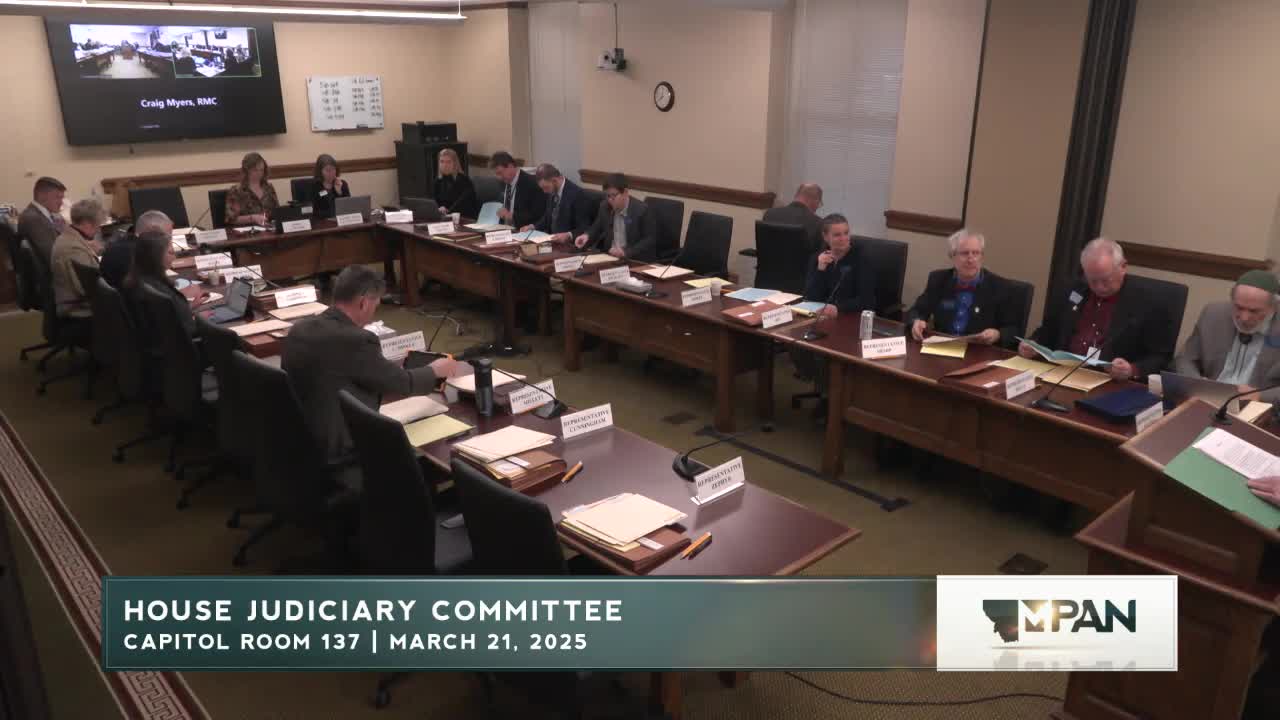
Senate Bill 164 — a bill that would expand Montana’s child‑endangerment statute to make it a crime to provide puberty blockers, cross‑sex hormones or surgeries to anyone under 16 — prompted hours of testimony and sharply divided public comment during a House Judiciary Committee hearing on March 10.
Senate Bill 164 — a bill that would expand Montana’s child‑endangerment statute to make it a crime to provide puberty blockers, cross‑sex hormones or surgeries to anyone under 16 — prompted hours of testimony and sharply divided public comment during a House Judiciary Committee hearing on March 10.
The bill’s sponsor, Sen. John Fuller, said the amendment to section 45‑5‑622 of the Montana Code Annotated is aimed at protecting children from “harmful and irreversible medical interventions.” “This is an amendment to section 45‑5‑622, outlining the endangerment of the welfare of children,” Fuller told the committee, and he argued in opening remarks that the proposed change is within the Legislature’s authority under Article V, Section 1 of the Montana Constitution.
Supporters, who included a mix of parents, self‑described whistleblowers and conservative legal groups, told the committee that medical interventions such as puberty blockers and cross‑sex hormones can cause lasting physical and psychological harm. Derek A. Streicher of the Montana Family Foundation described a February study he said analyzed “more than 100,000 individuals” and that he read as showing higher rates of depression and suicidal ideation among people who underwent surgery. Jamie Reed, who identified herself as a former pediatric gender‑medicine worker and whistleblower, described patients she said suffered complications and urged criminal penalties so doctors would be deterred from providing those treatments.
Opponents — including large medical organizations, civil‑liberties groups and many parents and clinicians — said the bill would criminalize standard medical practice and interfere with parental authority and patient privacy. Dr. Lauren Wilson, a pediatrician speaking for the Montana chapter of the American Academy of Pediatrics, and the Montana Academy of Family Physicians, told the committee the bill’s language is unclear and could sweep in medically necessary treatments for non‑trans conditions such as precocious puberty or pituitary disorders. “This is a poorly written bill that potentially could criminalize the use of these medications in other circumstances,” she said. The ACLU of Montana and Planned Parenthood Advocates of Montana urged the committee to oppose the measure as harmful and unconstitutional.
Committee members repeatedly questioned witnesses about scope and implementation. Several members asked whether the bill would affect treatment for intersex children or for ordinary endocrine disorders; witnesses including Dr. Wilson and Child and Family Services staff said the draft language lacks an explicit intersex exception and could create confusion for clinicians. Senator Fuller and others replied that the criminal elements in the bill require proof of the sponsor’s stated intent — for example, treatment “for the purpose of altering appearance” or to “affirm the child’s perception” of gender — and said prosecutorial discretion would limit prosecutions.
No formal committee action was recorded during the hearing. Testimony stretched through much of the morning and into the afternoon, with more than three dozen speakers for and against the bill. Supporters said criminal penalties are necessary to protect minors; opponents said the proposal would chill medical practice and risk patient safety by deterring physicians from treating vulnerable children. The committee closed the SB164 hearing near midday and moved on to other bills without reporting a recommendation on the measure.