Get Full Government Meeting Transcripts, Videos, & Alerts Forever!
Get email alerts on the School Safety topic
No spam. Unsubscribe anytime.
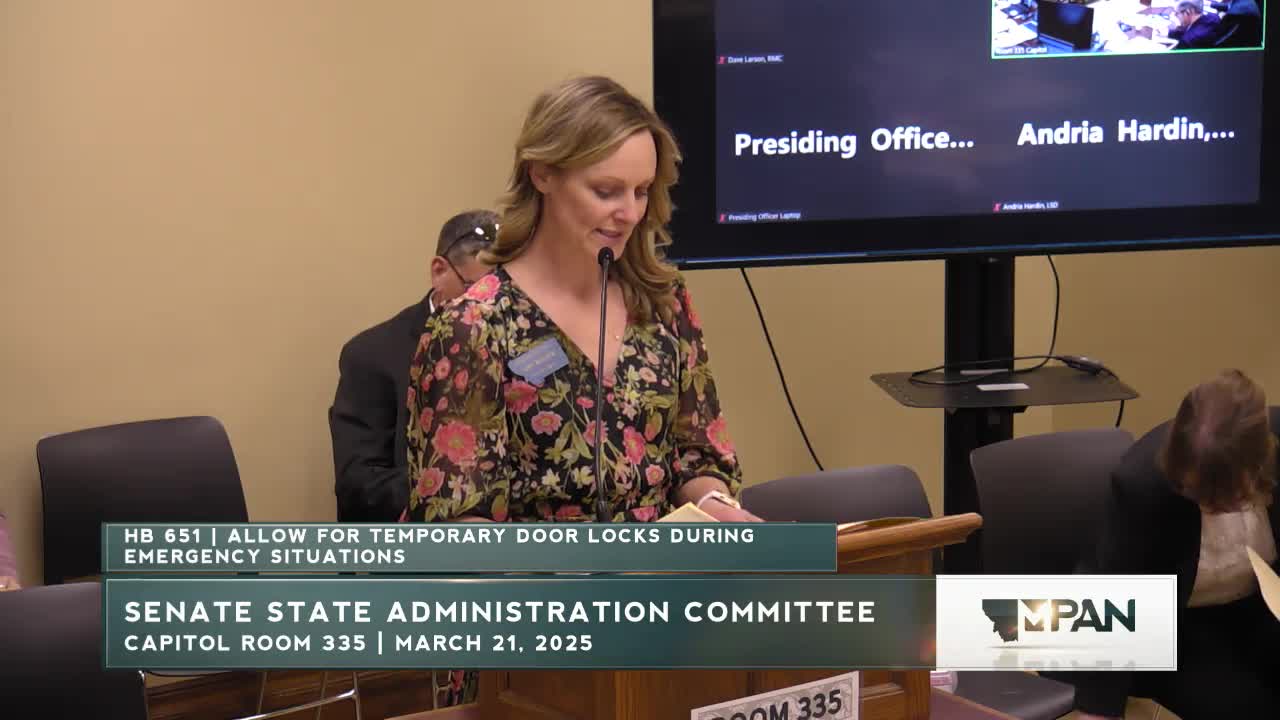
Committee hears testimony supporting emergency door-lock exception for shelters-in-place (HB651)
Summary
House Bill 651 would create an exception in the fire code permitting certain emergency door-lock devices to be used to shelter in place during active-threat events. Law enforcement, firefighters, school and security officials testified in favor; no opponents appeared.
Representative Amy Regier introduced House Bill 651, which would create a limited exception in the fire code to allow specified emergency door-lock devices for shelter-in-place situations such as active-shooter events, while preserving access for emergency responders.
Proponents included Shelby Demars of Nightlock (manufacturer), Dan Smith of the Montana Police Protective Association, Carter Marsh of the Montana Professional Firefighters, Larry Crowder representing the Montana Rural Education Association and the Coalition of Advocates of Montana Public Schools, and Jack Taylor of Nightlock (online). They said the devices are for emergency use only, designed to be removable from the inside without a key and to include provisions allowing law enforcement and firefighters to gain entry once a threat is contained. Demars described product features, including brackets and removable locks, and said Nightlock products range in retail price from roughly $30–$90 depending on door type.
Fire and law-enforcement witnesses said the devices would not meaningfully hinder trained responders. Carter Marsh said firefighters train with law enforcement in rescue task-force exercises and that responders carry mechanical means and keys to gain entry; Steve Biamonte, director of security for the capital complex, attended as an informational witness. Dan Smith said additional barriers can buy time and improve outcomes in active-threat scenarios.
Committee members asked practical questions about cost, operation, how keys or master access would be managed, and whether devices would be used routinely. Witnesses emphasized the devices are intended solely for emergency shelter-in-place uses and that keys, Knox-box practices or agency-held master keys would allow responders to regain access after an incident.
No opponents testified in person or online. The sponsor requested a do-pass recommendation. Committee discussion focused on implementation details, local approval by fire and law-enforcement authorities (required under the bill), and ensuring access for emergency personnel.