Get Full Government Meeting Transcripts, Videos, & Alerts Forever!
Get email alerts on the Environment topic
No spam. Unsubscribe anytime.
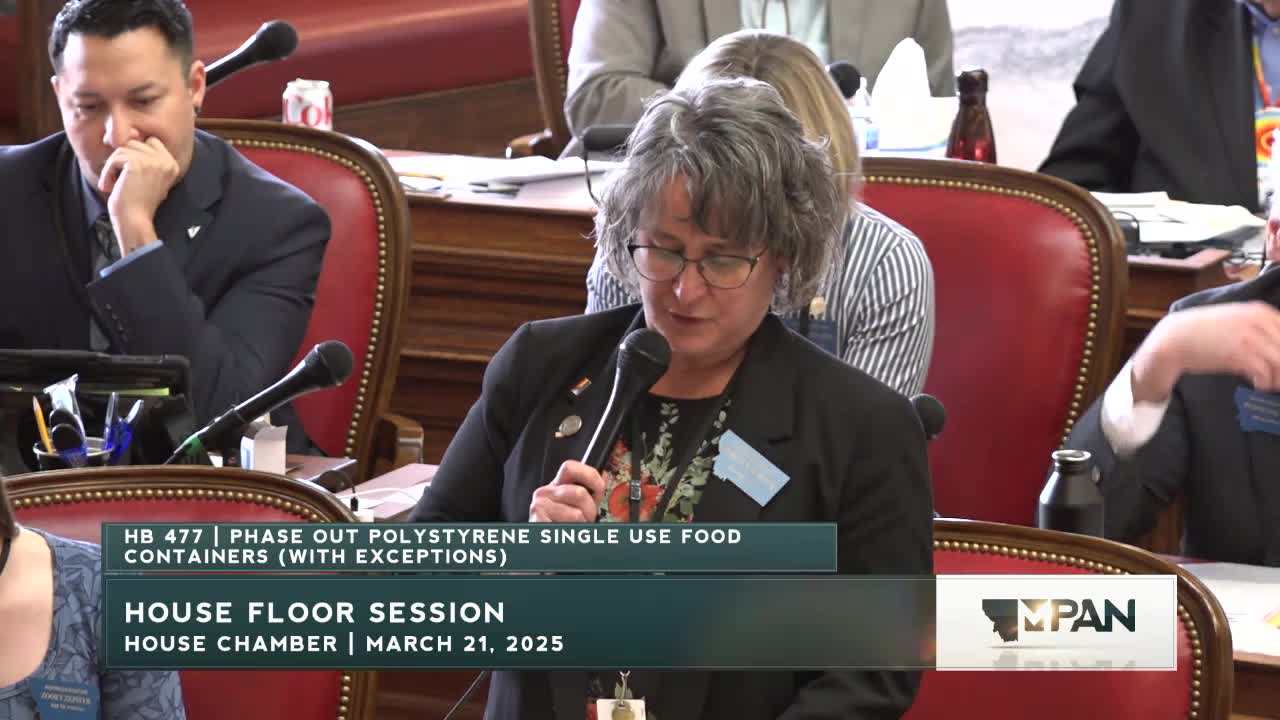
House approves phased ban on polystyrene food containers; sponsors add enforcement language
Summary
After debate and a technical amendment, the House passed second reading of HB 477, phasing out polystyrene single‑use food containers with specified exemptions for raw meat and eggs and authorizing DEQ enforcement and a July 1, 2025 effective date.
The Montana House voted to pass House Bill 477 on second reading Wednesday, advancing a phased prohibition on polystyrene (commonly termed “Styrofoam”) single‑use food containers with exemptions and an enforcement mechanism.
Representative Marler, the sponsor, told colleagues the bill phases out polystyrene containers over five years, allows businesses to seek exemptions and excludes raw meat and eggs from the ban because of insulation concerns for those products. “House Bill 4 77 will phase out polystyrene foam containers…over a very reasonable five year time period,” Marler said.
Why it matters: Sponsors and backers framed HB 477 as a public‑health and environmental measure; supporters pointed to alternatives made from agricultural byproducts and Montana manufacturers. Opponents called for market solutions and warned of new regulatory costs for small businesses.
What changed on the floor: The sponsor moved and the House approved an amendment (posted as amendment 2.2) at the Department of Environmental Quality’s request to correct account language related to any civil penalties. The amendment passed on the floor (clerk recorded 87 ayes, 12 noes). The House then debated an out‑of‑order amendment that would have replaced the bill with a prohibition on regulation; the chair’s ruling that the amendment was in order was challenged and ultimately not upheld. The House adopted the bill as amended on second reading with a recorded vote of 56 ayes and 43 noes.
Enforcement and fiscal detail: The sponsor said civil penalties, if assessed, would be deposited into an existing Solid Waste Management account and that the fiscal note funds a partial FTE to administer the program; the transcript records a fiscal‑note figure of $73,946 net impact to the general fund in FY 2026. Marler told the House the bill does not apply to raw meat or eggs because those products need polystyrene’s insulating properties.
Context and next steps: The bill sets an effective date of July 1, 2025. Debate reflected both consumer‑health and free‑market concerns; the House’s recorded second‑reading vote was 56–43. The measure will move to the next step in the legislative process for consideration on third reading.
Ending: With the vote, the House advanced a five‑year phase‑out while preserving exemptions and establishing DEQ authority to collect penalties under existing statute.