Get Full Government Meeting Transcripts, Videos, & Alerts Forever!
Get email alerts on the Legislation Votes topic
No spam. Unsubscribe anytime.
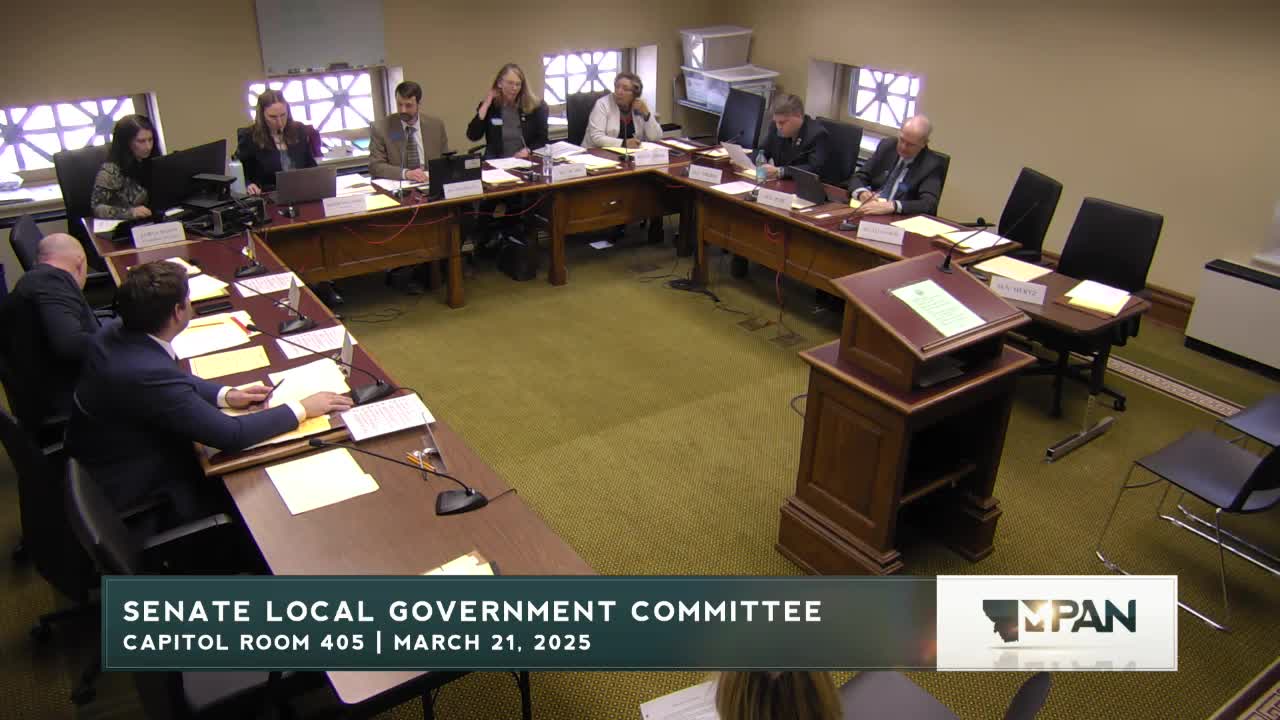
Senate Local Government concurs in four House bills; committee adopts fee-reallocation amendment
Summary
The Montana Senate Local Government Committee gave concurrence to four House bills after brief discussion, including an amendment to House Bill 192 that reallocates portions of clerk-and-recorder fees to county and state geospatial accounts.
The Montana Senate Local Government Committee voted to concur in four House bills during a session that included early action on House Bills 180, 192 (amended), 233 and 520.
The bills taken by early action were: House Bill 180 (revision of sanitation and subdivision laws), House Bill 192 (revising county clerk and recorder fee distributions, as amended), House Bill 233 (transfer of open space title and final plats to homeowners associations) and House Bill 520 (clarifying that local prohibitions on conveying family transfer parcels do not apply to conveyances involving lenders). Committee members recorded brief discussion on each item and then approved concurrence by voice vote; several senators were recorded as voting aye by proxy.
House Bill 192 drew the most detailed explanation. Committee staff described an amendment that increases the shares of the existing recording fee allocated to two accounts: the county land information account (raised from $0.50 to $0.75) and the Montana Geospatial Information account (raised from $1.50 to $2.25). The amendment also adds inflation-style language and requires the resulting figure to be rounded down to the nearest quarter dollar. Staff emphasized the amendment does not increase the overall recording fee charged to filers; it reallocates portions of the existing fee.
Committee members signaled no further objections after the amendment explanation and approved House Bill 192 as amended by voice vote. For the other bills, discussion was short; one senator said a question he had about House Bill 233 was resolved by talking with the Department of Revenue. Each bill was carried to the Senate floor by a senator volunteering to be the chamber carrier.
Votes recorded in the transcript included several proxies cast as aye: Senator Ellsworth (aye by proxy), Senator Fern (aye by proxy) and Senator Hertz (aye by proxy) at various voice votes during the session. The committee chair announced that the listed bills had been concurred in and named floor carriers to carry the measures to the Senate floor.
Why it matters: The bills move routine local-government and land-use changes toward final action in the Legislature. The HB192 amendment shifts how existing recording-fee revenue is distributed to county and statewide geospatial accounts, which affects how those accounts are funded without raising fees for filers.
What happens next: Committee members carried the concurred bills to the Senate floor for consideration. Additional debate or amendment could occur on the floor; the committee record shows concurrence here but not final enactment into law.