Get Full Government Meeting Transcripts, Videos, & Alerts Forever!
Get email alerts on the Doj Highway Patrol Pay topic
No spam. Unsubscribe anytime.
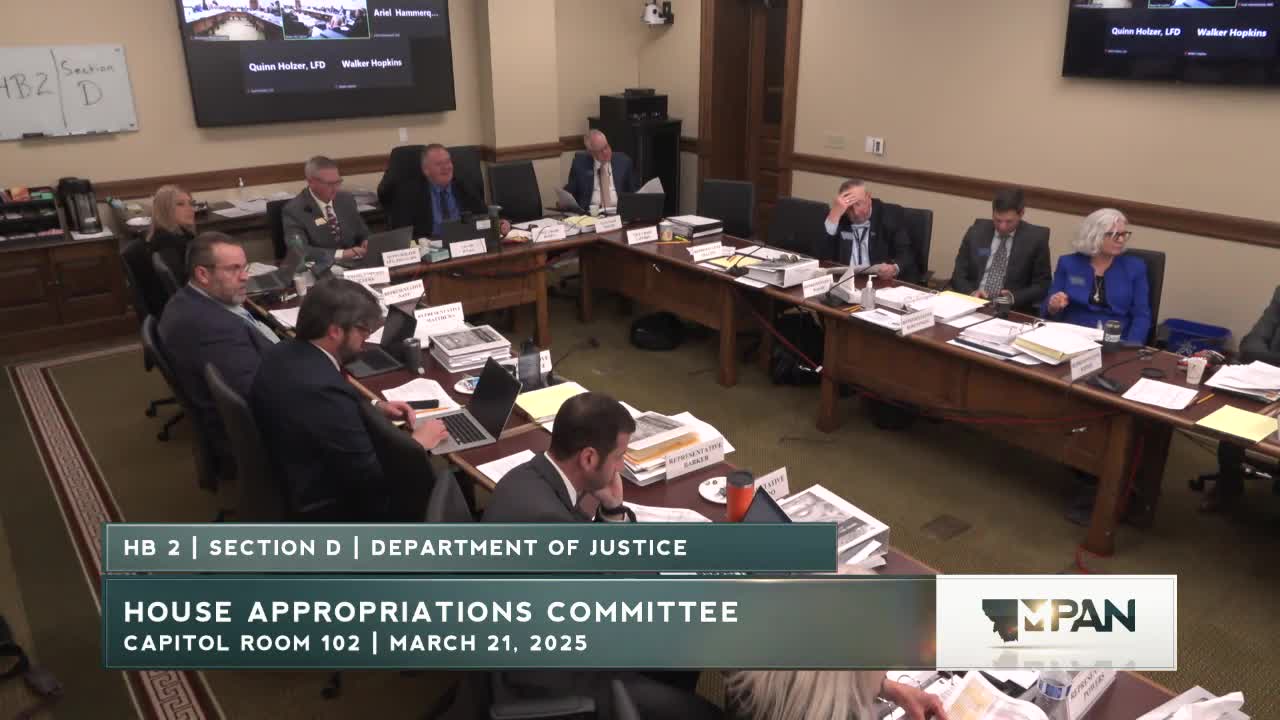
Attorney General urges pay boosts for highway patrol; committee debates funding source
Summary
The Department of Justice told the House Appropriations Subcommittee D that highway patrol recruitment and retention problems required a sizable pay increase; the committee approved a 14% raise in principle but debated whether to fund it from the general fund or a proposed railroad/vehicle tax referenced by the Executive.
The Department of Justice told the House Appropriations Subcommittee D that recruitment and retention problems within the Montana Highway Patrol had reached a critical level and required a significant pay adjustment.
An agency representative identified trooper pay as the department’s largest single budget issue, saying plainly, “Trooper pay is killing me.” That testimony described a pattern in which county and municipal law‑enforcement employers frequently offer higher pay than the patrol, producing a steady churn of officers and recent waves of retirement that left vacancies in the patrol’s ranks.
The governor’s executive request had included a 14% pay adjustment for highway patrol employees; the subcommittee approved the raise but debated the funding source. The executive office proposed paying the increase from a state special revenue mechanism linked to vehicle/rail taxes (referred to in testimony as the “Maserati tax”); Chairwoman Nave said she preferred a stable general‑fund appropriation for an ongoing pay change and planned a technical amendment to switch funding sources.
Department of Justice staff outlined additional, smaller budget requests in the HB 2 package, including maintenance authority for the Montana Law Enforcement Academy and ongoing maintenance for a new motor-vehicle system (CARS). The department asked for authority (rather than new general fund dollars) in several line items where money already exists in special accounts; agency staff said the authority was needed to expend those funds for deferred maintenance and other recurring operations.
Will Selph, chief of staff for the Department of Justice, answered detailed committee questions on cost drivers and described the salary survey mechanism used to set comparable law‑enforcement pay. Committee members asked for the underlying salary‑survey data and for more detailed metrics from the department’s annual plan; the department said it would supply additional documentation to the committee for review during the interim.