Get email alerts on the Climate topic
No spam. Unsubscribe anytime.
Riverside trustees preview draft Climate Action and Resilience Plan, no action required
Summary
Assistant Manager Ashley Monroe and consultant Melanie Nutter presented a draft 70-plus page Climate Action and Resilience Plan that includes a 2022 greenhouse-gas inventory, a climate risk assessment, 45 strategies and 127 actions across eight sectors; trustees were asked to review and provide feedback and no board action was taken.
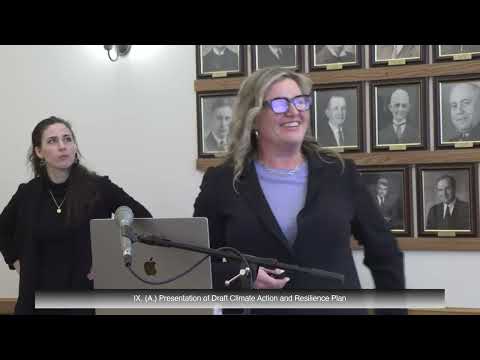
Assistant Manager Ashley Monroe and consultant Melanie Nutter presented the Village of Riverside’s draft Climate Action and Resilience Plan at the March 20 Board of Trustees meeting, describing the plan’s inventory of emissions, climate risks and recommended strategies.
The presentation introduced a document of more than 70 pages that includes a community-wide greenhouse gas inventory using 2022 data, a customized climate risk assessment and an implementation framework. "We have 45 strategies and 127 actions across 8 sectors," Melanie Nutter said, outlining the plan structure and next steps.
The nut graf: the plan aims to give Riverside a menu of prioritized actions the village can take to reduce greenhouse gas emissions and increase resilience. Staff framed the draft as a starting point for trustee feedback and subsequent public review rather than a final policy the board must approve tonight.
Nutter summarized key findings from the greenhouse gas inventory: "a majority of your greenhouse gas emissions do come from buildings," with about 38% attributed to natural gas use in buildings, about 25% from electricity in buildings and roughly 23% from gasoline passenger vehicles. She described the eight sectors covered by strategies: efficient buildings and green energy; clean transportation; waste reduction and sustainable materials; healthy green spaces; sustainable village operations; water and wastewater; community-wide resilience; and social cohesion and equity.
Nutter and Monroe described how each strategy in the plan includes a short description, supporting actions and implementation considerations such as estimated greenhouse-gas reduction potential, cost, time frame and likely lead (village-led or partner-led). They told trustees the plan will be followed by (a) an implementation matrix that assigns partners, funding sources and key performance indicators to each action and (b) a shorter priority-action list of near-term items staff recommends for the next two to three years based on impact, feasibility and community support.
Trustees were invited to submit comments through a feedback form; staff said it will incorporate trustee input, release a draft for public review, and then finalize the plan for launch and implementation. No vote or formal direction was requested or taken at the meeting.
The presentation was followed by a brief period for questions and no public comment was offered on the item. The board moved on to other agenda items after accepting the presentation for review.
AI generated
The text on this page is AI generated. Summaries, highlights, analysis, and video transcripts are all produced from the original source material.
AI can make mistakes, so if you spot one, and we will fix it for everyone.
Note: the source content is unaltered by us. Any content source we link to, be it a video, an audio recording, or a document, is presented exactly as its publisher released it. That publisher is usually a government body, sometimes an individual official or another organisation.