Get Full Government Meeting Transcripts, Videos, & Alerts Forever!
Get email alerts on the Budget And Fiscal Audit topic
No spam. Unsubscribe anytime.
Pennsylvania Commission on Sentencing warns of depleted reserves, accepts audit and outlines $4.1M budget request
Summary
The commission accepted an independent fiscal audit, detailed operating reserves and spending constraints, and reported a $4.1 million budget request after explaining its current funding shortfall and staffing reductions.
The Pennsylvania Commission on Sentencing accepted its independent fiscal audit and described sharply constrained operating reserves as staff urged legislative support for a $4.1 million budget request.
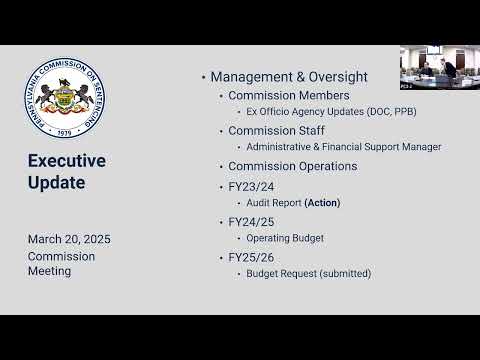
Chairman Fox opened the commission’s fiscal report and the board voted to accept the contract audit prepared by Boyer & Ritter. Executive Director Dr. Matthew Kleinman then walked members through the agency’s operating budget, recent savings actions and a formal budget request submitted in February.
The audit: The commission contracted Boyer & Ritter under a three-year agreement; the independent review for fiscal year 2023–24 found no material deficiencies in internal control and no reportable instances of noncompliance. The commission put the audit to a vote and the audit was accepted without recorded objection.
Why it matters: Kleinman told commissioners the agency has been flat-funded since fiscal year 2019–20 while workload and statutory responsibilities have increased. The shortfall threatens routine operations and staff capacity to respond to urgent data requests and legislative inquiries.
Key details and staff actions: Kleinman said the commission reduced full‑time equivalents from 24 to 22 last December and is holding one outreach specialist vacancy for budget reasons. The operating budget for fiscal year 2024–25 is presented at $3,700,000. He noted staff salaries total about $2,700,000, so the appropriation level in the governor’s proposal — $2,553,000 — would not fully cover payroll.
Reserves and restrictions: The commission reported roughly $1,600,000 in reserves on the books but explained these funds are largely earmarked: roughly $687,000 derives from Justice Reinvestment Initiative (JRI‑2) project funds reserved for a canceled contract to rebuild the legacy application; $97,000 is set aside under the Penn State MOU for the university partnership (graduate students, postdocs, space and services). After earmarks and encumbrances, Kleinman said the agency has about $72,000 of unearmarked operational funds remaining for the fiscal year.
Budget request and next steps: In February Kleinman said staff submitted a $4,100,000 request to the governor’s office and legislative leadership to support general operations. Commissioners discussed coordinated outreach to legislative allies, the courts, and stakeholder organizations to press the case for additional funding.
Votes at a glance: The meeting recorded three formal actions: approval of the December quarterly business meeting minutes (motion and second recorded; vote: all in favor), acceptance of Boyer & Ritter’s financial audit (motion and second; outcome: accepted, no objection), and approval of a service contract for application development with Carbon Creek (see separate IT article for details and vote tally).
What the commission will watch: Members noted incoming statutory work — for example, mandates from House and Senate resolutions — and routine requests (impact analyses, data pulls) that consume staff time. Commissioners asked legislative members on the panel to help coordinate support and approaches for the budget request.
Closing: The commission asked members to prepare for lobbying and outreach on funding in the weeks ahead, and scheduled follow-up discussions as the budget season progresses.