Get Full Government Meeting Transcripts, Videos, & Alerts Forever!
Get email alerts on the School Budgeting topic
No spam. Unsubscribe anytime.
PGCPS details school-based budgeting, timeline after FY26 request sent to county
Summary
Director of Budget Shavonn Smith told the Operations, Budget and Fiscal Affairs Committee the Board of Education's FY26 requested budget has been transmitted to the county and outlined how school-based budgeting (SBB), per-pupil amounts and charter funding questions will be handled as the system finalizes allocations.
Shavonn Smith, director of Budget and Management Services for Prince George's County Public Schools, told the Operations, Budget and Fiscal Affairs Committee on March 19 that the board-requested FY26 budget has been transmitted to the county and that the district is now finalizing school operating resources and the requested budget book.
Smith said school allocations will be set by minimum school funding calculations, school-based locked allocations and centrally managed locked allocations. "We have our unlocked, locked, and locked plus positions," she explained, describing unlocked positions as those schools may purchase using allocated SBB funds and locked positions as those funded and staffed by central office for specialized requirements. She added that locked-plus positions are centrally funded but may be supplemented by schools.
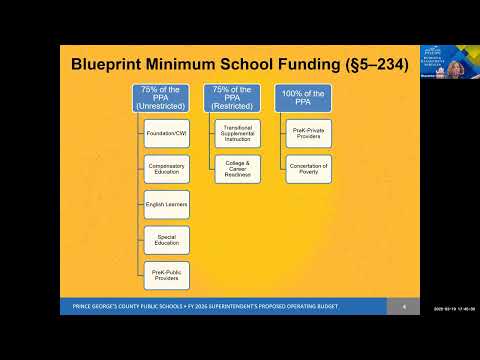
The update explained how per-pupil amounts (PPA) from the blueprint legislation drive school revenues: "PPA is our per pupil amount," Smith said. "For every program, there is a prescribed per pupil amount that is indicated in the actual blueprint legislation. We don't set it. It is set for us, for every LEA." She said the minimum school funding statute requires PGCPS to distribute prescribed percentages of the per-pupil amounts to each school's cost center.
Smith outlined the near-term timeline: school-based budgeting (SBB) will "kick off" at the end of March with training clinics, the Apex budgeting tool is scheduled to go live April 7 for principals to begin formulating budgets, and May–early June will focus on reconciliation when final State aid and the county-approved budget are known. "There is a lot that has to get done between now and the June," Smith said, noting the budget office will present an approved FY26 balanced budget to the board in June.
Board members pressed Smith about charter-school funding under the new blueprint formula. Smith said the district is still sorting through charter impacts and that outcomes depend on student characteristics, blueprint rules and pending actions at the General Assembly. She described charter operators' concern that the new formula could result in a larger withheld share for centrally managed costs: "Their concern is that there will be a 25% withhold to charter schools. And so, that's what they're pressing on," Smith said, while also noting that certain centrally managed services directly support charter schools and that some services are opt-outable.
Smith referenced compliance and reporting requirements: "PGCPS is required to report on the allocation and execution of these school level resources monthly, demonstrating compliance with statute 5,234 of the blueprint legislation," she said.
The committee did not vote on any budget items at the March 19 meeting. Smith and the budget office said they will continue reconciliation work as state and county figures firm up and will return with completed details during the board's budget cycle.
Next steps include the SBB go-live in early April, monthly reporting on allocations and the June presentation of the approved FY26 balanced budget to the board.