
HISD board approves Teacher Excellence System amid broad public criticism and discussion of student achievement targets
Get AI-powered insights, summaries, and transcripts
Subscribe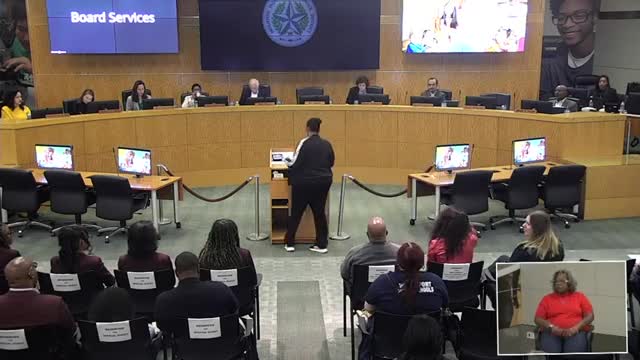
Summary
The Houston Independent School District Board of Managers adopted the Teacher Excellence System (TES) for 2025–26 on March 20 after extensive public comment and a board discussion about implementation, evaluation metrics and data timing.
The Houston Independent School District Board of Managers on March 20 approved a new Teacher Excellence System (TES) for implementation in school year 2025–26 and accepted several monitoring reports and calendar revisions intended to speed delivery of student-performance data.
The action came after more than an hour of public testimony, much of it sharply critical of TES, and a board-level discussion about how the system will be rolled out, how educators will be trained and how the district will monitor unintended consequences. The board vote to adopt TES was 8–0.
Justin Smith, executive director of assessment, accountability and compliance, presented the board with background on district monitoring documents and new or revised goal progress measures. "This report is put together at both the state, the district, and the region level," Smith told the board while describing the Texas Academic Performance Report and accompanying data products available on the district website.
Public commenters — including parents, teachers and students — said the proposed TES risks driving experienced teachers from the district and incentivizing competition over collaboration. "TES will likely make this matter worse that I see history repeating itself," researcher Dr. Dania Serrano said during public comment. Veteran teacher Michelle Williams told the board: "I've worked under many evaluation system, but TS is by far the worst I've ever seen. It's inequitable. It penalizes teachers with high achieving students, emerging bilingual students, and, frankly, parents of children."
Supporters of TES told the board the system includes multiple evidence-based components, certification for evaluators and a pathway to teacher incentive funding. Trista Bishop Watt of Houston GPS, which supports the district's accountability work, said the system "provides a comprehensive approach to evaluating and supporting our educators" and highlighted components intended to support implementation and fairness.
Board members pressed administration on implementation details, including how teachers and principals would be trained, how video calibration and spot observations would be managed, and what safeguards exist for Advanced Placement and International Baccalaureate assessments used as metrics. Trustee Rolando Martinez thanked staff for the outreach and noted the scope of the process: "it takes a lot of work, to get this much feedback from 3,000 participants," he said.
Administrators outlined a phased implementation plan the district described as planning this spring, training during the summer and continuous improvement during the school year. Smith said the district is assembling classroom video exemplars and calibrating spot-observation scoring; some videos are already live to principals and assistant principals and more will be posted to teacher-facing sites as ready. District staff also confirmed that student surveys were not included as a universal, required component of TES this year; the board heard that surveys were piloted at the district's trailblazer campuses and that surveys may be used in the Distinguished Teacher Review process and continue to be studied.
The board took votes on multiple items tied to the district’s monitoring and governance calendar. Besides adopting TES, the board accepted a monitoring update on Goal 1 (reading) and Goal 2 (math) progress measures, accepted the board audit committee's report, and approved revisions to the Lone Star governance monitoring calendar so data items are scheduled when the underlying data are available.
Votes at a glance - Acceptance of board monitoring update (Goal 1 progress measure 1.2; Goal 2 progress measure 2.2): motion by Dr. Michelle Cruz Arnold, second by Jeanette Garza Lindner; outcome: approved (tally reported as 6 in favor, 2 absent). - Board audit committee report (including final activity funds process report): motion passed (motion by Rolando Martinez; second Ms. Flowers; outcome recorded as approved, 6 in favor reported during roll call). - Approval of Teacher Excellence System (TES) for 2025–26 implementation: motion by Ms. Flowers, second by Jeanette Garza Lindner; outcome: approved, 8 in favor. - Lone Star governance monitoring calendar revisions and related GPM edits: accepted by the board (motion and second on the record; calendar changes approved to align reporting dates with data availability). - Acceptance of revised goal progress measures (revised GPM summary accepted following closed-session review): motion to accept the revised GPM summary carried unanimously. - Closed-session actions (summary): the board approved a resolution authorizing the sale of surplus real property to Harris County MUD 589 and approved a settlement in the case HISD v. Sosa (case number redacted in the public record). Both motions were adopted in closed session and reported in open session as passed.
What the board said about implementation and risk District leaders emphasized the implementation plan will rely on a cohort of "TES trainers" (representatives from each campus), principal and evaluator certification, and an ongoing feedback loop that district staff said will collect issues and adjust minor items by video explanation or updated guidance. The administration described teacher apprentices and learning coaches as a core staffing difference in the district’s NES model and noted the apprentice model is structured as roughly one apprentice or coach per 100 students in the NES staffing model.
Board members expressed interest in understanding fiscal sustainability and the degree to which additional staff (apprentices, learning coaches) contribute to gains in proficiency; administrators told trustees that the NES staffing model is a system and that some gains come from the combination of quality instruction, curriculum and in-school coaching.
Next steps and oversight District staff said they will continue monthly planning meetings this spring with TES trainer representatives, provide summer training for principals and teachers, and use quarterly trainer feedback and midyear/end-of-year data reviews for continuous improvement. The board asked for regular updates on implementation fidelity, student-survey pilot results and any adjustments the district recommends after a full year of implementation.
Ending Board members acknowledged strong sentiments on both sides of TES during the public hearing and asked the administration to prioritize clarity, transparency and responsiveness during implementation. The board voted to adopt the system; the district will begin training and communications to campuses this spring and summer.