
Victor Central previews 2025-26 budget; proposes personnel additions while managing $3.5 million gap
Get AI-powered insights, summaries, and transcripts
Subscribe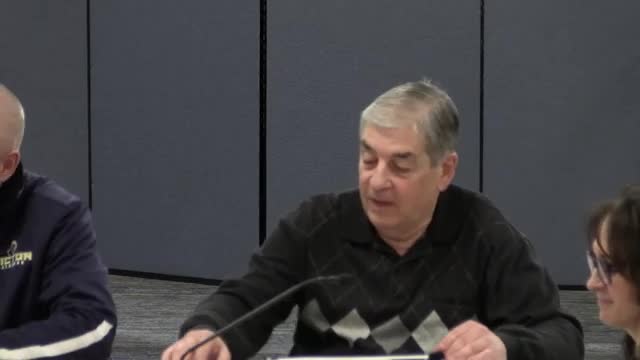
Summary
At a March 20 budget workshop, Assistant Superintendent Dorothy D'Angelo outlined budget-neutral personnel additions and revenue scenarios for Victor Central School District as leaders plan to bridge a projected $3.5 million gap under a flat-state-aid scenario.
Victor Central School District held a budget workshop on March 20 in which Assistant Superintendent for Personnel Dorothy D'Angelo presented proposed personnel changes for 2025-26 and district staff sketched revenue scenarios to close a projected budget shortfall.
D'Angelo said the personnel recommendations — a one-year psychologist intern stipend of $21,000, a 0.1 full-time-equivalent increase to the teacher center director (raising the role from 0.5 to 0.6 FTE), and a built-in "bubble" teacher position to add a section if enrollment increases — are budget neutral and intended to reallocate savings from identified efficiencies. "I want to again reiterate that we are not cutting any staff and we are not cutting any program," D'Angelo said.
The district identified three primary sources of staffing efficiencies: enrollment shifts (notably in grades 2 and 3), changes in student course choices, and sharing staff across buildings. D'Angelo said the psychologist intern position carries no benefits, and the teacher center director increase would expand existing staff time; she named Kristen Gookin as the staff member whose time would increase.
Finance staff presented two revenue scenarios. Under a flat-state-aid assumption the district currently faces a roughly $3.5 million gap. A second scenario assumes a possible $700,000 increase in state aid (about $200,000 in BOCES aid and $500,000 in foundation aid), which would reduce the shortfall. Christine (staff member) summarized the scenarios and said the district is monitoring state action: "We will monitor state aid...we're hopeful that we have a budget close to April 1 as possible."
Board member Tim Delucia asked whether the roughly $100,000 in federal revenue identified in the budget — reimbursements tied to Medicaid for school-based health services such as speech, occupational and physical therapy — is at risk. Christine responded that the $100,000 figure is a projected Medicaid reimbursement for the year and noted concern about federal action tied to a continuing resolution; she said she spoke with Karen Ryan and that the district projects that reimbursement will be "a little over $100,000 this year." D'Angelo added that, if federal reimbursements disappeared, the district would still have to provide the services and would need to fold the cost into the budget.
Staff warned Title II (professional-development) funds are a potential federal risk, with an estimated exposure of about $76,000 for the district, while total federal grant funding for the district was discussed in the $1.3 million to $1.5 million range (not specified precisely in the workshop). Officials said most other federal and state grants discussed remain funded under the current continuing resolution language.
To bridge the gap, staff recommended a short-term mix of options: use of the current-year fund balance at fiscal year end, reduction of next year's contingency, continuing to refine expenditures and find efficiencies, and avoiding program cuts. D'Angelo and finance staff said they do not currently plan to draw reserves and will continue reviewing this year's actuals to finalize projections.
Staff also reviewed timing: the district plans to have the budget booked by April 3, present and adopt a proposed budget at the April 10 Board of Education meeting, hold a public budget hearing and "Meet the Candidates" event on May 6, and place the budget and board election before voters on May 20.
On capital and other revenue options, staff said they are investigating whether so-called "member money" from the state (typically awarded for capital-type projects) could be applicable for future projects, but they do not expect it to affect the 2025-26 budget because of timing and application requirements. The district also noted the capital-outlay mechanism as one way to seek next-year aid for smaller capital items.
Christine and D'Angelo said they will continue to monitor state aid proposals (including library materials aid and foundation aid proposals), utilities and capital project costs, and will return with updated numbers. The board did not take formal votes at the workshop; staff framed the session as information and planning ahead of the April 10 adoption vote.
Next steps include continued monitoring of state and federal actions, further refinement of expenditures, and the scheduled April 10 Board meeting when the district will vote on the proposed budget to send to voters.