
Columbia leaders refine Light Business zoning rules, debate special exceptions and lot-size limits
Get AI-powered insights, summaries, and transcripts
Subscribe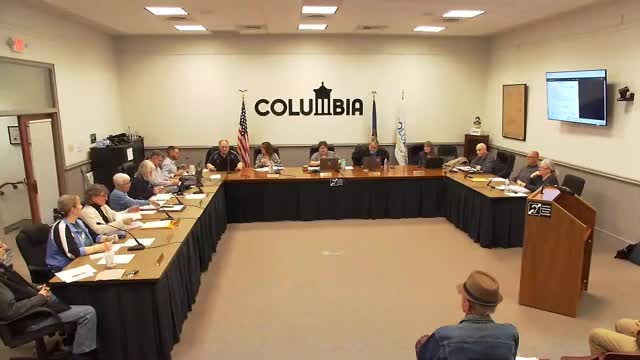
Summary
Council and the Planning Commission reviewed the Light Business zoning table for Columbiafocusing on permitted uses, special-exception criteria for package-delivery and warehousing, minimum lot sizes and coverage limits. Staff will draft special-exception language and the solicitor will review before the ordinance goes to Lancaster County.
Columbia Borough Council members and the Planning Commission on Wednesday reviewed proposed updates to the Light Business zoning district, narrowing permitted uses and asking staff and the solicitor to prepare special-exception criteria for several commercial and industrial activities.
The review focused on whether uses such as package-delivery distribution, stand-alone warehousing, certain industrial products, and communication towers should be permitted outright, allowed only by special exception, or prohibited in the borough's remaining Light Business zone. Commissioners and council members also discussed minimum lot-size rules and maximum building/impervious-coverage standards for the 42-acre tract the borough recently acquired.
Planning Commission Chair Mary Wickenheiser summarized the packet and said the commission's list of recommended changes was circulated to council and staff. Wickenheiser said the group clarified that 'large solar energy production facility' in the table referred to a solar collection field rather than manufacturing solar panels and recommended removing 'airport' from the permitted-uses table because no definition or supporting provisions exist elsewhere in the ordinance.
The commission and council agreed to remove golf courses and funeral homes from the Light Business permitted uses, and to leave outdoor recreation as not permitted while allowing certain indoor recreation uses. They also agreed to make 'communication power' (wireless communications) subject to special-exception review and to list indoor shooting ranges separately from outdoor target ranges (outdoor ranges were to remain prohibited).
Commissioners said they would accept building-supplies and concrete-product uses as permitted, but recommended that chemical or potentially hazardous manufacturing remain subject to a special exception so the borough and the public would have a chance to review safety and spill-response plans. Several planning members pointed out existing references in the zoning code to state or federal tables that distinguish hazardous from nonhazardous materials and suggested reusing those references in the special-exception criteria.
On logistics uses, council and the commission debated package-delivery distribution centers and warehousing. Planning members said the district's road network, underpass clearances and nearby residential streets create significant operational constraints. Councilmember Eric (surname not recorded) and others proposed writing a special-exception standard limiting vehicle size, hours of operation, routes and lighting and requiring loading access and buffering; the commission agreed to draft shared language for both 'package delivery' and 'warehouse' uses so the two could be reviewed under the same criteria.
Council and planning staff also recommended changing the dimensional rules for the Light Business parcel. The packet and discussion proposed removing a five-acre minimum tract requirement and the 40 percent maximum building coverage figure, leaving instead a 20,000-square-foot minimum lot option and an 85 percent maximum impervious-surface cap for the district as a whole. Commissioners and council members said the 42-acre site sold to the borough in 2022 should remain flexible for a developer to present a site-wide plan; any subsequent subdivision would be subject to standard subdivision, stormwater and access reviews.
Councilmember concerns repeatedly returned to public-revenue goals: several said the property had been purchased to broaden the borough's tax base and that allowing institutional, tax-exempt uses without a case-by-case review could undercut that goal. Commissioners responded that some private educational or cultural uses might align with the borough's Columbia 2040 plan and suggested permitting such uses by special exception rather than excluding them outright.
The commission agreed to leave accessory day-care uses available for businesses and employees while removing standalone day-care centers and larger institutional uses from the district's permitted-use list; commissioners said accessory child care should be listed explicitly in the accessory-use table to avoid ambiguity.
Planning and council directed staff to draft special-exception language for package delivery and warehousing and to refine definitions (for example, replacing 'warehousing' with the ordinance's defined term 'warehouse'). The solicitor will review the draft special-exception criteria. Planning Chair Wickenheiser said she aimed to have draft criteria available for the Planning Commission's next meeting on April 15, with the expectation that council could take action at its April 22 meeting if the commission recommends it and Lancaster County review requirements are met.
Commissioners and council members also asked staff to codify a medical-marijuana ordinance language that planning minutes show was adopted in 2017 but not fully codified in the zoning tables; several participants said a 2017 ordinance added definitions for 'marijuana dispensary' and related uses but the use was not carried into the current permitted-uses table and should be placed explicitly in the zoning map.
The borough will also remove language in the Light Business purpose statement that says the district is intended 'to provide for continuation of the airport if desired by the property owner,' because the airport references create conflicts with other proposed restrictions and because the airport term appears nowhere else in the ordinance.
Why it matters: Columbia has limited remaining developable land. Council and the Planning Commission are balancing the borough's desire to attract tax-producing employers and logistics operators with neighborhood impacts such as truck routes, underpass clearances, hours, lighting and buffering. The special-exception language the borough drafts will govern whether a developer can place package-delivery or warehousing operations on the site and under what conditions.
What's next: Planning staff will draft special-exception criteria (vehicle size, hours, routes, buffering, etc.) for package-delivery and warehouse uses and will refine definitions and cross-references to Chapter 2-20. The solicitor will review the language; Planning Commission will consider the draft on April 15, and council indicated it would consider bids for demolition and remediation at its April 22 meeting, timing the zoning update to align with the active marketing and remediation schedule.